

Wireless earbuds have become part of everyday life, but the small case that keeps them charged rarely receives much attention. Most people see it as a convenient storage box with a battery inside. In reality, a charging case contains a carefully arranged electronic system responsible for power management, charging control, and communication with the earbuds. Designing these compact circuits often requires PCB fabrication services that can accommodate tight mechanical dimensions and precise component layouts. Although the finished product looks simple, its internal electronics must work reliably through hundreds of charging and handling cycles.
A Small Case Contains Several Electronic Systems
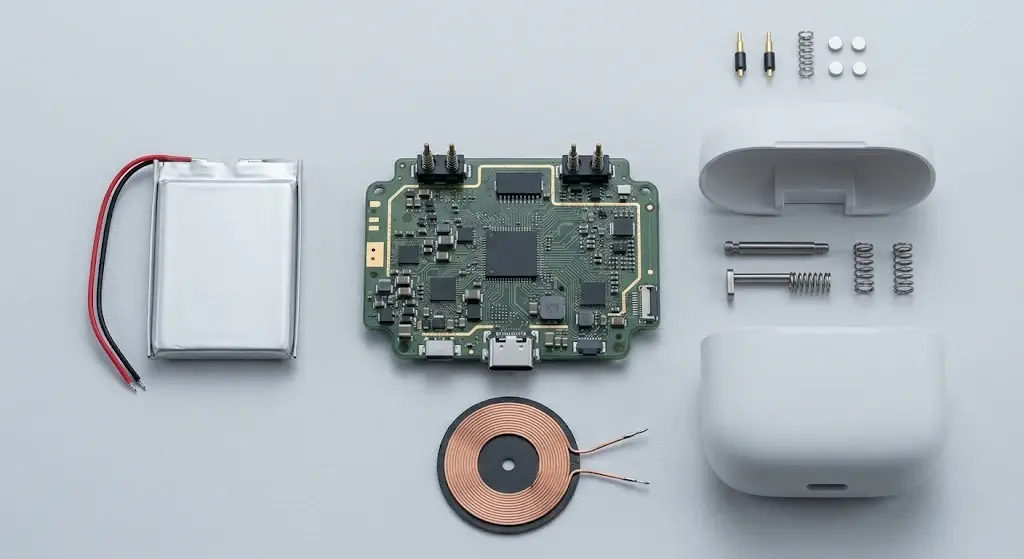
Inside a typical wireless earbud charging case, several components work together to manage charging and user interaction.
The internal circuit board may contain a battery charging IC, voltage regulation circuitry, a microcontroller, protection components, and connections to charging contacts.
Some designs also include wireless charging receivers, LED indicators, or sensors that detect whether the lid is open or closed.
Because the enclosure is small, these components must fit around the battery, hinges, magnets, and mechanical structures that hold the earbuds in place.
This limited space can make fine-pitch PCB assembly useful when compact integrated circuits and closely spaced components are required.
However, miniaturization is not simply about placing components closer together. Engineers must also maintain suitable electrical clearances, assembly tolerances, and mechanical accessibility.
Charging Contacts Must Work Every Time
One of the most important features of a wireless earbud charging case is also one of the simplest-looking: the small metal contacts that connect the case to the earbuds.
These contacts transfer electrical power when the earbuds are placed inside the case.
Depending on the design, spring-loaded contacts may accommodate small variations in earbud position.
However, reliable charging depends on more than the contacts themselves.
The earbuds must sit in the correct position, the contacts must maintain sufficient pressure, and the electrical connection must remain stable.
Dust, skin oils, or other contamination can interfere with contact performance over time.
Mechanical wear may also affect the connection after repeated use.
Engineers therefore need to consider contact materials, mechanical alignment, and charging behavior during product development.
A well-designed charging circuit cannot compensate for every mechanical contact problem.
Battery Management Is More Complicated Than It Appears
The battery inside a charging case serves as a portable energy source for the earbuds.
However, managing this energy requires several electronic functions.
The circuit must safely charge the case battery, monitor relevant electrical conditions, and deliver suitable power to the earbuds.
Depending on the battery configuration and charging architecture, the system may require voltage conversion and protection circuitry.
For example, the voltage required by the earbuds may differ from the battery voltage available inside the case.
Power conversion circuits help manage this difference.
At the same time, engineers must consider energy losses during charging and standby operation.
Even when the earbuds are not being charged, some electronic components may continue consuming small amounts of power.
Reducing unnecessary standby consumption can help the case retain its stored energy between uses.
Magnets and Sensors Help the Case Recognize Its State
Many wireless earbud charging cases use magnets to help position the earbuds and keep the lid closed.
Some also incorporate magnetic sensors or mechanical switches to detect changes in the lid position.
These features may appear unrelated to the circuit board, but they influence how the electronic system behaves.
For example, opening the lid may trigger a status indication or initiate communication-related functions, depending on the product design.
Closing the lid may allow the system to enter a lower-power operating state.
The sensor and magnet positions must be coordinated with the mechanical enclosure.
If the spacing or alignment is unsuitable, detection may become inconsistent.
This illustrates why the electronic and mechanical aspects of a charging case cannot be designed independently.
Compact PCB Layouts Require Careful Planning
The shape of a wireless earbud charging case creates unusual layout constraints.
Unlike a rectangular electronic enclosure, a charging case often has curved surfaces and limited flat internal space.
The PCB may need to fit beneath the earbud compartments or around the battery.
Connector placement is also important because charging contacts, indicator lights, and external charging ports must align with specific locations in the housing.
In some products, multiple small circuit boards or flexible interconnections are used to accommodate the mechanical design.
Engineers must balance board dimensions, component placement, routing requirements, and assembly feasibility.
For densely populated boards, manufacturing tolerances become especially important.
A component that is slightly misaligned may interfere with a nearby structure or create problems during final enclosure assembly.
Wireless Charging Adds Another Layer of Complexity
Some premium earbud charging cases support wireless charging.
This feature requires additional components, including a receiving coil and associated power management circuitry.
The coil must be positioned appropriately inside the enclosure to receive energy from a compatible charging pad.
Its placement can be influenced by the case shape, battery location, and nearby materials.
Wireless charging also introduces additional thermal considerations because energy transfer and power conversion are not perfectly efficient.
The system must manage charging behavior while maintaining suitable operating temperatures.
These requirements make wireless charging more than a simple addition to the existing battery circuit.
It becomes another part of the overall electrical and mechanical design.
Manufacturing Quality Affects Everyday Reliability
Wireless earbud charging cases experience frequent handling.
Users repeatedly open and close the lid, insert and remove the earbuds, connect charging cables, and carry the case in pockets or bags.
These everyday actions place demands on the mechanical structure and its electronic connections.
During PCB assembly, accurate component placement and controlled soldering processes help produce reliable electrical connections.
Inspection can identify certain manufacturing defects, while electrical and functional tests can verify defined charging and control functions.
However, the finished case also requires mechanical and system-level evaluation.
Charging contact alignment, lid detection, battery behavior, and repeated-use performance may need to be verified according to the product’s requirements.
A circuit board that passes electrical testing is an important starting point, but it does not automatically guarantee that the complete charging case will perform reliably in daily use.
Conclusion
Wireless earbud charging cases demonstrate how much engineering can be hidden inside an ordinary consumer product.
Their small size requires careful coordination between battery management, charging contacts, sensors, circuit board layout, and mechanical design.
Advanced manufacturing techniques help accommodate compact electronic components, but reliable performance also depends on how the complete system is designed and tested.
The next time a pair of earbuds begins charging as soon as it is placed inside its case, it is worth remembering that this seemingly simple action depends on several electronic and mechanical systems working together.
Also Read