
1. Looking Beyond the Product Photograph
A sneaker photographed against a plain background has an advantage: nothing competes with it. The sole looks deliberate, every stitched panel seems worth noticing, and the shoe appears to have a personality of its own. That impression can change once it is worn beneath an ordinary pair of trousers.
Derek Lawson, a fictional buyer used as a narrative perspective, likes unusual footwear but has no interest in rebuilding his wardrobe around a single purchase. He begins with a question that product photography cannot answer: which of these designs would he reach for on a Wednesday, rather than admire for five minutes on a screen?
The range covered by Louis Vuitton men’s shoes offers genuinely different answers. A court-inspired upper, an exaggerated skate silhouette and a running-derived sole ask for different things from the clothes around them. What interests Derek is less the presence of a familiar signature than the placement of the shoe’s visual weight.
2. Read the Sole Before the Logo
In a side photograph, look first at the space occupied by the sole. Does it extend beyond the heel? Is the toe visibly raised? Does its thickness remain consistent, or does the rear appear taller than the front? These details create an impression before the upper’s materials are considered.
The same outsole can appear substantial beneath a cropped trouser and nearly disappear below a generous hem. A broad edge also changes the view from the front, even if the upper itself is relatively narrow.
A useful comparison is to cover the upper portion of two product images and examine only their soles. You may discover that what you thought was a preference for one model’s decoration is actually a preference for its proportions. Then reverse the exercise and examine the uppers without the distraction of their outsoles.
3. The Problem With Judging Size by Appearance
A large-looking sneaker is not necessarily a large-fitting sneaker. Outer dimensions include padding, panels and rubber that may contribute little to the space available for the foot.
This is worth remembering when comparing LV men shoes across model families. A prominent toe bumper can make the front appear wider, while a tall collar may make the ankle look shorter. Neither observation tells the buyer whether the toes have enough room.
Clothing proportions add another complication. Straight denim can bridge the transition to a thick sole; a sharply tapered leg may draw attention to that thickness. A shoe that looks balanced under a long hem can feel visually oversized with cropped trousers.
Instead of treating the size printed on the box as a guide to appearance, separate two questions. How does the shoe fit the foot? And what does its exterior do to the silhouette of an outfit? They require different evidence.
4. Athletic References, Fashion Priorities
Basketball, skateboarding and running have each supplied fashion designers with a recognizable visual language. High-contrast panels suggest court shoes; padded tongues recall skate culture; wedge-like soles evoke older running designs. These references make a sneaker legible even to someone who knows little about its history.
They can also encourage mistaken assumptions. An upper inspired by basketball is not proof that a shoe is appropriate for the court. A running-style sole tells us about design ancestry, not whether the footwear has been tested for distance running.
What matters is the intended occasion. Someone looking for an expressive pair for dinners and weekends may be happy with a design that feels too substantial for a day of continuous walking. Another buyer may prefer a quieter profile but still need to confirm the fit in person.
5. From Basketball Courts to Fashion Footwear
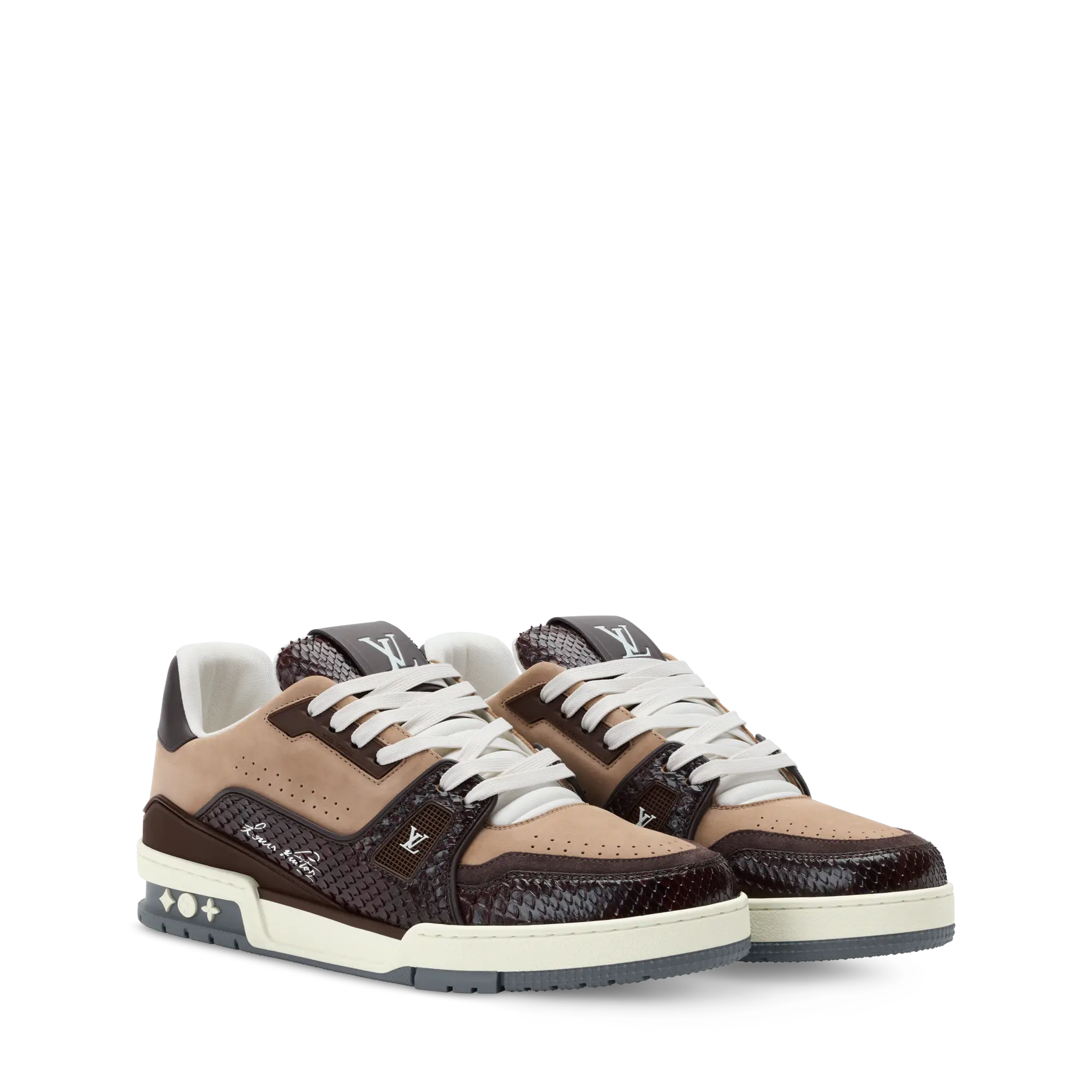
The LV Trainer has a clear point of departure. Originally designed by Virgil Abloh, it draws from vintage basketball sneakers, translating the familiar court-shoe language into a layered luxury design. The upper has enough structure to remain recognizable even when its materials change between editions.
That consistency makes the smaller differences more interesting. Smooth and textured leather panels can alter how light travels across the surface; stitching can draw attention to the curve of a toe or the division between adjacent pieces. These are design decisions worth observing rather than automatic indications of durability.
For someone exploring louis vuitton men shoes, the Trainer is a useful reference against the other models in the collection. It makes the contrast clear between a court-derived design, a broad skate-inspired upper and a sole that borrows from running footwear. The category is more revealing when viewed as a set of competing ideas rather than a row of interchangeable products.
Derek finds the Trainer compelling for precisely that reason. He can imagine it with straight denim or an otherwise simple outfit, where the panels remain visible without fighting several other decorative elements.
6. Two Eras of Skate-Inspired Design
The LV Skate draws upon the thickly padded skate shoes associated with the 1990s. Its substantial tongue, collar and laces make the upper unusually prominent. Even when trousers cover part of the outsole, much of that construction remains visible above the foot.
The LV Tilted turns toward a different moment. Introduced in the Spring-Summer 2026 pre-collection, it references skate footwear from the early 2000s, including the broader proportions associated with that period. The angled LV signature provides another recognizable feature without making it a variation of the Skate.
The contrast is most interesting from the front. The Skate’s tongue and collar place considerable emphasis around the opening; Tilted brings attention to its overall stance and signature details.
Treating both simply as ‘chunky sneakers’ misses the distinction. One design can appeal because the upper looks padded and expansive; another because its silhouette and graphics recall a different generation of skate culture.
7. What the Run Away Does Differently
The Run Away uses another part of athletic history. Its running-shoe inspiration is apparent in the elongated profile and distinctive wedge-shaped outsole, which draws the eye toward the lower half of the sneaker.
That shift matters. On a model dominated by its upper, the trouser hem interacts with collars, laces and panels. Here, the slope of the sole can remain visible even when most of the upper is covered. In some editions, leather trim and metal accents add a more polished finish to the sporting reference.
The running reference says little about athletic performance. The stronger reason to consider this model is an appreciation for its particular profile: length, elevation and a sense of motion created by the sole itself.
8. Two Ways to Make a Quieter Statement
Beverly Hills and Buttersoft can both appeal to someone who finds the most elaborate sneakers visually demanding, but their approaches are different. Beverly Hills has appeared with relatively clean leather uppers set against thick rubber outsoles. Its understated surface should not be confused with a small overall silhouette.
Buttersoft, designed under Pharrell Williams, looks toward the period when sneakers began moving from sport into everyday fashion during the 1960s. The focus falls on soft leather, padding and the handling of the material. Details vary by edition, so the actual product description matters more than a general impression of softness.
Within LV men sneakers, these two designs present an instructive contrast. Beverly Hills creates tension between a straightforward upper and a noticeable sole. Buttersoft asks the viewer to notice the surface, texture and the character of its construction.
The more useful question is where each one places its emphasis. Someone drawn to a clean upper may still dislike a thick outsole; someone who values tactile materials may prefer the subtler changes in leather and padding.
9. Seams Are Clues, Not Scores
Close-up images invite a familiar mistake: counting details as though their number were a measure of quality. More panels and denser stitching can produce a visually rich design, but their presence alone does not establish how long the sneaker will last.
A closer reading asks different questions. Where does a seam cross an area that bends when walking? Which edges are exposed? Are two materials joined near a place likely to receive repeated contact? The answers identify features that deserve scrutiny without pretending to predict a product’s lifespan.
Even neat-looking construction has limits as evidence. A photograph cannot tell you how the inside of a seam feels against a sock, or whether an apparently firm heel counter creates an uncomfortable pressure spot.
10. Texture Changes the Character of a Model
Material choice is not merely a finishing decision. Smooth leather reflects light in broad areas and allows panel edges to stand out. Grained leather breaks those reflections into smaller highlights. Suede makes a surface appear softer and less reflective, while mesh introduces visible depth and openness.
Those changes affect the appearance of Louis Vuitton men’s shoes even when two editions retain the same underlying silhouette. A design that looks crisp in smooth leather can feel more textured and casual when another material takes its place.
Rather than asking which material sounds most luxurious, consider how it behaves visually beside clothing. A heavily textured sneaker can work well against plain denim or a smooth trouser. A glossy panel arrangement may be more conspicuous against an outfit already rich in pattern.
Check the exact composition of the edition before drawing conclusions about how it will feel or age.
11. Choosing by the Location of Visual Weight
Derek returns to the six designs with a different question from the one that began his search. Instead of asking which is the most memorable, he asks where each model directs his attention.
Trainer draws him toward panel arrangement and its court-shoe ancestry. Skate gives the upper most of the attention; Tilted expresses another skate era through its broader stance and angled signature. Run Away makes the wedge-shaped outsole central. Beverly Hills creates a contrast between restrained upper styling and a prominent sole. Buttersoft shifts the conversation toward material character.
This does not produce a universal ranking. It produces three useful groups: designs led by the upper, designs led by the sole, and designs whose appeal comes from the treatment of their materials. A buyer who knows which group speaks to them can reduce a long product list without relying on arbitrary favorites.
Derek’s shortlist contains alternatives rather than near duplicates. The purpose of comparison is to expose genuine differences.
12. A Fit Test That Answers Specific Questions
Sizing information should start the fitting process, not end it. Internal length, forefoot space, instep clearance and heel retention may vary across styles even when the labels match.
When considering LV men shoes, use the socks that would normally accompany the pair. Stand before judging the fit, then walk at a normal pace. Is there room for the toes without a sliding sensation? Does the widest part of the foot feel compressed? Does the heel rise excessively with each step?
An online shopper cannot complete the same test. In that case, model-specific size guidance and the retailer’s exchange terms become part of the decision. The external silhouette remains a separate issue from these internal measurements.
13. The Tongue and Collar Deserve Their Own Check
A sneaker may pass a basic length test and still feel awkward around the top of the foot. This is particularly relevant when the tongue is substantial or the collar sits high.
During a fitting, notice where the laces apply pressure. A padded tongue can distribute it differently from a thin one, and tightening the shoe to secure the heel may create discomfort over the instep. The angle of the collar can matter when the ankle bends.
Try a normal walking stride, then pause and check for a single area doing most of the pressing. Adjusting the laces may help with ordinary tension, but it will not transform an unsuitable last or fix persistent rubbing from a rigid edge.
14. One Pair, Three Different Days
Imagine choosing shoes for an evening meal, a workday with short walks and a journey that involves standing for hours. The outfits may overlap; the demands on the feet do not.
For the evening, an expressive upper could be entirely appropriate. For extended movement, the fit and flexibility of the specific pair deserve more weight. Travel introduces packing, weather exposure and the possibility of wearing the same shoes for consecutive days.
These scenarios also make material choices more concrete. A finish that requires careful treatment after contact with rain may be acceptable for occasional wear but less convenient as the default travel pair. A bulky upper can occupy considerable luggage space even when the shoe itself is not particularly heavy.
15. Let the Trouser Hem Set the Terms
A shoe rarely appears in public as an isolated object. Its proportions are judged alongside the clothing immediately above it, and the trouser hem can change the entire impression.
Derek tests this idea using clothes he already owns. Straight denim leaves a familiar amount of room around the ankle. A narrow trouser exposes more of a broad outsole. A longer, generous hem covers much of the upper, leaving its lower edge to carry the design.
That exercise helps him see which Louis Vuitton men’s shoes could become part of his wardrobe without new purchases elsewhere. He would rather adjust a small detail, such as hem length, than buy a sneaker that only works with an imagined outfit.
Materials create their own relationships. A heavily worked upper can be effective against plain fabric; a softer leather surface can work beside a jacket with more texture. There is no single ideal combination, but there is a difference between a deliberate contrast and a pairing that feels unresolved.
16. Comparing Photographs Without Comparing Camera Tricks
Online galleries are rarely assembled for strict side-by-side comparison. One sneaker may be photographed slightly below eye level, another from above. The first can appear taller; the second may conceal its true width.
Start by matching viewpoints where possible: side to side, front to front, heel to heel. The side view reveals sole geometry, while the front exposes the width of the toe and prominence of the tongue. The heel view clarifies how the rear construction relates to the outsole.
Then look for on-foot photographs. These help establish scale beside a trouser leg, although the model’s foot size, styling and camera angle can still affect the impression. Do not infer fit from them.
More consistent images are worth seeking before making a decision.
17. Care Begins With the Most Vulnerable Surface
After purchase, the question changes from which texture looks appealing to which surfaces need attention. Smooth leather, suede and fabric components do not respond identically to water, friction or cleaning products. Mixed-material uppers make one-method cleaning especially risky.
Owners of LV men sneakers should identify the most delicate material on the specific pair and consult the manufacturer’s care directions. A treatment suitable for a smooth leather panel may be unsuitable for the suede immediately beside it. Test assumptions against the stated guidance rather than treating every luxury sneaker the same way.
Routine storage is less glamorous but useful. Damp shoes should be allowed to dry appropriately, away from direct heat, and substantial uppers should not be crushed under other items. Natural signs of wear will still develop, particularly at points of repeated flexing.
18. A Better Final Question Than ‘Which Is Best?’
When two candidates remain, a simple comparison can reveal why the decision has stalled. Write down the feature that initially attracted you to each pair. Then identify the strongest practical objection to each one.
The attraction might be a particular outsole, a leather finish or the way the shoe sits beneath trousers. The objection might be unresolved fit, demanding maintenance or the difficulty of wearing it with familiar clothes.
Next, ask what evidence would resolve the objection. A fitting may answer a sizing question. Additional photographs may clarify proportions. A product’s material description can settle uncertainty about care. Some reservations, however, reflect preference rather than missing information.
Leaving a pair unpurchased can be more sensible than buying it solely because the search has taken time.
19. What Remains After the Initial Excitement
Derek’s hypothetical search ends without announcing a winner. That is intentional. The six designs discussed here are not contestants in a universal ranking; they represent distinct approaches to proportion, material and athletic reference.
He began by responding to photographs. He finishes with a clearer understanding of the details that hold his interest: where the shoe carries its visual weight, how that weight works beside his clothes, and what remains uncertain until he tries the pair on.
The result may be the structured character of a court-inspired sneaker, an upper borrowing from skate history, a running-derived outsole or a quieter design led by leather and finishing. Each can be compelling for different reasons.
A lasting purchase is rarely explained by one eye-catching detail. It is the pair that survives a more ordinary test: after the photograph is closed and the first excitement has passed, does the owner still have a reason to wear it?
Also read