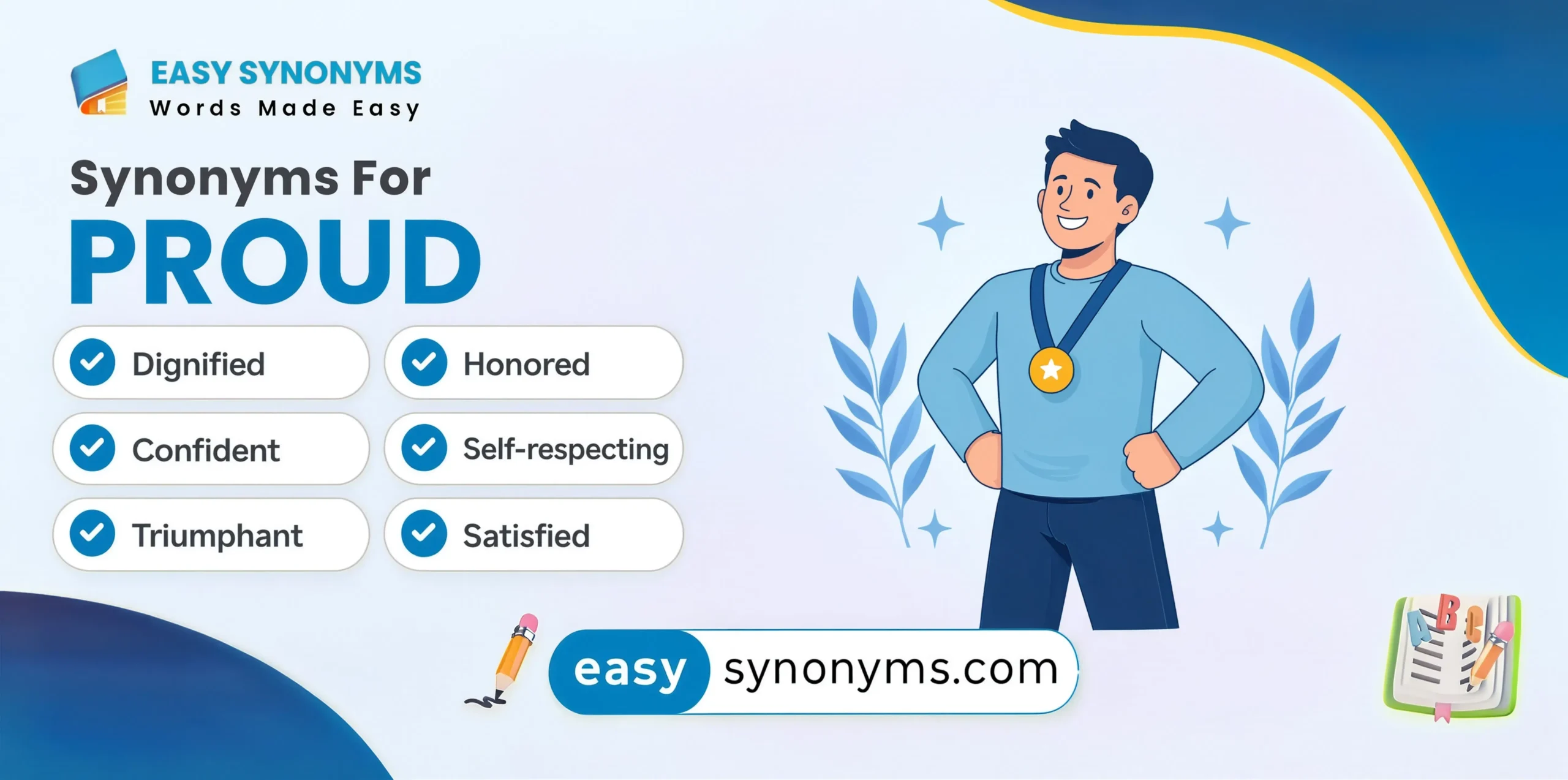

If you need synonyms of proud, useful alternatives include pleased, satisfied, confident, delighted, honored, accomplished, self-assured, boastful, arrogant, and conceited. The best word depends on whether proud describes a positive feeling, personal confidence, achievement, or excessive self-importance.
For example, you might feel pleased with your child’s progress, honored to receive an award, or accomplished after reaching an important goal. In a negative context, however, arrogant or conceited may describe someone who thinks too highly of themselves.
What Does Proud Mean?
Proud usually describes a feeling of pleasure and satisfaction caused by your own achievements or someone else’s success.
It can also describe self-respect, confidence, dignity, or an excessive sense of superiority.
For example:
She was proud of her academic achievement.
Here, proud expresses a positive feeling about success.
The word can also describe how you feel about another person:
His parents were proud of his progress.
In contrast, a sentence such as this has a negative meaning:
He was too proud to admit his mistake.
Here, proud suggests excessive self-respect or unwillingness to accept fault.
Quick Answer: Synonyms of Proud
| Synonym | Best Used For | Meaning |
|---|---|---|
| Pleased | Achievements or results | Feeling happy about something |
| Satisfied | Results or performance | Feeling content with an outcome |
| Delighted | Strong happiness | Very pleased |
| Confident | Ability or character | Believing in yourself |
| Self-assured | Personality | Confident and secure |
| Accomplished | Achievements | Successful or skilled |
| Honored | Recognition | Feeling privileged or respected |
| Gratified | Formal writing | Pleased by an achievement |
| Dignified | Character | Showing self-respect |
| Boastful | Negative behavior | Talking too much about achievements |
| Arrogant | Excessive pride | Believing you are better than others |
| Conceited | Self-image | Having an excessively high opinion of yourself |
| Haughty | Attitude | Acting superior to others |
| Self-important | Behavior | Giving yourself too much importance |
1. Pleased
Pleased is one of the closest positive alternatives to proud when you want to express happiness about an achievement or result.
For example:
- She was pleased with her exam results.
- His parents were pleased with his progress.
- We were pleased to see the project succeed.
The word sounds natural and polite. However, pleased does not always express the same sense of personal achievement as proud.
2. Satisfied
Satisfied describes contentment with a result, performance, or situation.
Consider these examples:
- He was satisfied with his performance.
- The team felt satisfied after completing the project.
- She was satisfied with the final design.
Unlike proud, satisfied focuses more on contentment than personal achievement.
Therefore, it works especially well when discussing results.
3. Delighted
Delighted means very pleased or happy.
For instance:
- She was delighted with her son’s achievement.
- We were delighted to receive the award.
- His parents were delighted by the news.
This word emphasizes happiness more than pride. Still, it can work well when someone feels strongly positive about an achievement.
4. Confident
Confident describes belief in your own abilities, qualities, or decisions.
Examples include:
- She is confident in her abilities.
- He felt confident about the presentation.
- The player looked confident before the match.
Although confidence and pride can overlap, they are different ideas. Confident focuses on belief in yourself, while proud often focuses on satisfaction with an achievement.
5. Self-Assured
Self-assured describes someone who feels confident and secure in themselves.
You might say:
- She gave a self-assured speech.
- He appeared calm and self-assured.
- The young leader was confident and self-assured.
This synonym is useful when proud refers to personal confidence or dignity.
6. Accomplished
Accomplished describes someone who has achieved a high level of success or skill.
For example:
- She is an accomplished writer.
- He became an accomplished musician.
- The company has an accomplished team of professionals.
This word does not directly mean proud. Instead, it describes the person or their achievements that may create a feeling of pride.
7. Honored
Honored works well when someone feels proud because they have received recognition, an opportunity, or an important responsibility.
Examples:
- I feel honored to receive this award.
- She was honored to represent her school.
- He felt honored by the invitation.
In these situations, honored combines pride with gratitude and respect.
8. Gratified
Gratified means pleased or satisfied, especially because something you hoped for or worked toward has happened.
For example:
- She felt gratified by the positive response.
- He was gratified to see his efforts succeed.
- The teacher felt gratified by her students’ progress.
This word has a more formal tone than proud or pleased.
9. Dignified
Dignified describes someone who shows self-respect, calmness, and a sense of worth.
For instance:
- She maintained a dignified attitude.
- He gave a dignified response to the criticism.
- The leader remained calm and dignified.
Use this word when proud relates to dignity or self-respect rather than achievement.
10. Boastful
Boastful has a negative meaning. It describes someone who talks too much about their abilities, possessions, or achievements.
For example:
- His boastful comments annoyed his colleagues.
- She sounded boastful when discussing her success.
- The interview revealed a rather boastful personality.
Therefore, boastful is not a direct positive synonym for proud. It is useful when pride becomes excessive and is openly displayed.
11. Arrogant
Arrogant describes someone who believes they are more important, talented, or capable than other people.
Examples include:
- His arrogant attitude caused problems.
- She became arrogant after winning the competition.
- Nobody appreciated his arrogant behavior.
The meaning is clearly negative. Use arrogant when excessive pride involves a sense of superiority.
12. Conceited
Conceited means having an excessively high opinion of yourself, especially your appearance, abilities, or intelligence.
For example:
- He is too conceited to accept criticism.
- Her conceited attitude was obvious.
- The character is confident without becoming conceited.
This word is often used to describe personality and behavior.
13. Haughty
Haughty describes someone who behaves as though they are better or more important than others.
For instance:
- She gave him a haughty look.
- His haughty manner upset the staff.
- The character appears cold and haughty.
This is a strong and formal negative alternative to excessive pride.
14. Self-Important
Self-important describes someone who believes they deserve more attention, respect, or importance than they actually do.
Examples include:
- His self-important attitude frustrated the team.
- She sounded self-important during the meeting.
- The manager came across as overly self-important.
The phrase is useful when pride becomes exaggerated or unreasonable.
Synonyms of Proud by Context
The right synonym depends on what proud means in your sentence.
Proud of an Achievement
Use:
- Pleased
- Satisfied
- Delighted
- Gratified
- Accomplished
Example:
She was proud of her achievement.
You could write:
She was pleased with her achievement.
Or:
She felt gratified by her success.
Proud of Someone
When you feel happy about another person’s success, consider:
- Pleased
- Delighted
- Honored
- Happy
- Satisfied
For example:
Her parents were proud of her.
A natural alternative is:
Her parents were delighted by her progress.
Proud of Yourself
When proud describes confidence or satisfaction with your own actions, try:
- Confident
- Satisfied
- Accomplished
- Self-assured
- Gratified
For example:
He felt proud of himself after completing the challenge.
You could instead say:
He felt accomplished after completing the challenge.
Proud as Self-Respect
When proud means having dignity or strong self-respect, useful alternatives include:
- Dignified
- Self-respecting
- Self-assured
- Confident
- Independent
For example:
She remained proud despite the criticism.
A more specific version could be:
She remained dignified despite the criticism.
Proud in a Negative Sense
If proud means excessively confident or superior, consider:
- Arrogant
- Conceited
- Haughty
- Boastful
- Self-important
- Egotistical
For example:
He was too proud to apologize.
Depending on the intended meaning, you could say:
He was too arrogant to apologize.
Proud vs. Pleased
Both words can describe a positive emotional response.
However, proud often connects to achievement, identity, or someone else’s success. Pleased simply means happy or satisfied with something.
Compare:
- I am proud of my daughter.
- I am pleased with her exam results.
The first sentence expresses a deeper sense of pride. The second focuses on satisfaction with a result.
Proud vs. Confident
These words are closely related but not interchangeable.
Confident means believing in your ability or judgment. Proud often means feeling satisfaction about something you have achieved or something connected to you.
For example:
- She is confident about her skills.
- She is proud of her work.
A person can be confident before achieving something. Pride often comes after a meaningful achievement or experience.
Proud vs. Arrogant
The difference is mainly positive versus negative.
Proud can describe healthy satisfaction or self-respect. Arrogant suggests excessive self-importance and a belief that you are better than others.
Compare:
- He is proud of his success.
- He is arrogant about his success.
The first sentence can be positive. The second clearly carries a negative judgment.
Proud vs. Conceited
Both words can describe excessive self-regard. However, conceited often focuses on someone’s opinion of their own qualities, appearance, or abilities.
For example:
- She is proud of her achievement.
- She is conceited about her appearance.
The second sentence suggests excessive self-admiration.
Common Collocations With Proud
Learning common phrases can help you use proud naturally.
Popular collocations include:
- Proud of yourself
- Proud of your work
- Proud of your achievement
- Proud of your success
- Proud of your family
- Proud parent
- Proud moment
- Proud member
- Proud tradition
- Proud heritage
- Feel proud
- Make someone proud
- Stand proud
- Rightfully proud
Examples:
Her graduation was a proud moment for the family.
He is proud of his work.
They are proud members of the community.
Common Mistakes With Proud Synonyms
One common mistake is treating proud, confident, pleased, and arrogant as exact synonyms. They can overlap, but their meanings are different.
For example, confident is about belief in your abilities. Pleased is about happiness or satisfaction. Meanwhile, arrogant describes excessive self-importance.
Another mistake is assuming that every use of proud has a positive meaning. The phrase too proud to apologize can suggest stubbornness or excessive self-regard.
Likewise, boastful does not simply mean proud. It specifically describes someone who talks openly and excessively about their achievements.
Therefore, look at the full sentence before choosing a replacement.
Formal and Informal Alternatives
Some synonyms fit formal writing better than everyday conversation.
| Formal or Neutral | Informal or Strong |
|---|---|
| Pleased | Happy |
| Satisfied | Glad |
| Gratified | Pleased |
| Honored | Proud |
| Self-assured | Confident |
| Dignified | Self-respecting |
| Arrogant | Full of yourself |
| Conceited | Too impressed with yourself |
| Haughty | Snobbish |
For professional writing, satisfied, gratified, honored, self-assured, and dignified can offer greater precision.
In casual writing, words such as happy, glad, confident, and proud are usually more natural.
Example Sentences
Here are natural examples of synonyms for proud:
- She was pleased with her final results.
- The team felt satisfied after completing the project.
- His parents were delighted by his success.
- She remained confident during the interview.
- He appeared calm and self-assured.
- She is an accomplished professional.
- I felt honored to receive the award.
- The teacher was gratified by her students’ progress.
- He maintained a dignified attitude.
- His boastful comments irritated the team.
- The manager seemed arrogant after the promotion.
- His conceited behavior made conversations difficult.
- She gave the guests a haughty look.
- His self-important attitude affected the meeting.
Frequently Asked Questions
What is the best synonym for proud?
Common alternatives include pleased, satisfied, confident, delighted, honored, accomplished, and self-assured. The best choice depends on the intended meaning.
What is another word for proud?
Another word for proud can be pleased, satisfied, confident, delighted, honored, or accomplished when the meaning is positive.
What is a positive synonym for proud?
Positive alternatives include pleased, satisfied, delighted, honored, accomplished, and self-assured.
What is a negative synonym for proud?
Negative alternatives include arrogant, conceited, haughty, boastful, and self-important.
What is a synonym for proud of someone?
Depending on the context, you can use pleased, delighted, honored, or happy about someone’s achievement.
What is a synonym for proud of yourself?
Useful alternatives include confident, satisfied, accomplished, gratified, and self-assured.
Is proud the same as confident?
Not exactly. Confident means believing in your abilities, while proud often means feeling satisfaction about an achievement or someone connected to you.
What is the opposite of proud?
Possible opposites include humble, modest, unassuming, ashamed, embarrassed, or insecure, depending on which meaning of proud you want to contrast.
Conclusion
The most useful synonyms of proud include pleased, satisfied, delighted, confident, self-assured, accomplished, honored, gratified, dignified, boastful, arrogant, conceited, haughty, and self-important.