
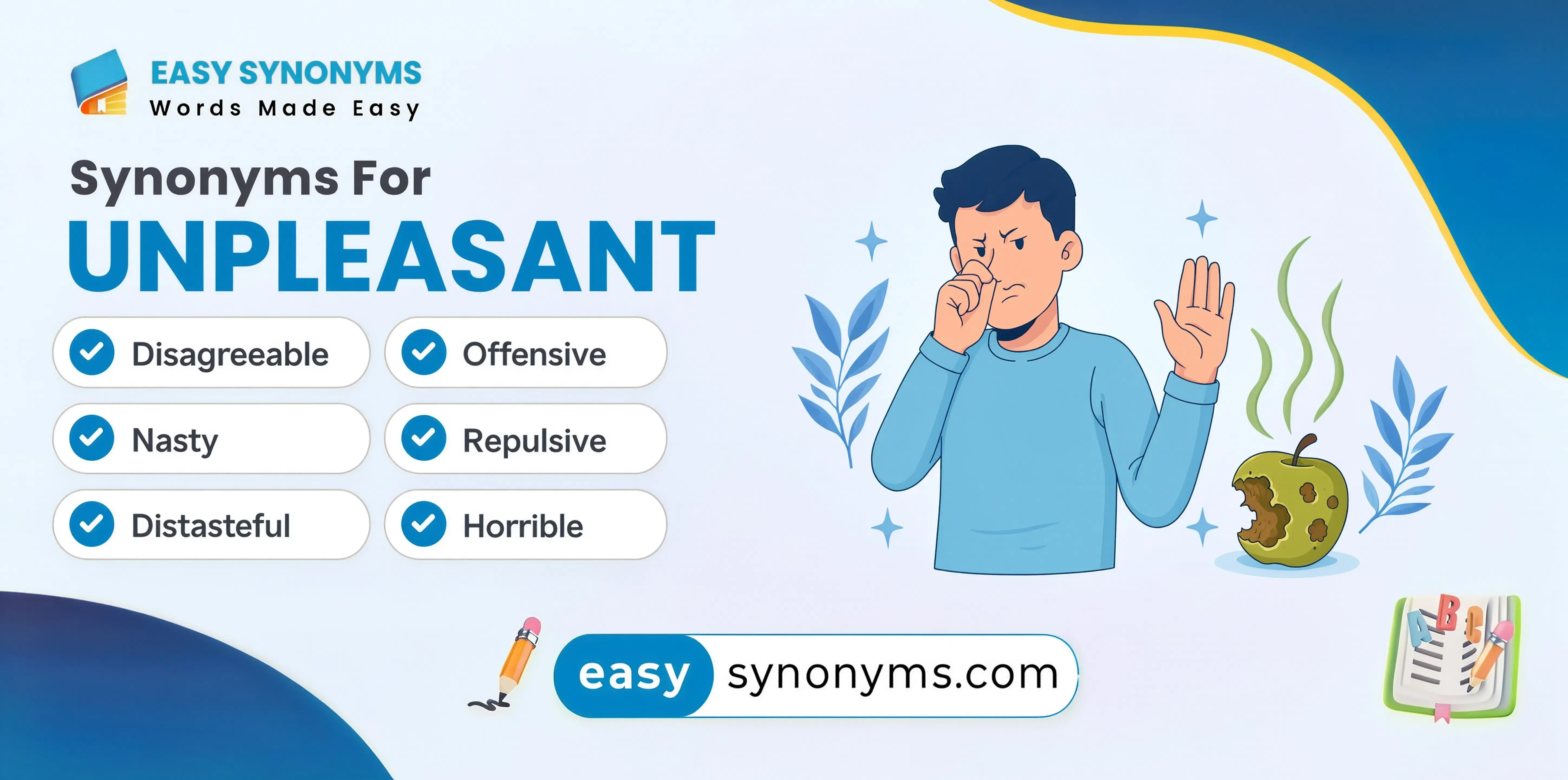

If you need synonyms for unpleasant, useful alternatives include disagreeable, uncomfortable, annoying, irritating, offensive, unpleasant, nasty, harsh, troubling, distressing, and unwelcome. The right word depends on what makes something unpleasant, such as its smell, behavior, experience, sound, or effect.
For example, an unpleasant smell may be offensive or foul, while an unpleasant experience may be uncomfortable, distressing, or troubling. Choosing a more precise synonym can make your writing clearer and more natural.
What Does Unpleasant Mean?
Unpleasant describes something that causes discomfort, dislike, annoyance, or an unwanted feeling.
It can describe many things, including:
- An unpleasant smell
- An unpleasant experience
- An unpleasant person
- An unpleasant conversation
- An unpleasant sound
- An unpleasant situation
- An unpleasant taste
- An unpleasant feeling
For instance:
The room had an unpleasant smell.
Here, unpleasant means the smell was disagreeable or unpleasant to experience.
The word can also describe something emotionally difficult:
She had an unpleasant conversation with her manager.
In this case, alternatives such as awkward, uncomfortable, difficult, or distressing may fit better.
Quick Answer: Synonyms for Unpleasant
| Synonym | Best Used For | Meaning |
|---|---|---|
| Disagreeable | Experiences, people, conditions | Not pleasant or enjoyable |
| Uncomfortable | Situations, feelings, conditions | Causing discomfort |
| Annoying | People, actions, situations | Causing irritation |
| Irritating | Sounds, behavior, problems | Causing frustration |
| Offensive | Smells, behavior, comments | Causing strong dislike or offense |
| Nasty | People, weather, smells, situations | Very unpleasant or unpleasant in a strong way |
| Harsh | Sounds, words, conditions | Severe, rough, or difficult |
| Troubling | News, situations, behavior | Causing concern |
| Distressing | Experiences, events, emotions | Causing sadness or anxiety |
| Unwelcome | Visits, attention, changes | Not wanted |
| Awkward | Social situations | Difficult or uncomfortable |
| Discomforting | Experiences, feelings | Causing discomfort |
| Irrksome | Tasks, habits, behavior | Annoying or bothersome |
| Foul | Smells, tastes, language | Extremely unpleasant or offensive |
| Repulsive | Smells, tastes, behavior | Causing strong disgust |
1. Disagreeable
Disagreeable is one of the closest general synonyms for unpleasant. It describes something that is not enjoyable or pleasing.
For example:
- The weather was disagreeable.
- He has a disagreeable personality.
- The medicine left a disagreeable taste.
This word works well in formal and everyday writing. However, it often sounds more formal than unpleasant.
2. Uncomfortable
Uncomfortable is useful when something causes physical or emotional discomfort.
Consider these examples:
- The chair was uncomfortable.
- I felt uncomfortable during the conversation.
- She was in an uncomfortable situation.
Unlike unpleasant, this word often points directly to discomfort.
For social situations, uncomfortable is usually more natural than disagreeable.
3. Annoying
Annoying describes something that repeatedly bothers or irritates you.
Examples include:
- The noise was annoying.
- His constant interruptions were annoying.
- Traffic can be annoying during rush hour.
Use this word when irritation is the main reason something feels unpleasant.
4. Irritating
Irritating is close to annoying, but it can suggest a stronger or more persistent source of frustration.
For instance:
- The buzzing sound was irritating.
- Her repeated questions became irritating.
- This skin cream can be irritating for some people.
The word can describe both emotional and physical irritation.
5. Offensive
Offensive works when something causes strong dislike, disgust, or a sense of being insulted.
For example:
- The room had an offensive odor.
- His comments were offensive.
- The advertisement used offensive language.
This synonym is more specific than unpleasant. Therefore, use it when the thing causes offense rather than simple discomfort.
6. Nasty
Nasty is a flexible, informal word for something very unpleasant, unpleasantly aggressive, dirty, or harmful.
You might say:
- We had some nasty weather.
- The food left a nasty taste.
- He made a nasty comment.
- That was a nasty experience.
Because nasty is informal and strong, it may not fit every professional context.
7. Harsh
Harsh describes something severe, rough, unpleasant, or difficult to experience.
Common examples include:
- Harsh criticism
- Harsh weather
- Harsh lighting
- Harsh words
- Harsh conditions
For example:
The harsh sunlight made it difficult to see.
Here, harsh gives more detail than simply saying the sunlight was unpleasant.
8. Troubling
Troubling describes something that causes concern, worry, or unease.
Examples:
- The report contained troubling information.
- His behavior was troubling.
- We received some troubling news.
This synonym works particularly well when an unpleasant situation creates concern about what might happen next.
9. Distressing
Distressing is stronger than general unpleasantness. It describes something that causes significant emotional pain, worry, or sadness.
For example:
- The family received distressing news.
- It was a distressing experience.
- The documentary contained distressing scenes.
As a result, choose distressing when the emotional impact is important.
10. Unwelcome
Unwelcome means unwanted or not gladly received.
For example:
- The guests received an unwelcome surprise.
- His advice was unwelcome.
- The change brought unwelcome problems.
This word is especially useful when the main idea is that something was not wanted.
11. Awkward
Awkward works well for uncomfortable social situations.
Consider these examples:
- There was an awkward silence.
- It was an awkward conversation.
- The meeting became awkward after his comment.
Although awkward and unpleasant overlap, they are not exact synonyms. Awkward usually points to social discomfort or difficulty.
12. Irrksome
Irrksome means annoying, bothersome, or irritating.
Examples include:
- The paperwork was irksome.
- Waiting in long lines can be irksome.
- His constant complaints were irksome.
This word is more formal and less common than annoying. Still, it can add variety to formal writing.
13. Foul
Foul is especially useful for extremely unpleasant smells, tastes, or language.
For example:
- There was a foul smell in the kitchen.
- The water had a foul taste.
- The room was filled with foul air.
The word is stronger than ordinary unpleasantness, so use it when the negative quality is obvious.
14. Repulsive
Repulsive means causing strong disgust or intense dislike.
Examples:
- The food had a repulsive smell.
- The sight was repulsive.
- The behavior was repulsive.
This is a much stronger word than unpleasant. Therefore, it should be reserved for situations involving a powerful negative reaction.
Synonyms for Unpleasant by Context
The best synonym changes according to the situation.
Unpleasant Smell
Good alternatives include:
- Offensive
- Foul
- Nasty
- Disagreeable
- Repulsive
Example:
The room had an unpleasant smell.
More specific alternatives:
The room had a foul smell.
The room had an offensive odor.
Unpleasant Experience
Consider:
- Uncomfortable
- Distressing
- Troubling
- Difficult
- Disagreeable
Example:
It was an unpleasant experience.
You could write:
It was a distressing experience.
The second version suggests a stronger emotional effect.
Unpleasant Person
Useful alternatives include:
- Disagreeable
- Annoying
- Irritating
- Nasty
- Difficult
For example:
He can be a disagreeable person.
This sounds more formal than:
He can be an annoying person.
Unpleasant Situation
Depending on the meaning, try:
- Uncomfortable
- Awkward
- Troubling
- Difficult
- Unwelcome
For example:
The meeting became awkward after the disagreement.
Unpleasant Sound
Useful choices include:
- Irritating
- Annoying
- Harsh
- Grating
- Jarring
For example:
The machine made an irritating sound.
Here, irritating explains the effect more clearly than the broad word unpleasant.
Unpleasant Taste
Consider:
- Bitter
- Foul
- Nasty
- Disagreeable
- Unpalatable
For example:
The medicine had a bitter taste.
In this sentence, bitter is more precise because it describes the actual taste.
Unpleasant vs. Disagreeable
Both words describe something that is not pleasant. However, disagreeable often sounds more formal.
Compare:
- Unpleasant weather = weather that is uncomfortable or undesirable.
- Disagreeable weather = unpleasant weather, with a somewhat more formal tone.
The two words can often replace each other, but unpleasant is more common in everyday English.
Unpleasant vs. Uncomfortable
These words overlap, but their focus differs.
Unpleasant means something causes dislike or a negative feeling. Uncomfortable focuses more directly on discomfort.
For example:
- The smell was unpleasant.
- The chair was uncomfortable.
- The conversation was uncomfortable.
Therefore, uncomfortable is often the better choice for physical or social discomfort.
Unpleasant vs. Annoying
Annoying describes something that causes irritation or frustration.
For example:
- The weather was unpleasant.
- The constant noise was annoying.
The first sentence expresses general dislike. The second identifies irritation as the main problem.
Unpleasant vs. Offensive
Offensive is stronger and more specific.
An unpleasant smell may simply be difficult to tolerate. An offensive smell usually causes a stronger negative reaction.
Similarly:
- Unpleasant comment = a comment that was not nice or comfortable.
- Offensive comment = a comment that caused offense.
As a result, do not use offensive unless the stronger meaning fits.
Unpleasant vs. Distressing
Distressing suggests significant emotional difficulty.
Compare:
- It was an unpleasant experience.
- It was a distressing experience.
The first statement is broad. The second suggests that the experience caused serious emotional discomfort.
Common Collocations With Unpleasant
Learning common combinations can help you use unpleasant naturally.
Popular collocations include:
- Unpleasant experience
- Unpleasant smell
- Unpleasant taste
- Unpleasant surprise
- Unpleasant situation
- Unpleasant conversation
- Unpleasant feeling
- Unpleasant person
- Unpleasant sound
- Unpleasant memory
- Unpleasant weather
- Unpleasant conditions
- Unpleasant truth
- Unpleasant experience
For example:
Nobody expected such an unpleasant surprise.
The room had an unpleasant smell.
They had an unpleasant conversation.
Common Mistakes With Unpleasant Synonyms
A common mistake is using every synonym as if it had exactly the same meaning. In reality, each word emphasizes a different type of negative experience.
For example, annoying suggests irritation, while distressing suggests emotional pain.
Likewise, foul often describes a very bad smell or taste. On the other hand, awkward usually refers to an uncomfortable social situation.
Another mistake is using strong words when a mild description is enough. Repulsive and offensive can sound much stronger than unpleasant.
Therefore, match the synonym to the intensity and context of your sentence.
Formal and Informal Synonyms for Unpleasant
Different situations call for different levels of formality.
| Formal or Neutral | Informal or Strong |
|---|---|
| Disagreeable | Nasty |
| Uncomfortable | Annoying |
| Troubling | Irritating |
| Distressing | Foul |
| Unwelcome | Awkward |
| Offensive | Repulsive |
For professional writing, disagreeable, uncomfortable, troubling, distressing, and unwelcome often work well.
Meanwhile, casual conversations may favor annoying, nasty, irritating, or awkward.
Example Sentences
Here are natural examples of synonyms for unpleasant:
- The hotel room had a disagreeable smell.
- I felt uncomfortable during the discussion.
- The constant noise became annoying.
- The bright lights were irritating.
- His comments were offensive.
- We experienced some nasty weather during the trip.
- The criticism sounded harsh.
- The report contained troubling information.
- It was a distressing experience for everyone involved.
- The invitation was an unwelcome surprise.
- The meeting became awkward after the disagreement.
- The old building had a foul smell.
- The sight was repulsive to many visitors.
Frequently Asked Questions
What is the best synonym for unpleasant?
Common synonyms include disagreeable, uncomfortable, annoying, irritating, offensive, nasty, harsh, troubling, distressing, and unwelcome. The best option depends on the context.
What is another word for unpleasant?
Another word for unpleasant can be disagreeable, uncomfortable, annoying, irritating, unwelcome, or troubling.
What is a strong synonym for unpleasant?
Stronger alternatives include repulsive, offensive, foul, nasty, and distressing. Each one adds a different type of intensity.
What is a polite synonym for unpleasant?
Disagreeable, uncomfortable, undesirable, and unwelcome can sound more measured than stronger words such as nasty or repulsive.
What is a synonym for an unpleasant person?
Depending on the intended meaning, you could use disagreeable, difficult, irritating, annoying, or nasty.
What is a synonym for an unpleasant experience?
Useful alternatives include uncomfortable experience, distressing experience, difficult experience, troubling experience, and disagreeable experience.
What is the opposite of unpleasant?
Common opposites include pleasant, enjoyable, agreeable, comfortable, delightful, and pleasantly surprising, depending on the context.
Conclusion
The most useful synonyms for unpleasant include disagreeable, uncomfortable, annoying, irritating, offensive, nasty, harsh, troubling, distressing, unwelcome, awkward, foul, and repulsive.