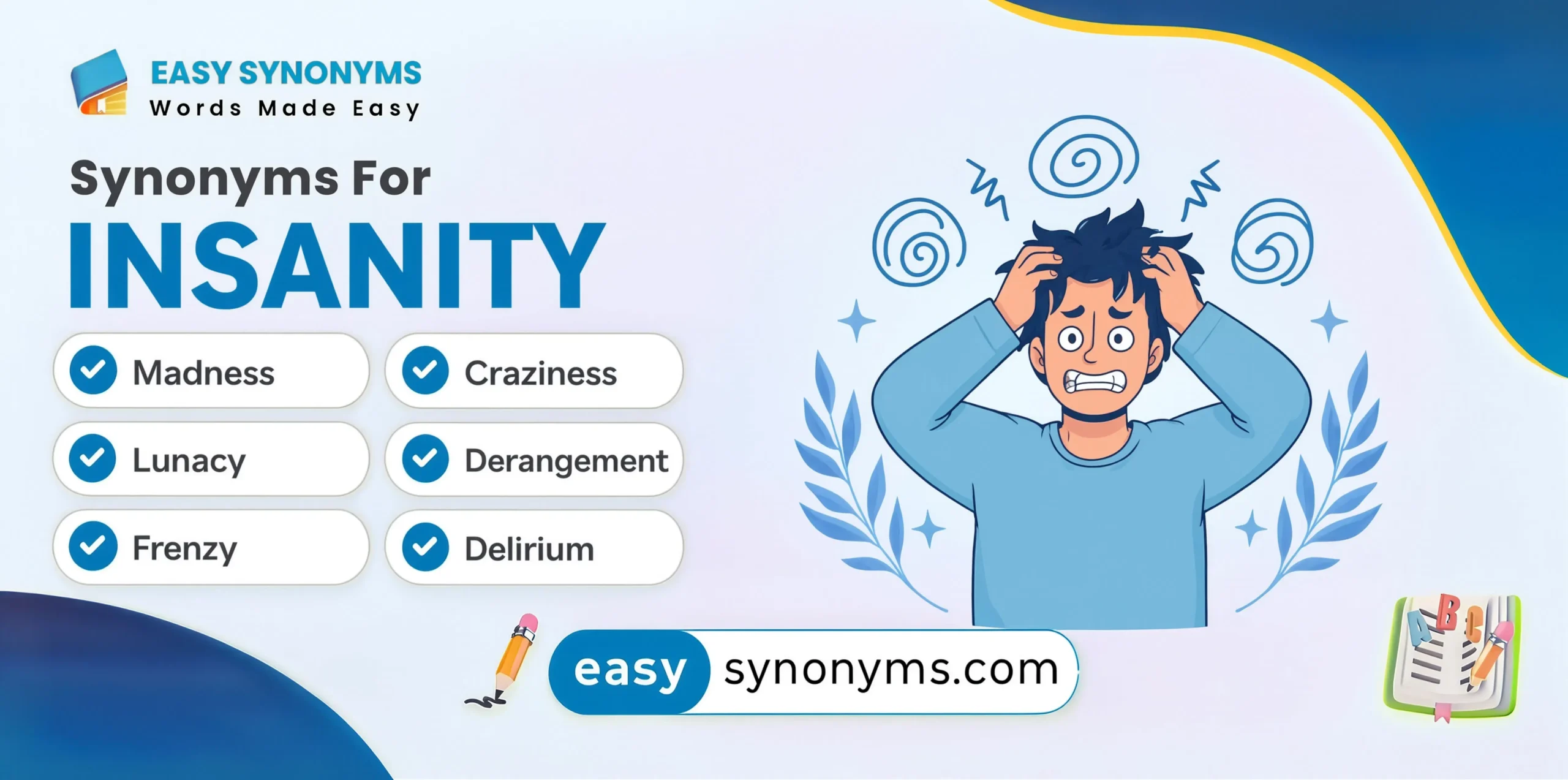

If you need synonyms for insanity, useful alternatives include madness, irrationality, absurdity, foolishness, recklessness, irrational behavior, confusion, delirium, and instability. The best choice depends on whether you mean extreme foolishness, unreasonable behavior, or a historical term related to mental illness.
The word insanity can have different meanings in everyday English and legal contexts. Therefore, it is important to choose an alternative that matches the exact idea you want to express.
What Does Insanity Mean?
Insanity is commonly used to describe extreme irrationality, unreasonable behavior, or a state that seems disconnected from ordinary judgment.
In everyday speech, someone might say:
It would be insanity to drive through that storm.
Here, insanity means extreme foolishness or recklessness. It does not necessarily refer to a mental health condition.
The term also has a specific historical and legal use. In those contexts, insanity has been used to describe a legal standard related to mental state. That meaning is different from ordinary words such as madness or foolishness.
Modern mental health writing usually uses specific clinical terms rather than treating insanity as a medical diagnosis.
Quick Answer: Synonyms for Insanity
| Synonym | Best Used For | Meaning |
|---|---|---|
| Madness | General or literary contexts | Extreme irrationality |
| Irrationality | Reasoning or behavior | Lack of logical thinking |
| Absurdity | Ideas or situations | Extreme lack of sense |
| Foolishness | Decisions or actions | Poor judgment |
| Recklessness | Risky behavior | Ignoring danger or consequences |
| Irrational behavior | Actions | Behavior that lacks reasonable judgment |
| Confusion | Mental state | Difficulty thinking clearly |
| Delirium | Medical contexts | Severe confusion and altered awareness |
| Frenzy | Intense activity | Wild or uncontrolled excitement |
| Derangement | Formal or literary contexts | Severe disturbance of thought or behavior |
| Imprudence | Formal writing | Lack of good judgment |
| Absurdity | Ideas or decisions | Something unreasonable or ridiculous |
| Nonsense | Speech or ideas | Meaningless or unreasonable ideas |
| Foolhardiness | Risky actions | Reckless disregard for danger |
1. Madness
Madness is one of the closest general alternatives to insanity. It can describe extreme irrationality, uncontrolled behavior, or a situation that seems completely unreasonable.
For example:
- The decision was complete madness.
- His actions seemed like madness.
- The crowd descended into madness.
The word also appears frequently in literature and figurative writing.
Unlike a clinical term, madness is broad and does not provide a specific medical description.
2. Irrationality
Irrationality describes a lack of logical or reasonable thinking.
Consider these examples:
- His decision showed clear irrationality.
- Fear can sometimes lead to irrationality.
- The argument was based on irrationality rather than evidence.
This word is useful when you want a neutral alternative to insanity in discussions about reasoning or decisions.
3. Absurdity
Absurdity describes something that is unreasonable, ridiculous, or completely lacking in sense.
For instance:
- The proposal was an absurdity.
- She could not believe the absurdity of the situation.
- Calling that plan safe would be an absurdity.
Use absurdity when the main idea is that something makes little or no sense.
4. Foolishness
Foolishness refers to poor judgment or a lack of good sense.
Examples include:
- His decision was an act of foolishness.
- They regretted their earlier foolishness.
- It would be foolishness to ignore the warning.
This word is often much less severe than insanity.
Therefore, it works well when you want to criticize a decision without suggesting a serious mental health problem.
5. Recklessness
Recklessness describes behavior that ignores obvious risks or possible consequences.
For example:
- Driving that fast was recklessness.
- His recklessness put others at risk.
- The decision showed extreme recklessness.
Choose this synonym when the key idea is dangerous or careless behavior.
6. Irrational Behavior
Irrational behavior is a clear and relatively neutral phrase for actions that do not appear reasonable or logical.
You might say:
- Stress can sometimes affect judgment and lead to irrational behavior.
- His response seemed like irrational behavior.
- The decision was difficult to understand and appeared irrational.
This phrase is often preferable to using insanity when discussing someone’s actions without making a claim about their mental health.
7. Confusion
Confusion describes difficulty understanding, thinking clearly, or knowing what to do.
For example:
- The sudden change caused confusion.
- The patient experienced severe confusion.
- His explanation only created more confusion.
However, confusion is not a direct synonym for insanity. It describes a specific state and can have many possible causes.
8. Delirium
Delirium is a specific medical term for a serious disturbance involving attention and awareness, often with rapidly changing mental functioning.
For example:
- The patient developed delirium after the illness.
- The doctor assessed the patient for signs of delirium.
Because delirium has a specific clinical meaning, it should not be used casually as a replacement for insanity.
9. Frenzy
Frenzy describes a state of intense, uncontrolled excitement, activity, or emotion.
Examples include:
- The announcement sent fans into a frenzy.
- The crowd reacted in a frenzy.
- Social media erupted into a frenzy after the news.
This word focuses on intense activity or emotion rather than mental illness.
10. Derangement
Derangement is a formal or literary term that can describe severe disturbance of normal thought or behavior.
For example:
- The novel portrays a character’s gradual derangement.
- His behavior appeared increasingly deranged.
The word has a strong tone, so it should be used carefully when describing real people.
11. Imprudence
Imprudence means a lack of care, wisdom, or good judgment.
For instance:
- The decision reflected serious imprudence.
- His financial choices showed imprudence.
- They later regretted their imprudence.
This is a useful formal alternative when insanity means extremely poor judgment rather than mental illness.
12. Nonsense
Nonsense describes words, ideas, or claims that have little meaning or make little sense.
For example:
- That argument is nonsense.
- Calling the plan risk-free is nonsense.
- She dismissed the claim as nonsense.
It is a much milder alternative to insanity and works best for statements or ideas.
13. Foolhardiness
Foolhardiness means taking unnecessary risks without considering the danger.
Examples:
- His actions showed remarkable foolhardiness.
- Climbing without safety equipment was pure foolhardiness.
- They criticized the plan for its foolhardiness.
This word is especially useful when insanity is being used figuratively to describe dangerous decisions.
Synonyms for Insanity by Context
The best alternative depends on what you mean by insanity.
Insanity Meaning Extreme Foolishness
Use:
- Foolishness
- Absurdity
- Imprudence
- Nonsense
- Foolhardiness
Example:
It would be insanity to attempt the journey without supplies.
A more precise version is:
It would be foolhardy to attempt the journey without supplies.
Insanity Meaning Irrational Thinking
Consider:
- Irrationality
- Unreason
- Illogical thinking
- Irrational behavior
- Confusion
For example:
Fear sometimes leads to irrational thinking.
This wording focuses on the reasoning rather than labeling a person.
Insanity Meaning Dangerous Behavior
Useful alternatives include:
- Recklessness
- Foolhardiness
- Frenzy
- Irrational behavior
For instance:
His decision to ignore the warning showed recklessness.
Insanity in Literary Writing
Writers may use:
- Madness
- Derangement
- Frenzy
- Delirium
These words can create a stronger dramatic or literary effect.
However, each one has a distinct meaning, so context still matters.
Insanity vs. Madness
Insanity and madness can overlap in everyday language. Both may describe extreme irrationality or behavior that appears unreasonable.
However, madness is often more literary or figurative.
Compare:
- The plan was insanity.
- The plan was madness.
Both sentences can mean that the plan was extremely unreasonable.
In modern mental health discussions, neither word should automatically be treated as a clinical diagnosis.
Insanity vs. Irrationality
Irrationality is more precise when you mean a failure to think logically.
For example:
Fear can produce irrationality.
This does not label the person. Instead, it describes a particular pattern of thinking.
Therefore, irrationality is often a better choice for formal discussions of decisions, arguments, or behavior.
Insanity vs. Foolishness
Foolishness is generally milder than insanity.
Consider:
- Ignoring the warning was foolishness.
- Ignoring the warning was insanity.
The second statement uses stronger language and may be rhetorical rather than literal.
For everyday writing, foolishness can communicate poor judgment without suggesting mental illness.
Insanity vs. Recklessness
These words focus on different things.
Recklessness specifically involves disregard for risk or consequences. Insanity can be used more broadly to describe something that seems extremely unreasonable.
For example:
Driving without brakes would be reckless.
The word reckless directly identifies the dangerous behavior.
Insanity vs. Delirium
These terms should not be treated as interchangeable.
Delirium is a specific medical condition involving disturbed attention and awareness. Insanity is a broad, non-clinical term and can also have a legal meaning.
As a result, use delirium only when the specific clinical meaning applies.
Common Collocations With Insanity
Learning common phrases can help you understand how insanity appears in English.
Common collocations include:
- Complete insanity
- Absolute insanity
- Sheer insanity
- Acts of insanity
- Moment of insanity
- Descent into insanity
- Plea of insanity
- Legal insanity
- Temporary insanity
- Criminal insanity
- Driven to insanity
- Bordering on insanity
For example:
The decision seemed like complete insanity.
The lawyer discussed the concept of legal insanity.
The legal phrase has a specialized meaning and should not be confused with ordinary conversational use.
Common Mistakes With Insanity Synonyms
One common mistake is treating insanity as a medical diagnosis. It is not the name of a specific mental disorder in modern clinical terminology.
Another issue is using delirium as a general synonym. Delirium has a specific medical meaning, so it should not simply replace insanity.
Similarly, madness can work in literary or figurative contexts, but it may sound stigmatizing when used casually about a person’s mental health.
Instead, describe the specific behavior or state whenever possible. Words such as irrational, confused, reckless, distressed, or disoriented can be more precise when they accurately describe the situation.
Formal and Informal Alternatives
Different words suit different types of writing.
| Formal or Neutral | Informal or Literary |
|---|---|
| Irrationality | Madness |
| Imprudence | Foolishness |
| Recklessness | Madness |
| Irrational behavior | Nonsense |
| Confusion | Frenzy |
| Absurdity | Madness |
| Delirium | Derangement |
For academic or professional writing, specific terms such as irrationality, recklessness, confusion, or imprudence can communicate the intended meaning more clearly.
Meanwhile, madness, frenzy, and nonsense may work better in creative or conversational writing.
Example Sentences
Here are natural examples using alternatives to insanity:
- The decision showed serious foolishness.
- His argument was based on irrationality.
- The proposal was an absurdity.
- Driving that fast was recklessness.
- Her response seemed irrational.
- The sudden change caused widespread confusion.
- The patient developed delirium during the illness.
- The announcement sent the crowd into a frenzy.
- The story explores the character’s gradual derangement.
- His financial decision reflected imprudence.
- She dismissed the claim as nonsense.
- Ignoring the safety rules was pure foolhardiness.
Frequently Asked Questions
What is the best synonym for insanity?
The best synonym depends on the intended meaning. Madness, irrationality, absurdity, foolishness, recklessness, and irrational behavior can all work in different contexts.
What is another word for insanity?
Another word for insanity can be madness in general or literary contexts. If you mean poor judgment, foolishness or recklessness may be more precise.
What is a polite synonym for insanity?
There is no single replacement that fits every situation. Irrational behavior, irrationality, confusion, or poor judgment may be more neutral when they accurately describe what happened.
What is a strong synonym for insanity?
Madness, derangement, frenzy, and absurdity can convey strong meanings, depending on the context.
Is madness the same as insanity?
The words can overlap in everyday English, but neither is a modern clinical diagnosis. Madness is often more literary or figurative.
Is insanity a medical term?
Insanity is not a specific modern clinical diagnosis. The term can appear in legal contexts, where it has a specialized meaning, and in everyday language as a broad description of extreme irrationality.
What is the opposite of insanity?
Depending on the meaning, possible opposites include reason, rationality, sanity, logic, sound judgment, and clarity.
Conclusion
Useful synonyms for insanity include madness, irrationality, absurdity, foolishness, recklessness, irrational behavior, confusion, delirium, frenzy, derangement, imprudence, nonsense, and foolhardiness.
However, these words are not interchangeable. Irrationality focuses on unreasonable thinking, while recklessness describes disregard for danger. Foolishness points to poor judgment, whereas delirium has a specific medical meaning.
For clear and respectful writing, identify the exact idea first. Then choose the word that describes the behavior, thought, or situation as precisely as possible.