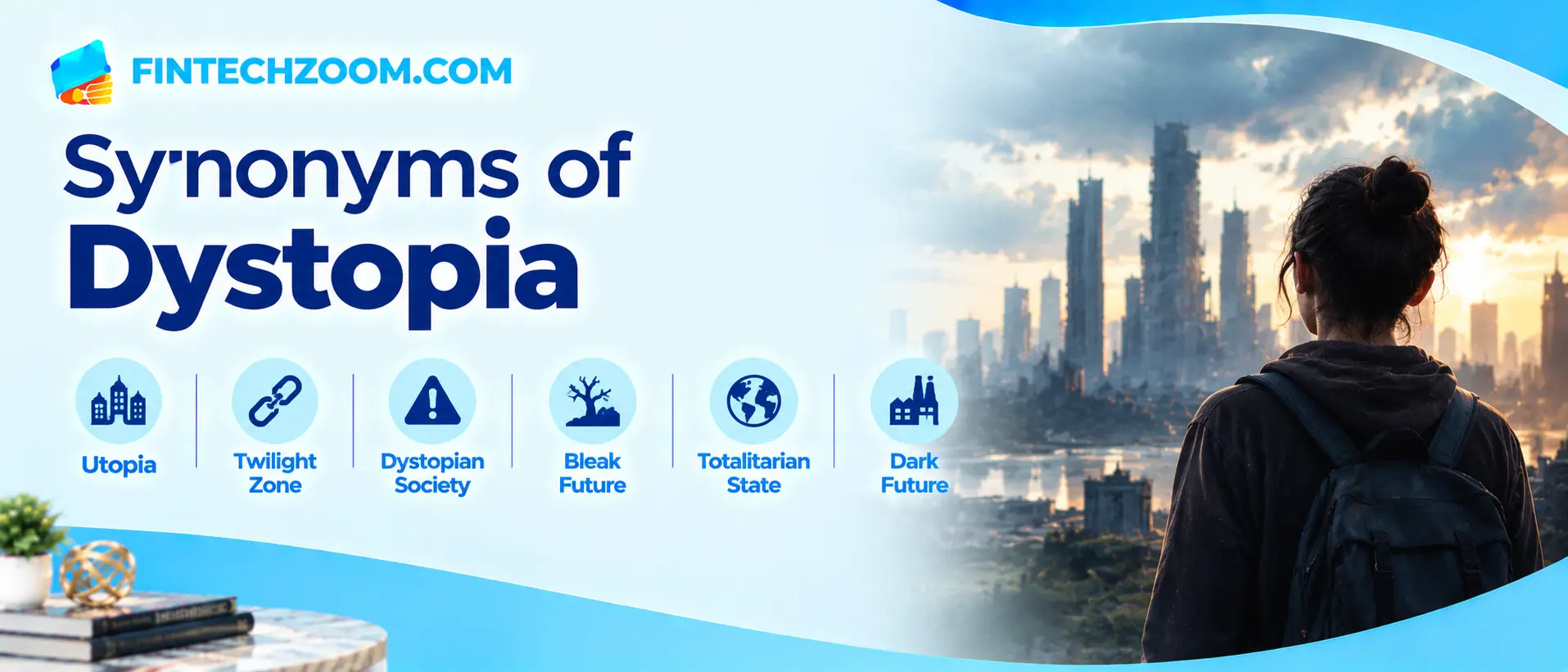

A dystopia is an imaginary or hypothetical society where people experience suffering, oppression, injustice, or extremely poor living conditions. Common synonyms include anti-utopia and the rare term cacotopia. Other useful alternatives are oppressive society, nightmare society, hellscape, and bleak future. However, these expressions have different meanings, so the best choice depends on your context.
For example, anti-utopia works well in literary analysis, while hellscape describes a frightening or devastated place. Similarly, authoritarian society emphasizes political control. This guide explains the closest synonyms, their differences, and how to use them naturally in everyday writing, academic work, and fiction.
Quick Answer: What Are the Synonyms of Dystopia?
The closest synonyms of dystopia are anti-utopia and cacotopia. Depending on the context, you can also use nightmare society, oppressive society, hellscape, bleak future, or dystopian world. However, these alternatives are not interchangeable in every sentence. Some describe an entire society, whereas others focus on suffering, political control, or environmental destruction.
List of Synonyms of Dystopia
The following table compares useful alternatives by meaning, formality, and context. As a result, you can quickly identify the word that best expresses your intended meaning.
| Synonym or alternative | Meaning | Best context | Example |
|---|---|---|---|
| Anti-utopia | An undesirable society that challenges the idea of a perfect world | Literature | The novel presents an anti-utopia ruled by fear. |
| Cacotopia | A bad or undesirable imagined society | Specialized literary writing | The story imagines a cacotopia shaped by cruelty. |
| Nightmare society | A society filled with fear and suffering | General writing | Citizens struggle to survive in a nightmare society. |
| Oppressive society | A society that restricts freedom through unfair control | Social and political writing | The characters live in an oppressive society. |
| Hellscape | A horrifying or devastated place | Creative writing | Pollution has turned the city into a hellscape. |
| Bleak future | A future with little hope or promise | Science fiction | The film depicts a bleak future without freedom. |
| Nightmarish world | A frightening or disturbing setting | Fiction and reviews | The hero escapes a nightmarish world. |
| Totalitarian society | A society under extreme government control | Political fiction | The novel portrays a totalitarian society. |
| Authoritarian society | A society ruled by leaders with restricted political freedoms | Politics and history | Journalists struggle in an authoritarian society. |
| Ruined world | A world damaged by disaster or decline | Post-apocalyptic fiction | Survivors travel through a ruined world. |
| Desolate wasteland | A barren, empty, or devastated landscape | Descriptive writing | The travelers cross a desolate wasteland. |
| Failed utopia | An ideal society that fails to achieve its goals | Literary analysis | The settlement becomes a failed utopia. |
Keep in mind: Anti-utopia and cacotopia are the closest alternatives in this list. By contrast, the other expressions describe particular features of a dystopian world.
What Does Dystopia Mean?
A dystopia is an imagined or hypothetical society in which life is extremely unpleasant, unjust, or oppressive. Such societies often feature strict government control, social inequality, environmental destruction, constant surveillance, or a lack of personal freedom.
Dystopian stories frequently appear in novels, movies, and television series. Through these stories, writers explore the possible consequences of political abuse, dangerous technology, and social injustice.
For example:
- The novel depicts a dystopia where the government controls every aspect of daily life.
- The movie imagines a dystopia devastated by environmental collapse.
- The story explores a technological dystopia in which people have no privacy.
The noun is dystopia, while the adjective is dystopian. Therefore, you can describe a fictional society as a dystopia or call its setting a dystopian world.
The Best Synonyms of Dystopia Explained
1. Anti-Utopia
Meaning: An undesirable imagined society that opposes or challenges the concept of a utopia.
Anti-utopia is one of the closest alternatives to dystopia. Both terms describe deeply undesirable societies. However, anti-utopia can place greater emphasis on the failure of an ideal social system.
Best context: Literary criticism, speculative fiction, and discussions of supposedly perfect societies.
Example: The author creates an anti-utopia in which the promise of happiness hides widespread suffering.
2. Cacotopia
Meaning: A bad or undesirable imagined society.
Cacotopia is a rare literary term with a meaning similar to dystopia. Although it can add variety to academic writing, most general readers will recognize dystopia more easily.
Best context: Specialized literary or philosophical discussions.
Example: The philosopher describes a cacotopia where absolute power destroys individual freedom.
For ordinary writing, choose dystopia unless the rare term serves a clear purpose.
3. Oppressive Society
Meaning: A society in which people face harsh control, unfair treatment, or restrictions on their freedom.
This expression highlights the treatment of people rather than the overall appearance of their surroundings. Consequently, it is particularly useful when discussing unjust laws, censorship, or discrimination.
Best context: Political commentary, social analysis, and fiction.
Example: The novel follows a young woman trying to escape an oppressive society that denies her basic rights.
4. Nightmare Society
Meaning: A society characterized by fear, suffering, or disturbing conditions.
Unlike the more technical term dystopia, this phrase communicates an emotional experience. Therefore, it works well in accessible writing and dramatic storytelling.
Best context: Book reviews, movie reviews, and general descriptions.
Example: The series portrays a nightmare society where citizens are punished for expressing independent opinions.
5. Hellscape
Meaning: A place or environment that appears horrifying, miserable, or devastated.
Hellscape creates a vivid image of destruction. For instance, it may describe a polluted city, a war-torn landscape, or a dangerous place after a catastrophe.
Best context: Creative writing and descriptions of environmental damage.
Example: Decades of pollution have transformed the beautiful valley into a toxic hellscape.
However, a hellscape does not have to be a society. The word can describe a terrible environment even when no oppressive government exists.
6. Bleak Future
Meaning: An imagined future with little hope or improvement.
This phrase emphasizes pessimistic expectations rather than a specific social system. As a result, it works well when discussing science fiction, technology, and possible future problems.
Best context: Speculative fiction and future scenarios.
Example: The film presents a bleak future in which clean water is available only to wealthy families.
7. Totalitarian Society
Meaning: A society governed by a system that seeks extensive control over public and private life.
A totalitarian society can be dystopian, especially when the government suppresses independent thought. Nevertheless, the two terms have different purposes: totalitarian identifies a form of political control, while dystopia describes an extremely undesirable society.
Best context: Political fiction, history, and government analysis.
Example: The novel depicts a totalitarian society where independent thought is treated as a crime.
8. Authoritarian Society
Meaning: A society ruled by leaders who exercise power with limited political freedom and accountability.
This expression is useful when political restrictions are central to the discussion. However, authoritarianism alone does not automatically make every aspect of a society dystopian.
Best context: Political writing, journalism, and fiction.
Example: The story follows journalists working in an authoritarian society that censors the press.
9. Ruined World
Meaning: A world severely damaged by war, disaster, pollution, or social collapse.
A ruined world often appears in dystopian and post-apocalyptic fiction. Even so, physical destruction is not necessary for a dystopia; some oppressive societies appear clean, wealthy, and technologically advanced.
Best context: Post-apocalyptic stories and survival fiction.
Example: After the global catastrophe, survivors search for food across a ruined world.
10. Nightmarish World
Meaning: A frightening or disturbing world that seems difficult to escape.
This phrase emphasizes atmosphere and emotional intensity. Therefore, it is especially effective when describing a fictional setting that creates fear or uncertainty.
Best context: Creative writing and entertainment reviews.
Example: The protagonist struggles to survive in a nightmarish world controlled by artificial intelligence.
Which Synonym of Dystopia Should You Use?
The right choice depends on the specific feature you want to describe.
| Your intended meaning | Best choice | Reason |
|---|---|---|
| An undesirable society opposed to an ideal world | Anti-utopia | Connects the idea to utopia |
| A society marked by unfair control | Oppressive society | Emphasizes injustice and restrictions |
| A society dominated by government control | Totalitarian society | Highlights extensive political power |
| A frightening place | Hellscape | Creates a vivid image |
| A future with little hope | Bleak future | Emphasizes pessimistic expectations |
| A society filled with fear | Nightmare society | Focuses on people’s experiences |
| A world damaged by disaster | Ruined world | Highlights destruction |
| A rare literary alternative | Cacotopia | Provides a specialized term |
For most general readers, oppressive society and nightmare society are easy to understand. In academic writing, anti-utopia may fit better. Meanwhile, hellscape is more effective when you want readers to picture a horrifying environment.
Choosing Words for Different Writing Situations
For literature and essays
Use anti-utopia when analyzing a fictional society that challenges the idea of a perfect world. Alternatively, choose oppressive society when the discussion focuses on injustice or restricted freedom.
For creative writing
Choose nightmarish world to create a disturbing atmosphere. Similarly, hellscape works well when the setting is physically devastated.
For political analysis
Use authoritarian society or totalitarian society when those political descriptions are accurate. Although both may describe features of a dystopia, they should not automatically replace the broader term.
For future scenarios
Use bleak future when emphasizing a pessimistic outlook. By contrast, dystopian future more clearly suggests a future shaped by deeply undesirable social conditions.
Dystopia vs. Similar Words
Several words are closely connected to dystopia but have distinct meanings. Understanding these differences will help you avoid choosing an inaccurate synonym.
Dystopia vs. Anti-Utopia
Both terms can describe undesirable imagined societies. However, anti-utopia may emphasize the failure or rejection of an ideal social order, while dystopia is the more familiar general term.
Example: The novel presents a dystopia ruled by fear and uses an anti-utopian message to challenge the promise of perfect social control.
Dystopia vs. Apocalypse
An apocalypse refers to a catastrophic event or destruction. A dystopia, on the other hand, describes an extremely undesirable society or state.
Example: A global war causes an apocalypse, and the survivors later establish a dystopian society.
Dystopia vs. Hellscape
A hellscape is a horrifying or devastated place, whereas a dystopia generally describes an undesirable society or state.
Example: A polluted city may be a hellscape. If its residents also live under oppressive laws and constant surveillance, the wider society may be dystopian.
Dystopia vs. Utopia
A utopia is an imagined ideal society. In contrast, a dystopia is an imagined or hypothetical society characterized by extremely undesirable conditions.
Example: The story begins with a utopia promising equality. Eventually, however, the system becomes a dystopia that suppresses personal freedom.
Dystopia vs. Post-Apocalyptic World
A post-apocalyptic world is a setting after a major catastrophe. A dystopia, by contrast, focuses on undesirable living conditions or social structures.
As a result, a post-apocalyptic story can feature a fair community rebuilding after disaster, while a dystopian story can take place in a functioning, technologically advanced city.
Common Mistakes When Using Dystopia Synonyms
1. Treating Every Disaster as a Dystopia
A disaster does not automatically create a dystopian society. For example, an earthquake may destroy buildings without establishing an oppressive social system.
Better choice: Use catastrophe for the event and dystopia for the society if the wider conditions fit the definition.
2. Confusing Apocalypse With Dystopia
Although these concepts can overlap, they are not identical. An apocalypse describes catastrophic destruction, whereas a dystopia describes an undesirable society or state.
Better choice: Describe the disaster as an apocalypse and the oppressive society that follows as a dystopia.
3. Calling Every Authoritarian Society a Dystopia
Authoritarianism describes how political power is exercised. Dystopia is a broader term that describes a deeply undesirable society or imagined world.
Better choice: Use authoritarian society when political control is the focus. Choose dystopia when discussing the wider conditions of life.
4. Using Rare Words Without Considering Your Audience
Cacotopia is a valid but uncommon alternative. Consequently, it may confuse readers who are unfamiliar with specialized literary vocabulary.
Better choice: Prefer dystopia in general writing unless the rare term adds useful precision.
5. Confusing Dystopia With Dystopian
These words serve different grammatical purposes. Dystopia is a noun, while dystopian is an adjective.
- Correct: The novel describes a dystopia.
- Correct: The novel has a dystopian setting.
- Incorrect: The novel describes a dystopian.
Therefore, use the noun for the society itself and the adjective to describe its features.
Related Words and Antonyms
Related Words
The following terms help explain dystopian themes. However, they are related concepts rather than direct synonyms.
- Dystopian: An adjective describing something associated with a dystopia.
- Oppression: Harsh or unjust control over people.
- Surveillance: Close monitoring of people or activities.
- Totalitarianism: A political system seeking extensive control over society.
- Authoritarianism: A system characterized by concentrated political power and restricted freedoms.
- Post-apocalyptic: Describing a setting after a major catastrophe.
- Speculative fiction: Fiction that explores imagined possibilities, including alternative societies and futures.
Antonyms of Dystopia
The clearest antonym of dystopia is utopia, which describes an imagined ideal society. Other contrasting expressions include ideal society, harmonious community, and paradise.
Although these expressions share a positive meaning, they are not exact substitutes in every context. Nevertheless, they help illustrate the contrast between a society built around well-being and one characterized by suffering.
Example: The story contrasts a utopia built on cooperation with a dystopia controlled by fear.
Frequently Asked Questions
What is the closest synonym of dystopia?
Anti-utopia is one of the closest alternatives, while cacotopia is a rare term with a similar meaning. For general writing, oppressive society or nightmare society may communicate the idea more clearly. The best choice depends on whether you are discussing literature, political control, or living conditions.
What is another word for a dystopian society?
You can use oppressive society, nightmare society, or authoritarian society, depending on the context. Choose oppressive society when injustice and restricted freedom are central. Alternatively, use authoritarian society when political control is the main feature.
Is anti-utopia the same as dystopia?
The terms overlap significantly, and anti-utopia can serve as an alternative to dystopia. However, anti-utopia may place greater emphasis on opposing or exposing the failure of a supposedly ideal society. Dystopia remains the more familiar general term.
Is hellscape a synonym for dystopia?
Hellscape is a contextual alternative rather than a direct synonym in every situation. It describes a horrifying place, while dystopia generally refers to an undesirable society or state. A ruined city may be a hellscape, but its oppressive social system may be dystopian.
What is the opposite of dystopia?
The clearest opposite is utopia, an imagined society where conditions are ideal. A dystopia features extremely undesirable living conditions, whereas a utopia represents an idealized alternative. In fiction, a society may begin as a utopia and later become a dystopia when its ideals turn oppressive.
Can I use apocalypse instead of dystopia?
Not in every sentence. Apocalypse refers to catastrophic destruction, while dystopia describes an undesirable society or state. Both terms may apply when a disaster creates a society marked by suffering, but each word emphasizes a different aspect of the situation.
What is the difference between dystopia and dystopian?
Dystopia is a noun that names an undesirable society or state. In contrast, dystopian is an adjective describing something associated with that society. For example, you can say that a novel depicts a dystopia or that it presents a dystopian future.
Conclusion
The closest synonyms of dystopia include anti-utopia and the rare term cacotopia. Other useful alternatives include oppressive society, nightmare society, hellscape, and bleak future. However, each expression emphasizes a different aspect of an undesirable world.
For literary analysis, consider anti-utopia. When discussing political control, use oppressive society or totalitarian society if the description is accurate. Meanwhile, hellscape and ruined world work well for devastated environments. By choosing words according to their meaning and context, you can make your writing clearer, more natural, and more precise.