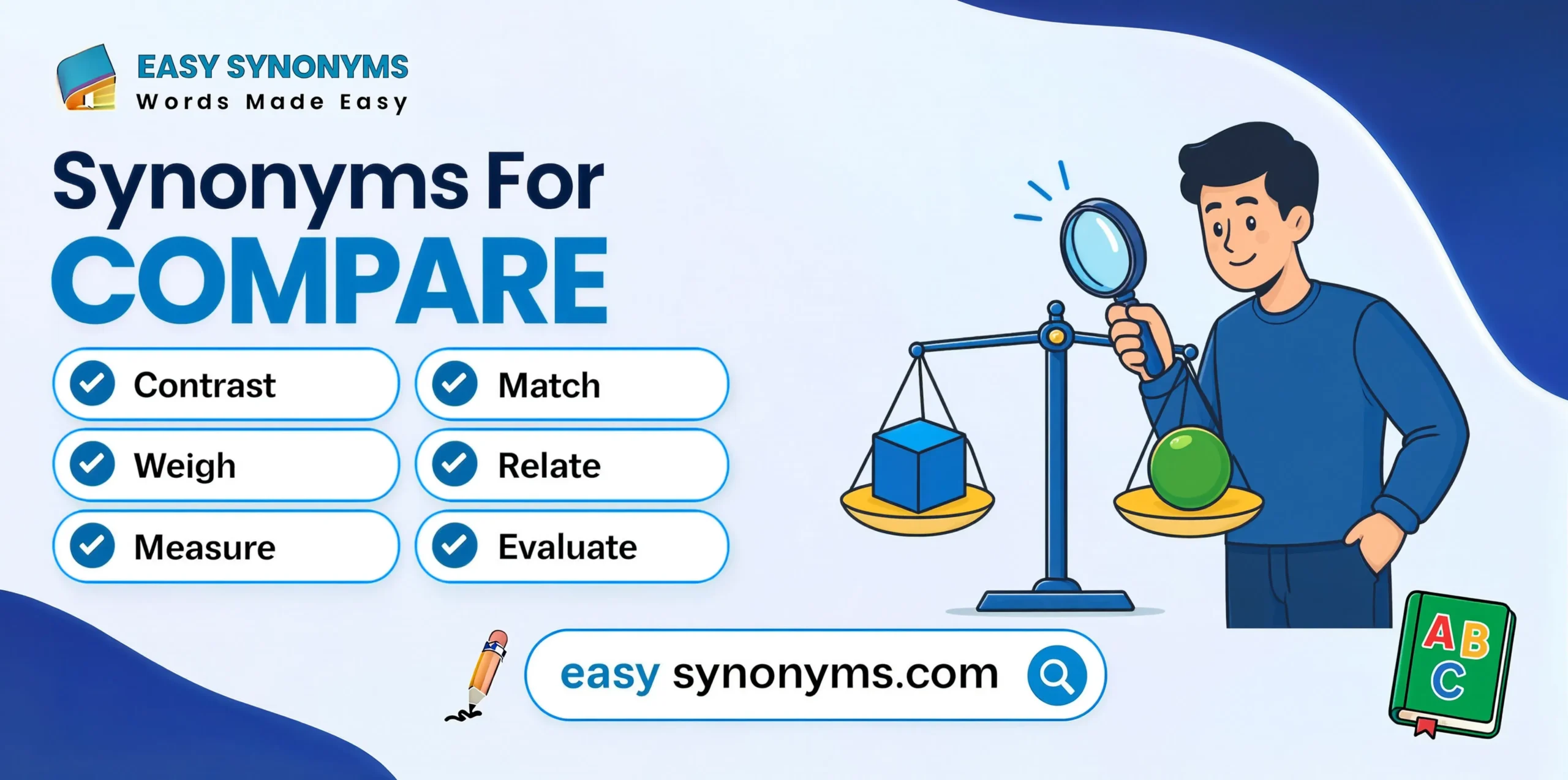

The word compare means to examine two or more people, things, ideas, or situations to identify their similarities and differences. It can also mean describing one thing as similar to another.
Common synonyms of compare include contrast, evaluate, examine, assess, match, measure, relate, liken, equate, juxtapose, differentiate, and analyze. However, these words do not always have exactly the same meaning.
The best alternative depends on what you want to emphasize. For example, contrast focuses on differences, while liken emphasizes similarity.
Quick Answer: Synonyms of Compare
Here are useful alternatives to compare:
| Synonym | Best Used For | Meaning |
|---|---|---|
| Contrast | Differences | Examine differences between things |
| Evaluate | Quality or performance | Judge something based on criteria |
| Examine | Detailed comparison | Study something carefully |
| Assess | Value or condition | Judge or estimate something |
| Match | Similarity or suitability | Show that things are equal or compatible |
| Measure | Standards or performance | Judge against a standard |
| Relate | Connections | Show a connection between things |
| Liken | Similarity | Describe one thing as similar to another |
| Equate | Equality | Treat two things as equal |
| Juxtapose | Direct comparison | Place things together to highlight differences |
| Differentiate | Distinctions | Identify what makes things different |
| Analyze | Detailed study | Examine parts or characteristics |
| Rank | Relative position | Put things in order based on criteria |
| Weigh | Pros and cons | Consider different factors before deciding |
| Correlate | Relationships | Show a connection between variables |
What Does Compare Mean?
Compare is a verb that means to examine two or more things to determine how they are similar or different.
For example:
We compared the two laptops before buying one.
This means we examined their features, prices, performance, or other characteristics.
Compare can also emphasize similarity:
Her voice is often compared to that of a professional singer.
In this use, the speaker is pointing out a similarity.
The word can therefore work in several contexts, including:
- comparing products
- comparing people
- comparing ideas
- comparing prices
- comparing results
- comparing experiences
- comparing writing styles
- comparing performances
1. Contrast
Contrast is one of the closest alternatives to compare, but it focuses specifically on differences.
Examples:
- The study contrasts traditional and modern teaching methods.
- The two designs contrast sharply in color.
- The article compares and contrasts the two theories.
A useful distinction is simple:
Compare → similarities and differences
Contrast → mainly differences
For example:
We compared the two phones.
This could involve similarities and differences.
We contrasted the two phones.
This emphasizes how they differ.
2. Evaluate
Evaluate means to judge the quality, value, importance, effectiveness, or performance of something.
Examples:
- We evaluated three software options.
- The manager evaluated the team’s performance.
- Researchers evaluated the effectiveness of the treatment.
Evaluate is useful when a comparison leads to a judgment.
For example:
We compared five laptops.
This means we examined them.
We evaluated five laptops.
This suggests we judged their quality or suitability.
3. Examine
Examine means to study or inspect something carefully.
It can be used when comparing things, especially in academic or professional writing.
Examples:
- The researchers examined the results from two studies.
- The report examines different approaches to the problem.
- We examined the features of each product.
Unlike compare, examine does not always require two or more things. You can examine a single object.
4. Assess
Assess means to evaluate or estimate the quality, value, condition, or importance of something.
Examples:
- The team assessed the risks of each option.
- We assessed the performance of both systems.
- The teacher assessed the students’ progress.
Assess often sounds professional and is common in business, education, and research.
5. Match
Match can mean to compare something with another thing to determine whether they are equal, compatible, or suitable.
Examples:
- Compare the receipt with the order to make sure they match.
- Her skills match the requirements of the position.
- The colors match perfectly.
Match is not always a direct synonym for compare. It focuses more on similarity, compatibility, or equality.
6. Measure
Measure means to determine the size, amount, degree, or performance of something. It can also mean judging something against a standard.
Examples:
- We measured the two companies’ growth rates.
- The report measures customer satisfaction.
- His performance was measured against industry standards.
In figurative usage:
How does this product measure up against its competitors?
Here, measure up against means compare with a standard or competitor.
7. Relate
Relate can mean to show a connection or relationship between things.
Examples:
- The study relates sleep patterns to academic performance.
- The article relates economic growth to technological development.
- These findings can be related to earlier research.
It is useful when the purpose is to show how ideas or factors are connected rather than simply placing them side by side.
8. Liken
Liken means to describe one person or thing as being similar to another.
It is often followed by to.
Examples:
- Critics likened the film to a classic thriller.
- The writer likened the city to a living organism.
- Her voice was likened to that of a famous singer.
Liken strongly emphasizes similarity.
Compare vs. Liken
Critics compared the two films.
This could mean they examined both films.
Critics likened the new film to a classic.
This specifically says they saw the new film as similar to the classic.
9. Equate
Equate means to consider or treat two things as equal or equivalent.
Examples:
- We should not equate popularity with quality.
- The report equates higher spending with better performance.
- Success should not be equated with wealth.
This word can suggest that someone is treating two things as equivalent.
Because of this, equate is not always interchangeable with compare.
10. Juxtapose
Juxtapose means to place two or more things close together so that their similarities or differences become noticeable.
It is common in art, literature, criticism, and academic writing.
Examples:
- The filmmaker juxtaposed scenes of wealth and poverty.
- The article juxtaposes traditional and modern approaches.
- The artist juxtaposed bright colors with dark backgrounds.
The word is more formal and specific than compare.
11. Differentiate
Differentiate means to identify or show the differences between things.
Examples:
- The study differentiates between short-term and long-term effects.
- These features differentiate the product from its competitors.
- The teacher explained how to differentiate the two concepts.
Like contrast, this word focuses on differences rather than similarities.
12. Analyze
Analyze means to examine something carefully by studying its parts, features, relationships, or effects.
Examples:
- Researchers analyzed the results of both experiments.
- The report analyzes the performance of several companies.
- Students were asked to analyze two poems.
Analyze is broader than compare. A comparison can be part of an analysis, but analysis usually involves deeper examination.
13. Rank
Rank means to place people or things in an order based on quality, performance, importance, or another standard.
Examples:
- The website ranks the top ten smartphones.
- Researchers ranked the candidates according to their scores.
- The products were ranked by customer satisfaction.
Ranking usually requires comparison, but rank has the additional meaning of putting things in an order.
14. Weigh
Weigh can mean to consider different factors carefully before making a decision.
Examples:
- We weighed the advantages and disadvantages of both options.
- She carefully weighed the two proposals.
- Consumers should weigh price against quality.
This is especially useful when comparing pros, cons, benefits, risks, or costs.
15. Correlate
Correlate means to show or identify a relationship between two or more things.
It is especially common in scientific, statistical, and academic writing.
Examples:
- The study examined how exercise correlates with sleep quality.
- Researchers correlated test scores with study time.
- Higher income does not necessarily correlate with greater happiness.
Correlate is more technical than compare and should be used when discussing relationships between variables.
Compare Synonyms by Context
The best synonym depends on your purpose.
When You Mean Finding Similarities
Use:
- match
- liken
- relate
- equate
- resemble
Example:
The reviewer likened the novel to a modern classic.
When You Mean Finding Differences
Use:
- contrast
- differentiate
- distinguish
- juxtapose
Example:
The report contrasts the two business models.
When You Mean Judging Quality
Use:
- evaluate
- assess
- measure
- rank
- weigh
Example:
The team evaluated several suppliers.
When You Mean Detailed Study
Use:
- examine
- analyze
- investigate
- assess
Example:
Researchers analyzed the results from both groups.
Compare vs. Contrast
These two words are closely related.
Compare focuses on similarities and differences.
Contrast focuses mainly on differences.
Examples:
The essay compares the two novels.
The essay may discuss both similarities and differences.
The essay contrasts the two novels.
The essay emphasizes their differences.
This distinction is especially important in academic writing.
Compare vs. Evaluate
Compare means examining things in relation to one another.
Evaluate means judging their quality, value, or effectiveness.
For example:
We compared the three proposals.
This means we examined their features.
We evaluated the three proposals.
This suggests we judged which proposals met our criteria or goals.
Compare vs. Assess
Assess is similar to evaluate, but it often emphasizes determining the condition, importance, risk, or likely value of something.
Examples:
We compared the two strategies.
We assessed the risks of the two strategies.
The first focuses on comparison. The second focuses on judgment or estimation.
Compare vs. Examine
Examine means to study carefully.
Compare specifically involves considering two or more things in relation to each other.
You can examine one object:
The doctor examined the patient.
But you generally compare at least two things:
We compared the two reports.
Compare vs. Liken
Liken emphasizes similarity.
The critic likened the singer’s voice to a violin.
This means the critic thought the voice sounded similar to a violin.
Compare is broader:
The critic compared the two singers.
This could involve their voices, performances, styles, or careers.
Compare vs. Equate
Equate means to treat two things as equal or equivalent.
Do not equate wealth with happiness.
The sentence says these two ideas should not be treated as equal.
Compare does not necessarily suggest equality:
We compared wealth and happiness.
This simply means we examined them together.
Common Collocations With Compare
Learning common phrases can help you use compare naturally.
Compare With
- compare with
- compare to
- compare prices
- compare products
- compare results
- compare performance
- compare features
- compare options
- compare methods
- compare approaches
- compare experiences
- compare opinions
- compare data
Common Expressions
- compare the two
- compare different options
- compare favorably
- compare unfavorably
- compare side by side
- compare and contrast
- cannot compare
- pale in comparison
- by comparison
- in comparison with
Compare With vs. Compare To
Both compare with and compare to are standard English.
Compare with often emphasizes examining similarities and differences.
We compared the two products with each other.
Compare to often emphasizes a similarity or analogy.
She compared his voice to a violin.
In modern English, the distinction is not always strict. Context determines the intended meaning.
Formal Synonyms for Compare
For academic, business, and professional writing, these alternatives can be useful:
- contrast
- evaluate
- assess
- examine
- analyze
- differentiate
- juxtapose
- measure
- correlate
- weigh
For example:
Simple:
We compared the two strategies.
More specific:
We evaluated the two strategies based on cost and efficiency.
The second version tells the reader exactly what kind of comparison was performed.
Informal Alternatives to Compare
In everyday speech, you may use phrases such as:
- look at side by side
- check against
- see how it stacks up
- see how it matches
- look for differences
- see how they differ
Examples:
Let’s compare the two options.
Let’s see how the two options stack up.
The second sentence is more conversational.
Compare Synonyms for Essays
When writing an essay, repeating compare too often can make the writing feel repetitive.
Depending on the meaning, you can use:
- contrast
- examine
- evaluate
- analyze
- differentiate
- assess
- juxtapose
- explore the differences
- identify similarities
- consider the relationship
For example:
This essay compares two approaches to education.
You could write:
This essay examines two approaches to education.
Or:
This essay contrasts two approaches to education.
The best choice depends on what the essay actually does.
Common Mistakes With Compare
1. Treating compare and contrast as exact synonyms
They overlap, but contrast focuses more strongly on differences.
2. Using equate when you mean compare
Equate suggests treating two things as equal.
We compared the two ideas.
does not mean the same thing as:
We equated the two ideas.
3. Using evaluate when you only mean compare
Evaluate suggests judgment.
If you simply examine similarities and differences, compare may be more accurate.
4. Assuming comparison always means similarity
A comparison can identify both similarities and differences.
5. Confusing liken with compare
Liken specifically emphasizes resemblance.
She likened the city to a maze.
This does not simply mean she examined the city and a maze.
Examples of Compare Synonyms in Sentences
- We compared the prices of five laptops.
- The report contrasts traditional and modern teaching methods.
- The manager evaluated each candidate.
- Researchers examined the results from both groups.
- The team assessed the risks of each option.
- The two designs match in size and shape.
- The writer likened the character to a hero from Greek mythology.
- The article equates success with financial independence.
- The photographer juxtaposed old and new images.
- These features differentiate the product from its competitors.
- Scientists analyzed the results of both experiments.
- The website ranks the products according to customer reviews.
- The committee weighed the benefits and drawbacks.
- Researchers correlated the data from both studies.
Words Related to Compare
If you are expanding your vocabulary, these related words can also be useful:
- comparison
- contrast
- similarity
- difference
- distinction
- evaluation
- assessment
- analysis
- examination
- measurement
- ranking
- relationship
- resemblance
- equivalence
- correlation
- criterion
- standard
- benchmark
- preference
- judgment
Nouns Related to Compare
The noun form comparison is common in academic and professional writing.
Related nouns include:
- comparison
- contrast
- evaluation
- assessment
- analysis
- examination
- distinction
- measurement
- correlation
- ranking
Examples:
The comparison revealed several important differences.
The analysis identified a strong relationship between the two variables.
Antonyms of Compare
There is no single perfect opposite of compare, but depending on the context, possible contrasting ideas include:
- ignore
- separate
- isolate
- disregard
- overlook
- distinguish
However, distinguish can sometimes overlap with compare because identifying differences often requires comparison.
FAQ About Synonyms of Compare
What is the best synonym for compare?
The best synonym depends on the intended meaning. Contrast works when focusing on differences, while evaluate and assess work when judging quality or performance. Examine and analyze are useful for detailed study.
What is another word for compare?
Another word for compare can be contrast, examine, evaluate, assess, match, measure, liken, equate, analyze, or juxtapose.
What is a simple synonym for compare?
Examine or look at side by side can work as simple alternatives, depending on the sentence.
Is contrast a synonym for compare?
Yes, but with an important difference. Compare can focus on similarities and differences, while contrast mainly focuses on differences.
What is the difference between compare and evaluate?
Compare means examining two or more things in relation to one another. Evaluate means judging their quality, value, or effectiveness.
What is the difference between compare and assess?
Compare focuses on similarities and differences. Assess focuses on judging or estimating the condition, value, risk, or importance of something.
What is the difference between compare and analyze?
Compare examines things in relation to one another. Analyze involves a deeper examination of parts, features, relationships, or causes.
What is a formal word for compare?
Formal alternatives include evaluate, assess, examine, analyze, contrast, differentiate, juxtapose, and measure.
What is the opposite of compare?
There is no exact single antonym. Depending on context, words such as ignore, disregard, overlook, and isolate can express contrasting ideas.
Conclusion
The word compare has several useful alternatives, but each one carries a slightly different meaning. Contrast emphasizes differences, while liken emphasizes similarities. Evaluate and assess suggest judgment, whereas examine and analyze focus on careful study.
For academic writing, contrast, evaluate, assess, analyze, differentiate, and juxtapose can add precision. In everyday English, compare, match, and look at side by side are often more natural.
Choosing the right synonym depends on what you are actually doing: identifying similarities, highlighting differences, judging quality, or studying relationships. This distinction makes your writing clearer and more precise.