
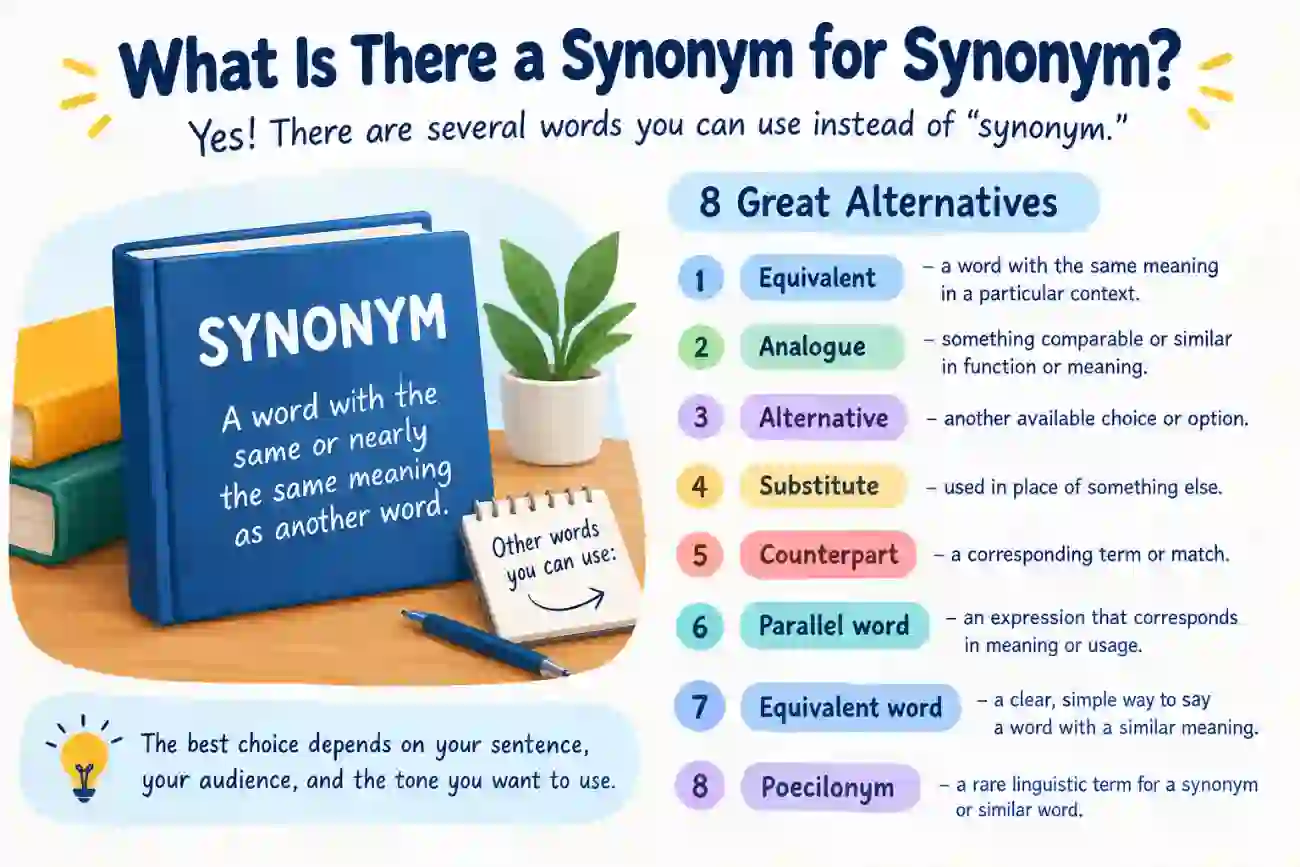

Yes, several words can serve as alternatives to synonyms, including equivalent, analogue, alternative word, substitute, and parallel word. The best choice depends on the sentence and its meaning. In everyday writing, “equivalent word” is a clear option, while “analogue” works better when describing something similar or comparable.
Key Takeaways
- Equivalent is one of the clearest alternatives to synonyms.
- Analogue describes something comparable in meaning, function, or structure.
- Alternative word and substitute work in many everyday writing situations.
- A thesaurus is a reference tool that helps you find synonyms; it is not itself a synonym for a word in the linguistic sense.
- Always check the context before replacing one word with another.
What Is Another Word for Synonyms?
If you are wondering, “What is a synonym for synonyms?” The short answer is yes. English has several words and phrases that express a similar idea.
A synonym is a word or phrase that has the same or nearly the same meaning as another word or phrase. For example, happy and joyful are synonyms because they express similar feelings.
You can also describe a synonym as an equivalent word, an alternative expression, or a word with a similar meaning. However, these expressions do not always work interchangeably.
For example, “equivalent” suggests that two things have the same value or meaning in a particular context. “Analogue” usually describes something comparable, while “substitute” emphasizes replacing one thing with another.
The right choice depends on whether you are writing an essay, preparing a report, improving your vocabulary, or simply trying to avoid repeating the same word.
8 Words You Can Use Instead of Synonym
Here are eight alternatives to consider, along with their meanings and examples.
1. Equivalent
Equivalent is one of the most useful alternatives when you want to describe a word or expression with the same meaning as another.
It works well in academic writing, professional communication, and everyday conversation.
Example: “Joyful” is an equivalent of “happy” in many sentences.
You can also use the phrase “equivalent word” when explaining vocabulary to students or readers. It is clear, familiar, and easy to understand.
2. Analogue
An analogue is something comparable to another thing in certain ways. In American English, analog is also common, particularly in technical contexts.
This word is useful when two words have related meanings but do not match perfectly.
Example: “A close analogue of ‘begin’ is ‘start.’”
Remember that an analogue does not always have exactly the same meaning as another word. The comparison may involve function, structure, or a particular aspect of meaning.
3. Alternative
Alternative refers to another available choice or option. When you describe a word as an alternative, you suggest that a writer can use it instead of the original.
Example: “‘Glad’ is an alternative to ‘happy’ in many contexts.”
This word is especially useful when editing an article, improving a sentence, or choosing vocabulary for different audiences.
However, an alternative does not automatically qualify as a true synonym. The replacement must still fit the original sentence.
4. Substitute
A substitute is something used in place of another thing. When discussing language, it can describe a word that replaces another word in a sentence.
Example: “‘Assist’ can serve as a substitute for ‘help’ in formal writing.”
This term emphasizes replacement rather than a direct relationship between two words’ meanings.
For instance, you might substitute “purchase” for “buy” in a formal document. Both words can communicate the same basic action, although their tone differs.
5. Counterpart
A counterpart is a person or thing that corresponds to another in a particular role, position, or function.
It is not a direct synonym for every word, but it can work when you are comparing corresponding terms.
Example: “The English term has a French counterpart with a similar meaning.”
Use this word when discussing related expressions across languages, different versions of a document, or matching terminology in separate systems.
6. Parallel Word
A parallel word is an expression used to describe a word that corresponds to or resembles another word in meaning or usage.
Example: “‘Begin’ and ‘start’ are parallel words in many everyday sentences.”
This phrase may help explain similar vocabulary, but it is less common and less precise than “synonym” or “equivalent word.”
For most readers, “similar word” or “equivalent” will sound more natural.
7. Equivalent Word
Equivalent word is a clear, reader-friendly phrase for explaining the meaning of a synonym.
It works particularly well in educational materials, vocabulary guides, and beginner-friendly writing.
Example: “The word ‘rapid’ is an equivalent word for ‘fast’ in some contexts.”
Although the phrase is understandable, it can sound repetitive if you use it too often. In polished writing, consider “synonym,” “similar word,” or “alternative expression” instead.
8. Poecilonym
Poecilonym is a rare linguistic term associated with a synonym or a word that has a similar meaning to another word.
Example: “A specialist vocabulary reference may list a pseudonym for a particular term.”
This word may interest linguistics students, language enthusiasts, or readers exploring unusual vocabulary.
However, most people do not need it in everyday writing. If your goal is to communicate clearly, “synonym” or “equivalent word” is a much better choice.
Which Synonym for Synonym Works Best?
The best alternative depends on your purpose, audience, and sentence.
Use this comparison table to select a suitable expression.
| Word or phrase | Best use | Example |
| Equivalent | Similar or matching meaning | An equivalent term |
| Analogue | Something comparable | An analogue of the original |
| Alternative word | Another vocabulary choice | Choose an alternative word |
| Substitute | Replacement | A substitute for the original term |
| Counterpart | A corresponding term | Its English counterpart |
| Similar word | Simple explanation | A similar word for “quick” |
| Equivalent word | Educational explanation | An equivalent word for “large” |
| Poecilonym | Specialized vocabulary | A rare term for a synonym |
For most American readers, equivalent, similar word, and alternative word are the most practical options.
If you are writing an academic paper, use “equivalent” when you mean a close match. If you are helping beginners learn vocabulary, “similar word” may be easier to understand.
Avoid choosing a rare word simply to make your writing sound more sophisticated. Clear communication matters more than complicated vocabulary.
Is a Thesaurus Another Word for Synonyms?
No. A thesaurus and a synonym are related, but they mean different things.
A synonym is a word or phrase with the same or nearly the same meaning as another expression. A thesaurus is a reference resource that organizes synonyms and often antonyms or related terms.
For example, small and little are synonyms in many contexts. A thesaurus is a tool you can consult to discover those words.
You can use an online thesaurus, a printed reference book, or a built-in writing tool to explore alternatives.
A thesaurus can help you improve your vocabulary, reduce unnecessary repetition, and discover words that better match your intended tone.
However, it is important to check each suggestion. A reference tool may list related words that do not fit your sentence in the same way.
Synonym vs. Equivalent vs. Antonym
These three terms are related to word meaning, but they describe different concepts.
| Term | Meaning | Example |
| Synonym | A word with the same or similar meaning | Happy / joyful |
| Equivalent | Something equal or corresponding in a particular context | An equivalent expression |
| Antonym | A word with an opposite meaning | Happy / sad |
A synonym focuses on similarity in meaning. An equivalent emphasizes a match or correspondence, while an antonym expresses an opposite meaning.
For example, “quick” and “fast” are synonyms in many sentences. “An equivalent term” describes a word or expression that matches another in a particular situation. “Slow” is an antonym of “fast” in common use.
Understanding these differences helps you select words accurately rather than relying on a list of similar terms alone.
How to Choose the Right Alternative
Finding another word is easy. Choosing one that fits naturally requires a little more care.
Follow these practical tips when selecting an alternative to synonyms or any other word.
1. Check the original meaning. Make sure the replacement expresses the idea you want to communicate.
2. Consider the audience. Use familiar expressions such as “similar word” for general readers. Reserve specialized vocabulary for situations that call for it.
3. Match the tone. “Equivalent” often sounds appropriate in formal writing, while “another word” feels conversational.
4. Read the complete sentence. A word may look suitable in a list but sound awkward when you use it in context.
5. Avoid unnecessary changes. If “synonym” communicates your meaning clearly, there is no need to replace it with a rare or complicated term.
For example, consider this sentence:
Original: “The writer found a synonym for the word ‘important.’”
Clear alternative: “The writer found another word for ‘important.’”
More formal alternative: “The writer found an equivalent term for ‘important.’”
Each version communicates a similar idea, but the tone and precision differ slightly. Choose the version that suits your readers.
Frequently Asked Questions
What is the closest synonym for synonym?
“Equivalent” is one of the closest practical alternatives when you mean a word with the same or nearly the same meaning. “Alternative word” is another clear option. However, the best replacement depends on the sentence because an equivalent may describe a broader relationship than a synonym does.
Is there a more formal word for synonyms?
Yes. “Equivalent” can work well in formal or academic writing when two words express the same idea in a particular context. “Analogue” may suit a comparison between related terms. Still, “synonym” remains the most precise and familiar word when discussing words with similar meanings.
What is the opposite of a synonym?
The opposite of a synonym is an antonym. Antonyms have opposite or contrasting meanings. For example, hot and cold are antonyms, while hot and warm can be synonyms in some contexts, although their meanings are not identical.
Can two words have exactly the same meaning?
Yes, some words can share the same meaning in a specific context. However, many synonyms differ slightly in tone, intensity, or usage. For example, “slim” and “skinny” both describe a thin person, but they can create different impressions. Always consider context before treating two words as interchangeable.
Is “similar word” the same as “synonym”?
The expressions are closely related, but they are not always identical. “Similar word” is a broad, informal phrase that can describe words related in meaning. “Synonym” is the more precise linguistic term for a word or expression with the same or nearly the same meaning as another.
How can I find another word for a word?
Use a reliable dictionary or thesaurus to explore possible alternatives. Read the definitions and example sentences before choosing a replacement. You can also compare words in context to check their tone and meaning. This approach helps you find vocabulary that improves clarity without changing your intended message.
Conclusion
So, what is a synonym for synonyms? Several alternatives exist, including equivalent, analogue, alternative word, substitute, and similar word.
For everyday writing, “another word” or “similar word” offers a simple explanation. For formal contexts, “equivalent” may be more appropriate, while “analogue” works when describing something comparable.
Ultimately, the best word is the one that fits your meaning and sounds natural in your sentence. Use synonyms to improve clarity, not simply to make your writing more complicated.