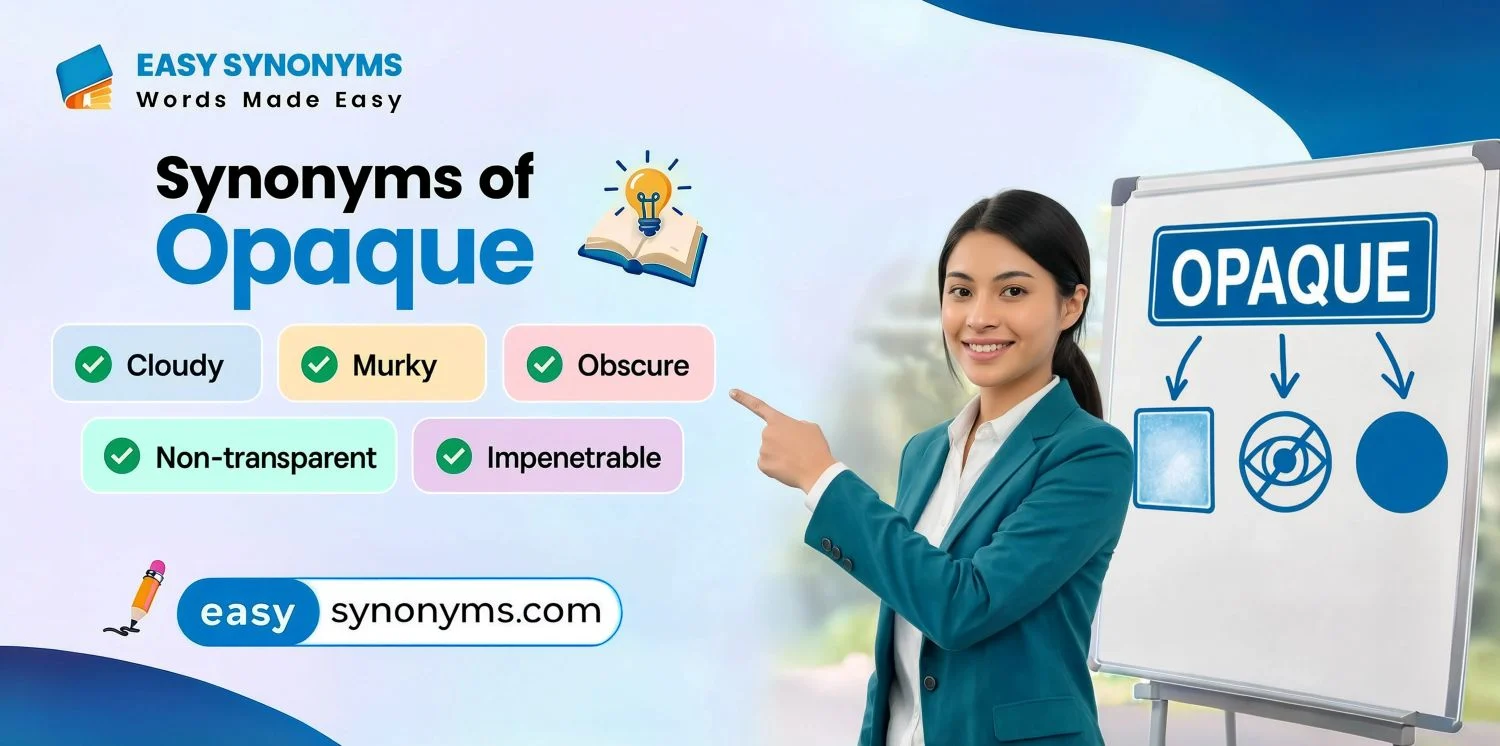

The word opaque has two important meanings, so the best synonym depends heavily on context. When describing a physical object, opaque means that light cannot pass through it, as in opaque glass.
When describing language, an explanation, or an idea, it means difficult to understand or interpret. Cambridge and Collins both recognize these two central uses.
Quick Answer
The closest synonyms of opaque depend on what you mean. For something that cannot be seen through, useful alternatives include nontransparent, cloudy, murky, muddy, and turbid. For something difficult to understand, consider unclear, obscure, ambiguous, cryptic, enigmatic, incomprehensible, or unintelligible. These words overlap with opaque, but they are not interchangeable in every sentence.
Best Synonyms of Opaque at a Glance
| Word | Relationship | Meaning | Best Context |
|---|---|---|---|
| nontransparent | Direct synonym | Not allowing light or sight through | Glass, materials |
| cloudy | Contextual synonym | Visually unclear or obscured | Glass, liquids, skies |
| murky | Near synonym | Dark, cloudy, or difficult to see through | Water, atmosphere, figurative situations |
| muddy | Contextual synonym | Clouded by particles or lacking clarity | Water, colors, explanations |
| turbid | Contextual synonym | Cloudy because of suspended particles | Water, scientific writing |
| unclear | Near synonym | Difficult to understand | Instructions, statements |
| obscure | Near synonym | Difficult to understand, see, or recognize | Ideas, meanings, references |
| ambiguous | Near synonym | Open to more than one interpretation | Statements, language |
| cryptic | Contextual synonym | Mysteriously or deliberately difficult to understand | Messages, remarks, clues |
| enigmatic | Near synonym | Mysterious and difficult to interpret | People, behavior, statements |
| incomprehensible | Stronger alternative | Impossible or extremely difficult to understand | Speech, writing, ideas |
| unintelligible | Contextual synonym | Impossible to understand clearly | Speech, writing, sounds |
| vague | Near synonym | Lacking precise detail | Answers, descriptions, plans |
| hazy | Near synonym | Unclear or indistinct | Memories, ideas, views |
The important point is that these are not one-for-one replacements. Some describe physical appearance, while others describe meaning or communication.
What Does Opaque Mean?
Opaque is an adjective pronounced /oʊˈpeɪk/ in American English and /əʊˈpeɪk/ in British English.
It has two common meanings.
1. Opaque means not transparent
An opaque material does not allow light to pass through clearly. You cannot see through it.
- opaque glass
- opaque plastic
- opaque paint
- an opaque window
For example:
The bathroom window is made of opaque glass for privacy.
In this sense, nontransparent is the closest straightforward replacement. Words such as cloudy, murky, and turbid can work in particular contexts, but they often add a specific visual quality that opaque does not necessarily express.
2. Opaque means difficult to understand
The figurative meaning describes something whose meaning, process, or purpose is difficult to understand or determine.
- opaque language
- an opaque explanation
- an opaque process
- an opaque decision
- an opaque organization
For example:
The company’s pricing structure remains opaque to customers.
Here, unclear, obscure, or difficult to understand may be more natural depending on the intended nuance.
Cambridge specifically describes opaque writing or speech as difficult to understand, while its Business English definition extends the idea to things that are difficult to understand or know about because they are secretive or complicated.
Synonyms of Opaque for Physical Objects
When opaque describes a material or substance, choose a synonym according to the particular visual quality you want to emphasize.
Nontransparent
Nontransparent is the most direct alternative when the essential meaning is simply “not transparent.”
The laboratory uses nontransparent containers to protect the samples from light.
Unlike murky or cloudy, it does not necessarily suggest dirtiness, haze, or an unusual appearance.
Best for: technical, scientific, and straightforward descriptions.
Cloudy
Cloudy describes something that is visually obscured, hazy, or not clear.
The glass became cloudy after years of exposure to moisture.
It can overlap with opaque, but cloudy glass may still allow some light through. Therefore, it is not always an exact substitute.
Best for: glass, liquids, skies, and surfaces.
Murky
Murky suggests something dark, dirty, cloudy, or difficult to see through.
The river water was murky after the storm.
It is more descriptive than opaque and often carries a negative or unclean connotation.
Best for: water, dark environments, and figurative situations involving uncertainty.
Muddy
Muddy can describe water or another substance that has become clouded with dirt or sediment.
Heavy rain left the pond muddy and opaque.
It is not a universal synonym for opaque because muddy usually suggests the presence of dirt, sediment, or a similarly clouding substance.
Turbid
Turbid is a more technical term meaning cloudy or opaque because particles are suspended in a liquid.
Scientists measured the turbidity of the turbid water.
Best for: scientific, environmental, and technical writing.
Collins lists cloudy, clouded, muddy, murky, hazy, filmy, and turbid among alternatives associated with the physical sense of opaque.
Synonyms of Opaque for Ideas and Communication
The figurative sense has a much richer synonym set.
Unclear
Unclear is one of the safest alternatives when opaque means difficult to understand.
The instructions were unclear.
Unlike opaque, unclear is extremely broad and can describe anything that lacks sufficient clarity.
Choose “unclear” when: you want plain, direct English.
Obscure
Obscure means difficult to understand, see, recognize, or know.
The report contains several obscure references.
It is particularly useful when something is difficult to understand because it is unfamiliar, hidden, or not expressed clearly.
Opaque vs. obscure: Opaque often emphasizes a lack of transparency or accessibility, while obscure can emphasize that something is difficult to perceive, understand, or identify.
Ambiguous
Ambiguous means that something can reasonably have more than one interpretation.
The manager’s ambiguous response left everyone uncertain.
This is an important distinction: something can be ambiguous without being opaque. Ambiguity specifically involves multiple possible interpretations.
Cryptic
It describes language or a message that is mysterious, puzzling, or deliberately difficult to understand.
He sent me a cryptic message about the meeting.
Cryptic is stronger and more stylistically marked than unclear.
Use it when the wording seems like a puzzle or contains a hidden meaning.
Enigmatic
Enigmatic describes something mysterious or difficult to interpret.
Her enigmatic smile gave nothing away.
It often works especially well for people, behavior, expressions, events, and statements.
It usually has a more literary or sophisticated tone than unclear.
Incomprehensible
Incomprehensible is stronger than opaque. It suggests that something cannot be understood, or is extremely difficult to understand.
The technical explanation was incomprehensible to most readers.
Use this when you want to emphasize the severity of the problem.
Unintelligible
Unintelligible means impossible or extremely difficult to understand, particularly because speech, writing, or sounds cannot be made out clearly.
The recording was so distorted that the speaker’s words were unintelligible.
It is therefore especially useful for speech, audio, handwriting, or text that cannot be deciphered.
Vague
It describes something that lacks precise information or detail.
His answer was vague and unhelpful.
Vague and opaque overlap, but they are not identical. A statement can be vague because it lacks detail, whereas an opaque statement may contain plenty of detail but still be difficult to understand.
Hazy
Hazy means unclear or indistinct.
I have only a hazy understanding of how the system works.
It is common in both literal and figurative language, especially with memories, ideas, perceptions, and explanations.
Which Word Should You Use?
Choosing the right synonym is easier when you focus on why something is opaque.
Choose “nontransparent” when:
You are describing a physical material that does not transmit light.
The container is nontransparent.
Choose “cloudy” when:
Something looks visually unclear or hazy.
The glass has become cloudy.
Choose “murky” when:
Something is dark, dirty, or difficult to see through.
The water was murky.
Choose “turbid” when:
You are writing technically about suspended particles in a liquid.
The sample was highly turbid.
Choose “unclear” when:
You simply mean that an explanation or statement is difficult to understand.
The instructions were unclear.
Choose “obscure” when:
Something is difficult to understand, recognize, or access.
The article makes an obscure reference to an ancient text.
Choose “ambiguous” when:
There are two or more plausible interpretations.
The wording is ambiguous.
Choose “cryptic” when:
The message is mysterious or puzzle-like.
Her cryptic reply confused me.
Choose “enigmatic” when:
Something is mysterious and difficult to interpret.
His motives remained enigmatic.
Choose “incomprehensible” when:
Something is extremely difficult or impossible to understand.
The explanation was incomprehensible.
Opaque vs. Obscure
These words overlap strongly when describing ideas or language, but they are not identical.
| Word | Main idea | Example |
| Opaque | Difficult to understand or access | The company’s decision-making process is opaque. |
| Obscure | Difficult to understand, recognize, or know | The text contains an obscure reference. |
Opaque often suggests that the meaning or process is not readily accessible. Obscure has a wider range of meanings and can also describe something little-known or hidden.
Opaque vs. Ambiguous
Opaque means difficult to understand.
Ambiguous means capable of being interpreted in more than one way.
The explanation was opaque.
This means the explanation was difficult to understand.
The explanation was ambiguous.
This means the explanation could reasonably mean different things.
An explanation can be both opaque and ambiguous, but the words identify different problems.
Opaque vs. Unclear
Unclear is broader and more conversational.
The instructions are unclear.
Opaque is more formal and often suggests that the underlying meaning, process, or reasoning is not readily accessible.
The organization’s decision-making process is opaque.
For everyday communication, unclear is usually the simpler choice. For formal writing about systems, institutions, policies, or complex ideas, opaque can be more precise.
Opaque vs. Cryptic
Cryptic suggests mystery or deliberately puzzling language.
He gave me a cryptic answer.
Opaque does not necessarily imply that the speaker intended to be mysterious.
The report uses opaque language.
The report may simply be difficult to understand because of complexity, technical language, poor explanation, or lack of transparency.
Common Mistakes With Opaque Synonyms
1. Treating every thesaurus entry as a perfect synonym
Large thesaurus lists contain related words, contextual alternatives, and words associated with particular senses. Merriam-Webster, for example, separates several meanings and provides different groups of related words.
Words such as ambiguous, cryptic, obscure, murky, and vague should therefore not automatically be treated as interchangeable.
2. Using “murky” for every figurative use
❌ The legal contract is murky.
This may work if the contract is unclear, but opaque, unclear, or ambiguous may communicate the intended meaning more precisely.
3. Using “ambiguous” when there is only one unclear meaning
If a sentence is simply difficult to understand, ambiguous may be inaccurate. Ambiguity specifically involves multiple possible interpretations.
4. Using “turbid” outside appropriate contexts
Turbid is strongly associated with liquids and suspended particles. It is not a general replacement for opaque in ordinary figurative writing.
5. Assuming “opaque” always means “dark”
An opaque object does not necessarily have to be dark. Its defining property is that it does not allow light to pass through in the relevant sense. Cambridge defines it in terms of preventing light from traveling through and distinguishes it from translucency.
Antonyms of Opaque
The best antonym depends on the sense.
For physical materials:
- transparent
- translucent
- clear
- see-through
For ideas and communication:
- clear
- explicit
- understandable
- intelligible
- straightforward
- transparent
The strongest general contrast in figurative contexts is often transparent, particularly when discussing processes, organizations, information, or decision-making.
Pronunciation and Word Origin
Opaque
- US: /oʊˈpeɪk/
- UK: /əʊˈpeɪk/
The word ultimately comes from Latin opacus, meaning “shady” or related to shade. Collins traces the English word through Middle English and Latin opacus.
Frequently Asked Questions
What is the closest synonym for opaque?
There is no single synonym that works in every context. Nontransparent is a close choice for physical objects, while unclear, obscure, or incomprehensible may work for ideas and language.
What is another word for opaque glass?
Nontransparent is the most direct alternative. Depending on its appearance, cloudy, frosted, or translucent may describe particular types of glass, but these words are not exact substitutes in every situation.
What is a synonym for opaque in writing?
Useful alternatives include unclear, obscure, cryptic, enigmatic, and incomprehensible. The best choice depends on why the writing is difficult to understand.
Is “unclear” a synonym for opaque?
Yes, when opaque means difficult to understand. However, unclear is broader and more ordinary, while opaque often has a more formal tone and can suggest a lack of transparency.
Is “ambiguous” the same as “opaque”?
No. Ambiguous means that something has multiple possible interpretations, whereas opaque means that something is difficult to understand or interpret. They can overlap, but they identify different problems.
Is “obscure” a synonym for opaque?
Often, yes, particularly when opaque means difficult to understand. However, obscure also means little-known, hidden, or difficult to perceive, so it has a broader range of uses.
What is the opposite of opaque?
For physical objects, common opposites are transparent and clear. For language or processes, clear, explicit, understandable, and transparent can be appropriate opposites.
Conclusion
The best synonym for opaque depends on what is being described. For physical materials, nontransparent, cloudy, murky, muddy, and turbid can be useful in the right contexts. For ideas and communication, unclear, obscure, ambiguous, cryptic, enigmatic, incomprehensible, and unintelligible provide different shades of meaning.
The key is not to replace opaque mechanically. Choose the word that identifies why something is difficult to see through or understand. That small distinction makes your writing more precise and natural.