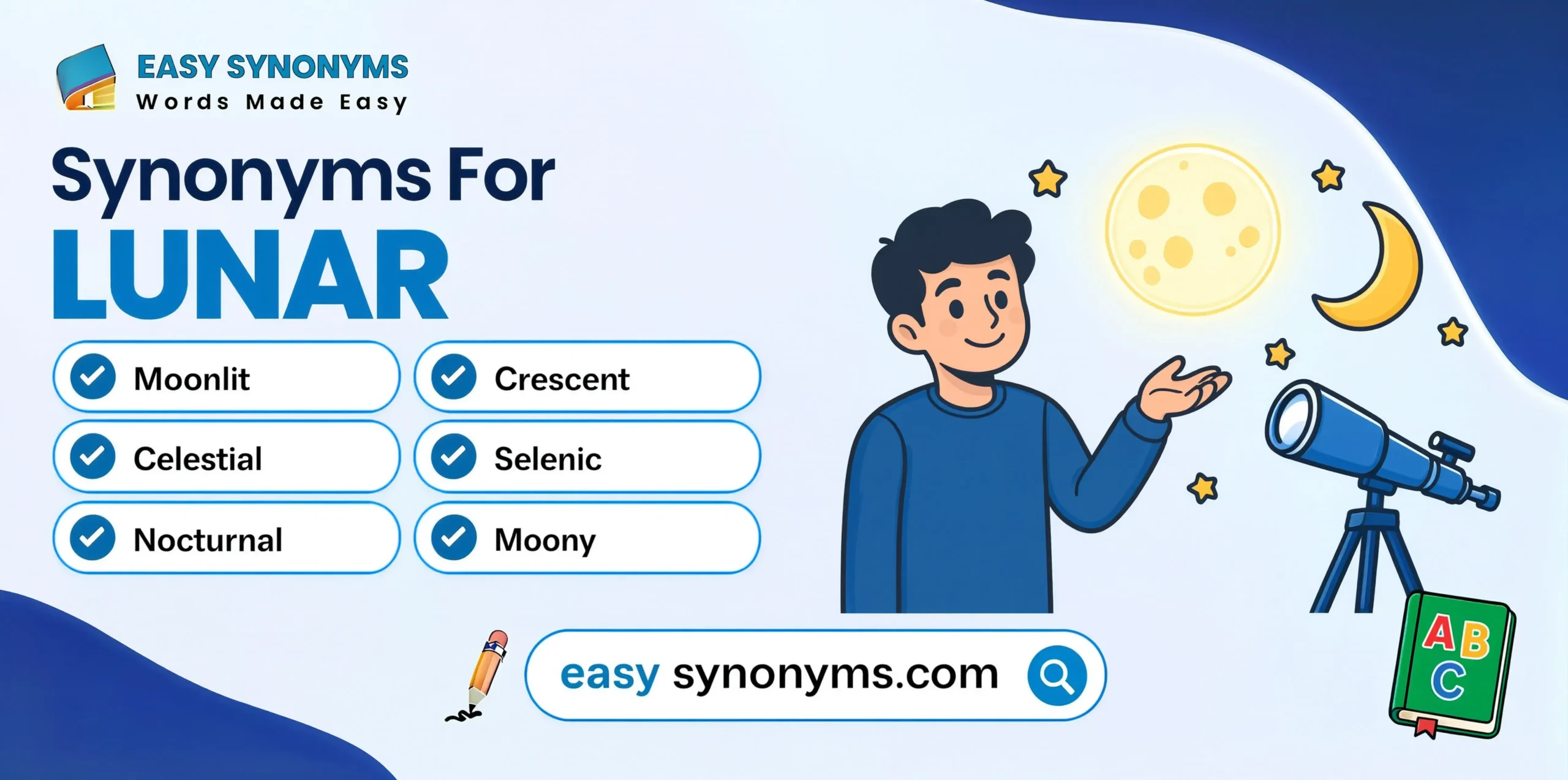

The word lunar means relating to the Moon. It is commonly used in astronomy, science, calendars, and descriptive writing. Depending on the context, useful alternatives include moon-related, moon-based, moonlike, selenic, Selenean, and moon-associated.
However, these alternatives do not always have exactly the same meaning. Lunar is usually the clearest and most natural adjective for something connected with the Moon.
Quick Answer: Synonyms of Lunar
Common synonyms and related alternatives for lunar include:
| Synonym | Best Used For | Meaning |
|---|---|---|
| Moon-related | General writing | Connected with the Moon |
| Moon-based | Calendars and systems | Based on the Moon or its cycles |
| Moonlike | Appearance | Resembling the Moon |
| Selenic | Scientific or literary writing | Relating to the Moon |
| Selenean | Specialized or literary writing | Associated with Selene or the Moon |
| Moon-associated | General descriptions | Connected or linked to the Moon |
| Satellite-related | Astronomy | Connected with a natural satellite |
| Lunary | Rare or literary writing | Related to the Moon |
| Crescent | Shape and appearance | Having a curved Moon-like shape |
| Celestial | Astronomy | Related to the sky or outer space |
Note: Not every word in this list is a direct synonym. Some are related terms or context-specific alternatives.
What Does Lunar Mean?
Lunar is an adjective meaning related to the Moon.
The word comes from the Latin word luna, meaning “moon.”
You will often see lunar in phrases such as:
- lunar eclipse
- lunar surface
- lunar cycle
- lunar calendar
- lunar mission
- lunar orbit
- lunar phase
- lunar landscape
- lunar month
- lunar exploration
For example:
Scientists studied the lunar surface.
This means they studied the surface of the Moon.
The word can also be used descriptively:
The landscape looked almost lunar.
In this sentence, lunar suggests that the landscape looked similar to the Moon or its surface.
1. Moon-Related
Moon-related is the simplest plain-English alternative to lunar.
It describes something connected with the Moon.
Examples:
- Scientists are studying several moon-related phenomena.
- The museum has an exhibit about moon-related discoveries.
- The article covers several moon-related events.
This phrase works especially well when writing for a general audience.
Lunar vs. Moon-Related
Consider these examples:
The mission collected lunar samples.
The mission collected moon-related samples.
The first sentence is more precise. Lunar samples usually means samples from the Moon.
The second sentence is broader. It could describe samples connected with Moon research without necessarily coming from the Moon.
2. Moon-Based
Moon-based describes something that depends on the Moon or its cycles.
It works particularly well when discussing calendars, systems, measurements, or timing.
Examples:
- Some traditional calendars are moon-based.
- The culture follows a moon-based calendar.
- Researchers examined a moon-based timing system.
Still, moon-based cannot replace lunar in every phrase.
For example, lunar calendar is a standard expression, while moon-based calendar is a more descriptive alternative.
3. Moonlike
Moonlike means resembling the Moon.
It can describe appearance, shape, color, light, or atmosphere.
Examples:
- The landscape had a moonlike appearance.
- The pale rock looked almost moonlike.
- A soft, moonlike glow filled the room.
This word is different from lunar.
Lunar means related to the Moon.
Moonlike means similar to the Moon.
For example:
The spacecraft entered lunar orbit.
Here, the spacecraft is connected directly with the Moon.
The desert had a moonlike appearance.
Here, the desert simply resembled the Moon.
4. Selenic
Selenic is a rare and specialized adjective meaning relating to the Moon.
It comes from Selene, the Greek goddess associated with the Moon.
The term may appear in scientific, historical, or literary contexts.
Examples:
- The research paper discusses selenic geology.
- The writer uses selenic imagery throughout the poem.
- The study examines the selenic environment.
For general readers, lunar is usually more familiar.
5. Selenean
Selenean is another uncommon adjective associated with Selene and the Moon.
It is more likely to appear in specialized or literary writing than in everyday English.
Examples:
- The poem contains Selenean imagery.
- The author created a Selenean landscape.
- The story uses Selenean symbolism.
If clarity is the main goal, lunar or moon-related is usually a better choice.
6. Moon-Associated
Moon-associated means connected or linked with the Moon.
This phrase can be useful when the relationship is broad rather than direct.
Examples:
- The culture has several moon-associated traditions.
- Researchers identified moon-associated changes.
- The study examines moon-associated phenomena.
It is a descriptive phrase rather than a direct replacement for lunar.
7. Satellite-Related
Satellite-related can sometimes work in astronomical contexts.
However, it has a broader meaning than lunar. A satellite can refer to the Moon or to an artificial object orbiting another body.
Examples:
- Researchers collected satellite-related data.
- The project involves satellite-related technology.
- Scientists analyzed satellite-related measurements.
Use this word carefully because it does not specifically identify the Moon.
8. Lunary
Lunary is a rare or literary adjective meaning related to the Moon.
It may appear in poetic or historical writing.
Examples:
- The painting has a distinctive lunary atmosphere.
- The writer used lunary imagery in the poem.
Because lunary is uncommon, lunar is usually the clearer choice for general writing.
9. Crescent
Crescent is not a direct synonym for lunar. It is a related word that describes a curved shape associated with certain phases of the Moon.
Examples:
- A crescent Moon appeared above the hills.
- The artist painted a thin crescent shape.
- A crescent of light appeared in the night sky.
Use crescent only when the specific idea involves shape or appearance.
10. Celestial
Celestial means relating to the sky or outer space, especially astronomical objects.
It is broader than lunar.
For example:
The Moon is a celestial body.
But:
The spacecraft studied lunar rocks.
The first sentence refers broadly to astronomy. The second specifically refers to the Moon.
Therefore, celestial is a related term rather than an exact synonym.
Lunar Synonyms by Context
The best alternative depends on how you are using lunar.
Lunar in Astronomy
For scientific and astronomical writing, useful terms include:
- lunar
- moon-related
- selenic
- Selenean
Example:
The spacecraft entered lunar orbit.
A plain-English version would be:
The spacecraft entered orbit around the Moon.
For technical writing, lunar is usually the most concise choice.
Lunar in Calendars
When discussing calendars based on Moon cycles, you can use:
- lunar
- moon-based
- Moon-related
Examples:
The community follows a lunar calendar.
The community follows a moon-based calendar.
Both sentences communicate a similar idea, although lunar calendar is the established term.
Lunar in Descriptive Writing
When something resembles the Moon, consider:
- moonlike
- silvery
- pale
- celestial
- otherworldly
Example:
The desert had a lunar appearance.
You could also write:
The desert had a moonlike appearance.
The second version makes the comparison more obvious.
Lunar vs. Moon
Lunar is an adjective, while Moon is primarily a noun.
Compare:
The lunar surface is covered with craters.
The surface of the Moon is covered with craters.
Both sentences are natural.
The first uses the adjective lunar. The second uses Moon as the object of the preposition.
In scientific and technical writing, lunar surface is a common and concise phrase.
Lunar vs. Moonlike
These words are often confused.
Lunar means relating to the Moon.
Moonlike means resembling the Moon.
For example:
Scientists analyzed lunar rocks.
The rocks are connected directly with the Moon.
The landscape looked moonlike.
The landscape resembled the Moon.
This distinction is important because the two words describe different relationships.
Lunar vs. Nocturnal
Nocturnal means relating to nighttime or occurring at night.
It is not a direct synonym for lunar.
For example:
The lunar eclipse was visible after sunset.
Nocturnal animals became active after sunset.
The first sentence concerns the Moon. The second concerns nighttime activity.
Something can be nocturnal without having any connection to the Moon.
Lunar vs. Celestial
Both words are common in astronomy, but they have different ranges.
Lunar specifically relates to the Moon.
Celestial refers more broadly to objects or phenomena in the sky or outer space.
Examples include:
- lunar surface
- lunar eclipse
- celestial body
- celestial object
- celestial event
A lunar event can be celestial, but not every celestial event is lunar.
Lunar vs. Solar
Lunar means related to the Moon.
Solar means related to the Sun.
These words often appear together when discussing astronomy.
Examples:
- lunar eclipse
- solar eclipse
- lunar cycle
- solar energy
- lunar mission
- solar system
Knowing the difference prevents confusion in scientific writing.
Common Collocations With Lunar
Learning common word combinations can make your English sound more natural.
Astronomy
- lunar eclipse
- lunar surface
- lunar orbit
- lunar rocks
- lunar samples
- lunar crater
- lunar landscape
- lunar environment
- lunar phase
- lunar cycle
Space Exploration
- lunar mission
- lunar landing
- lunar exploration
- lunar spacecraft
- lunar base
- lunar habitat
- lunar research
- lunar technology
Time and Calendars
- lunar calendar
- lunar month
- lunar year
- lunar cycle
- lunar phase
- lunar phases
Example Sentences With Lunar Synonyms
Here are natural examples showing how these alternatives work:
- Scientists studied the lunar surface.
- The mission collected Moon-related data.
- The community follows a moon-based calendar.
- The landscape had a moonlike appearance.
- The researcher examined selenic geological features.
- The poem contains Selenean imagery.
- The tradition has several moon-associated rituals.
- The project uses satellite-related technology.
- The painting has a rare lunary quality.
- A crescent Moon appeared over the mountains.
- The event was connected with a celestial phenomenon.
Formal and Informal Alternatives to Lunar
Because lunar is already a concise and widely accepted word, most alternatives are not necessarily simpler.
| Style | Alternative |
|---|---|
| Standard | lunar |
| Plain English | moon-related |
| Descriptive | related to the Moon |
| Appearance | moonlike |
| Scientific / rare | selenic |
| Literary / rare | Selenean |
| Rare / literary | lunary |
| Broad astronomical | celestial |
| Night-related | nocturnal |
For professional or scientific writing, lunar is generally the clearest option.
Common Mistakes With Lunar
1. Treating moonlike as an exact synonym
Moonlike means resembling the Moon. It does not necessarily mean directly connected with the Moon.
The rock has a moonlike appearance.
This means the rock looks similar to the Moon.
2. Using nocturnal as a synonym
Nocturnal refers to nighttime. It does not specifically refer to the Moon.
3. Using celestial when you mean lunar
Celestial is a broader word.
A lunar object is associated with the Moon. A celestial object can be a planet, star, asteroid, Moon, or another object in space.
4. Replacing established terms unnecessarily
Phrases such as lunar eclipse, lunar calendar, and lunar surface are standard English expressions.
Replacing them with unusual alternatives can reduce clarity.
5. Confusing lunar with other astronomy terms
Several astronomy words describe different things.
Lunar relates to the Moon. Solar relates to the Sun. Celestial refers more broadly to the sky or outer space.
Choosing the precise term makes your writing clearer.
Words Related to Lunar
These related words can help expand your vocabulary:
- Moon
- moonlight
- moonbeam
- moonrise
- moonset
- crescent
- full moon
- new moon
- eclipse
- orbit
- crater
- satellite
- astronomy
- celestial
- cosmic
- planetary
- solar
- nocturnal
- extraterrestrial
- space
FAQ About Synonyms of Lunar
What is the best synonym for lunar?
The simplest alternative is moon-related. Still, lunar is usually the most natural and precise choice, especially in scientific writing.
What is another word for lunar?
Another word for lunar is moon-related. Depending on the context, you can also use moon-based, moonlike, selenic, or Selenean.
What is a simple synonym for lunar?
Moon-related is the simplest plain-English alternative.
Is moonlike a synonym for lunar?
Not exactly. Moonlike means resembling the Moon, while lunar means relating to the Moon.
Is celestial a synonym for lunar?
No, not exactly. Celestial is broader and refers to things connected with the sky or outer space.
Is nocturnal a synonym for lunar?
No. Nocturnal means related to nighttime, while lunar means related to the Moon.
What is the opposite of lunar?
There is no single direct antonym for lunar. In astronomy, solar can provide a useful contrast because it relates to the Sun.
What does lunar mean in simple words?
Lunar means “related to the Moon.”
What is the difference between lunar and solar?
Lunar relates to the Moon, while solar relates to the Sun.
Conclusion
The word lunar means relating to the Moon. It is widely used in astronomy, science, calendars, and descriptive writing.
The simplest alternative is moon-related, while moon-based can describe systems that depend on the Moon or its cycles. When something resembles the Moon, moonlike is more accurate.
Specialized words such as selenic, Selenean, and lunary may appear in scientific or literary contexts. Meanwhile, celestial and nocturnal are related terms but are not exact synonyms.
For most situations, lunar remains the clearest and most precise choice. The right alternative depends on whether you mean a direct connection with the Moon, a resemblance to it, or a broader astronomical association.