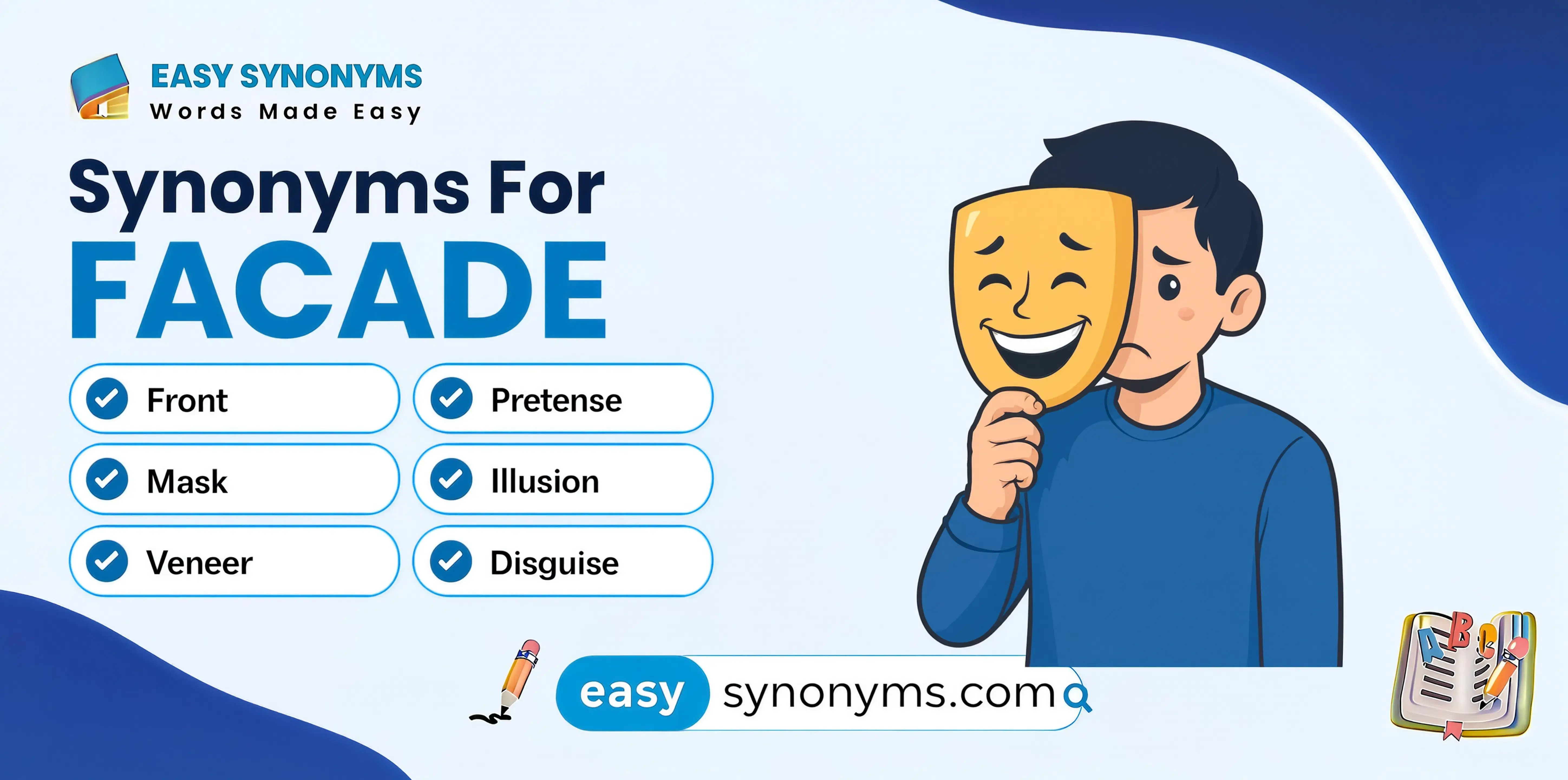

The word facade can describe the front of a building, but it can also describe a false appearance that hides someone’s real feelings, intentions, or situation. Because of these different meanings, the best synonym depends on the context.
Common synonyms of facade include front, exterior, appearance, surface, mask, disguise, pretense, veneer, cover, and false front. Some words work best for buildings, while others describe a person’s behavior or a misleading appearance.
Quick Answer: Synonyms of Facade
Here are some useful alternatives to facade:
| Synonym | Best Used For | Meaning |
|---|---|---|
| front | Buildings or people | The outward part or appearance |
| exterior | Buildings and objects | The outside surface |
| appearance | General contexts | How something looks from the outside |
| surface | Ideas, situations, feelings | The visible or obvious part |
| mask | Emotions or behavior | Something that hides the truth |
| disguise | People or identities | An altered appearance that hides identity |
| pretense | Behavior or claims | A false appearance or claim |
| veneer | People, organizations, ideas | A thin layer hiding what is underneath |
| cover | Secrets or problems | Something used to conceal the truth |
| false front | People or organizations | A misleading outward image |
| guise | Behavior or identity | An outward appearance used to conceal something |
| semblance | Formal contexts | An appearance of something that may not be real |
What Does Facade Mean?
Facade has two main meanings.
In architecture, a facade is the front or outward face of a building. For example, you might describe the glass facade of a modern office building.
The word also has a figurative meaning. In this sense, a facade is an outward appearance that hides the true nature of something.
For example:
She maintained a calm facade even though she was worried.
Here, facade does not refer to a building. It means the calm appearance she showed to other people.
The word is often associated with something that looks different on the outside from what exists underneath.
1. Front
Front is one of the simplest synonyms for facade when talking about buildings.
It refers to the side or part of a building that faces outward or toward a particular direction.
Examples:
- The front of the building was recently renovated.
- Workers cleaned the front of the historic theater.
- The house has an impressive stone front.
However, front can also have a figurative meaning. It may describe an outward appearance that hides something else.
Example:
- His friendly attitude was only a front.
In this sentence, front means a false appearance rather than a physical part of a building.
2. Exterior
Exterior refers to the outside of a building, object, or structure.
It is a strong alternative to facade in architectural and descriptive writing.
Examples:
- The exterior of the hotel combines glass and stone.
- The building has a modern exterior.
- The exterior was restored without changing the original design.
There is an important difference, though. Facade often refers specifically to the front face of a building, while exterior can describe the entire outside.
3. Appearance
Appearance is a broader synonym for facade.
It describes how someone or something looks from the outside. Unlike facade, it does not necessarily suggest deception.
Examples:
- His confident appearance hid his nervousness.
- The company has a professional appearance.
- The house has a simple appearance from the outside.
Use appearance when you want a neutral word. Use facade when you want to emphasize an outward image that may hide something underneath.
4. Surface
Surface refers to the outer or visible layer of something.
It can be used literally or figuratively.
Examples:
- The surface of the building was covered with stone.
- On the surface, everything seemed fine.
- The disagreement was only a surface problem.
In figurative writing, surface is useful when discussing what people can see compared with what lies underneath.
5. Mask
Mask is a strong figurative synonym for facade.
It describes something that hides a person’s true emotions, personality, intentions, or condition.
Examples:
- Her smile was a mask for her sadness.
- He used humor as a mask for his insecurity.
- Behind his confident mask, he felt uncertain.
The word mask usually suggests concealment more strongly than appearance.
6. Disguise
Disguise refers to an altered appearance or behavior used to hide identity or the truth.
It is especially useful when someone deliberately tries to conceal who they are.
Examples:
- The spy entered the building in disguise.
- His cheerful attitude was a disguise for his frustration.
- The simple design was a disguise for the complex technology inside.
Unlike facade, disguise often suggests deliberate concealment.
7. Pretense
Pretense means an attempt to appear or claim that something is true when it is not.
It is therefore a useful synonym for facade in situations involving false appearances.
Examples:
- His confidence was only a pretense.
- They maintained a pretense of friendship.
- She dropped her pretense of being uninterested.
The word often suggests that the outward image is deliberately maintained.
8. Veneer
Veneer has both a literal and figurative meaning.
Literally, it can mean a thin decorative layer placed over another material. Figuratively, it describes a thin outward layer that hides a different reality underneath.
Examples:
- The furniture has a wooden veneer.
- Beneath the veneer of success, the company was struggling.
- His polite veneer disappeared during the argument.
Veneer is especially effective when you want to contrast an attractive outside with a less attractive reality underneath.
9. Cover
Cover can mean something that hides or protects what is underneath.
In figurative contexts, it can describe something used to conceal a truth, problem, or activity.
Examples:
- The public event served as a cover for the secret meeting.
- His cheerful behavior was a cover for his disappointment.
- The story was used as a cover for what really happened.
This word is more focused on concealment than appearance.
10. False Front
False front is a direct figurative alternative to facade.
It describes an outward image that gives people a misleading impression.
Examples:
- His confidence was a false front.
- The company’s success was partly a false front.
- Behind the false front of stability, serious problems existed.
This expression works especially well when the main idea is deception or misrepresentation.
11. Guise
Guise refers to the outward appearance or form in which someone or something is presented.
It is often used when something is presented as one thing while actually being another.
Examples:
- The proposal was presented under the guise of helping employees.
- He approached them under the guise of friendship.
- The criticism appeared in the guise of helpful advice.
Guise is more formal than front or mask.
12. Semblance
Semblance means an outward appearance or impression of something.
It often appears in formal writing and can suggest that the appearance is incomplete or not entirely genuine.
Examples:
- The agreement restored some semblance of order.
- She maintained a semblance of calm.
- The team tried to preserve a semblance of normality.
This word is useful when the appearance of something exists, even if the reality is different.
Facade Synonyms by Context
The best synonym depends on what facade means in your sentence.
For a Building
Use:
- front
- exterior
- frontage
- outer wall
- face
Example:
The building has a beautiful stone facade.
Possible alternatives:
The building has a beautiful stone front.
The building has a beautiful stone exterior.
For a False Appearance
Use:
- front
- mask
- pretense
- veneer
- false front
- disguise
- guise
- appearance
Example:
Behind his friendly facade was a deeply competitive personality.
Possible alternatives:
Behind his friendly front was a deeply competitive personality.
Behind his friendly veneer was a deeply competitive personality.
His friendly appearance concealed a deeply competitive personality.
Facade vs. Front
Facade and front can both describe the front of a building.
However, facade sounds more architectural and formal. Front is simpler and more common in everyday speech.
Compare:
- The building has a historic facade.
- The building has a historic front.
In figurative writing, both can describe a false appearance.
- His confidence was a front.
- His confidence was a facade.
The second sentence often sounds more polished and emphasizes the contrast between appearance and reality.
Facade vs. Exterior
These words overlap in architecture, but they are not always interchangeable.
A facade usually refers to a particular face of a building, especially its front. An exterior refers more broadly to the outside of a structure.
Example:
The architect redesigned the building’s front facade.
Here, facade is more precise.
By contrast:
The entire exterior was repainted.
In this sentence, exterior refers to the outside as a whole.
Facade vs. Mask
Both words can describe something that hides the truth.
A mask usually focuses on hiding emotions, identity, or personality.
A facade can describe a wider outward image, including a person’s behavior, an organization’s public image, or a situation.
Examples:
- She wore a mask of confidence.
- The company maintained a facade of success.
The two words overlap, but mask often feels more personal and emotional.
Facade vs. Pretense
Pretense emphasizes false behavior or a false claim.
Facade focuses more broadly on the outward appearance.
Compare:
His calm facade hid his fear.
His calm pretense hid his fear.
The first sentence sounds more natural because facade strongly suggests an outer appearance. Pretense works better when someone is deliberately pretending.
Facade vs. Veneer
Both words can describe a thin outward layer that hides what is underneath.
However, veneer strongly suggests a superficial layer.
Example:
Beneath the veneer of politeness, there was resentment.
The phrase emphasizes the contrast between polite behavior and the feelings underneath.
Facade can carry a similar meaning:
Beneath his polite facade, there was resentment.
Both are natural, but veneer can make the idea of superficiality more noticeable.
Common Collocations With Facade
Learning common word combinations can help you use facade naturally.
Architectural Collocations
- building facade
- glass facade
- stone facade
- modern facade
- historic facade
- front facade
- exterior facade
- decorative facade
- brick facade
- facade design
Figurative Collocations
- false facade
- public facade
- calm facade
- friendly facade
- confident facade
- cheerful facade
- professional facade
- facade of success
- facade of normality
- facade of respectability
- maintain a facade
- hide behind a facade
- create a facade
- preserve a facade
- tear down a facade
Formal and Informal Alternatives
Different contexts call for different words.
| Formal | Neutral | More Informal |
|---|---|---|
| exterior | appearance | front |
| veneer | surface | cover |
| semblance | front | mask |
| guise | disguise | act |
| pretense | false appearance | show |
For academic or professional writing, veneer, guise, semblance, exterior, and pretense can work well.
In everyday conversation, front, appearance, mask, and cover are usually easier choices.
Example Sentences With Facade Synonyms
Here are examples showing how these words work naturally:
- The architect preserved the building’s historic facade.
- The building’s stone exterior was carefully restored.
- His relaxed appearance concealed his anxiety.
- She used humor as a mask for her disappointment.
- Their friendly behavior was only a front.
- The politician maintained a facade of unity within the organization.
- The company’s success had a thin veneer of stability.
- His confident attitude was a pretense.
- The suspect entered the building in disguise.
- The meeting was held under the guise of a routine discussion.
- They tried to maintain a semblance of normality.
- The cheerful event served as a cover for the private meeting.
Common Mistakes With Facade
1. Treating every synonym as interchangeable
Not every alternative works in every situation.
For example, exterior works well for a building, while pretense works better for false behavior.
2. Using facade only for buildings
The figurative meaning is extremely common.
You can use facade for:
- emotions
- relationships
- companies
- organizations
- public images
- social behavior
- political or professional appearances
- situations that look different from reality
3. Confusing facade with the whole building
A facade is generally a visible face or exterior surface, especially the front of a building. It does not mean the entire structure.
4. Assuming facade always means deception
The architectural meaning is neutral.
For example:
The museum has a beautiful marble facade.
There is no suggestion of dishonesty here.
The figurative meaning, however, often carries the idea of concealment or a difference between appearance and reality.
Words Related to Facade
If you are building your vocabulary around facade, these related words may also be useful:
- exterior
- interior
- appearance
- surface
- front
- frontage
- structure
- architecture
- design
- mask
- disguise
- pretense
- illusion
- impression
- image
- presentation
- veneer
- semblance
- concealment
- deception
Antonyms of Facade
The opposite of facade depends on which meaning you have in mind.
For the figurative meaning, useful opposites include:
- reality
- truth
- authenticity
- honesty
- openness
- sincerity
- genuineness
- transparency
- substance
For example:
The facade of confidence disappeared when he spoke honestly about his fears.
Here, authenticity and honesty represent ideas that contrast with a false outward appearance.
FAQ About Synonyms of Facade
What is the best synonym for facade?
The best synonym depends on the meaning. Front or exterior works well for a building. For a false appearance, mask, pretense, veneer, false front, and guise can be useful.
What is another word for facade?
Another word for facade is front when referring to a building. In figurative contexts, alternatives include appearance, mask, pretense, veneer, disguise, and false front.
Is facade a synonym for exterior?
They can overlap when discussing buildings. However, facade usually refers to a particular visible face, especially the front, while exterior can refer to the entire outside of a building.
Is facade the same as pretense?
Not exactly. Facade refers to an outward appearance that can hide reality. Pretense specifically emphasizes pretending or presenting something as true when it is not.
What is the opposite of facade?
For the figurative sense, possible opposites include reality, authenticity, honesty, sincerity, and transparency.
Can facade describe a person?
Yes. In figurative English, facade can describe a person’s outward behavior or appearance when it hides their real emotions, intentions, or personality.
Is facade a negative word?
Not always. In architecture, facade is neutral. In figurative use, it often suggests that the outward appearance differs from the underlying reality.
Conclusion
The best synonym of facade depends on the context. For buildings, front and exterior are common choices. When describing a false or misleading appearance, words such as mask, pretense, veneer, disguise, guise, and false front may be more appropriate.
Understanding these differences helps you choose a word that matches your exact meaning. Instead of replacing facade with any random synonym, consider whether you are describing a building, an outward appearance, or something that hides the truth.