
If you need a better word than navigate, the right choice depends on the context. You might be talking about finding a route, controlling a vehicle, moving through a website, or dealing with a difficult situation. Common synonyms include steer, guide, direct, pilot, maneuver, sail, and find your way. However, these words are not interchangeable in every sentence. This guide explains their differences and shows you when each alternative sounds natural.
Quick Answer
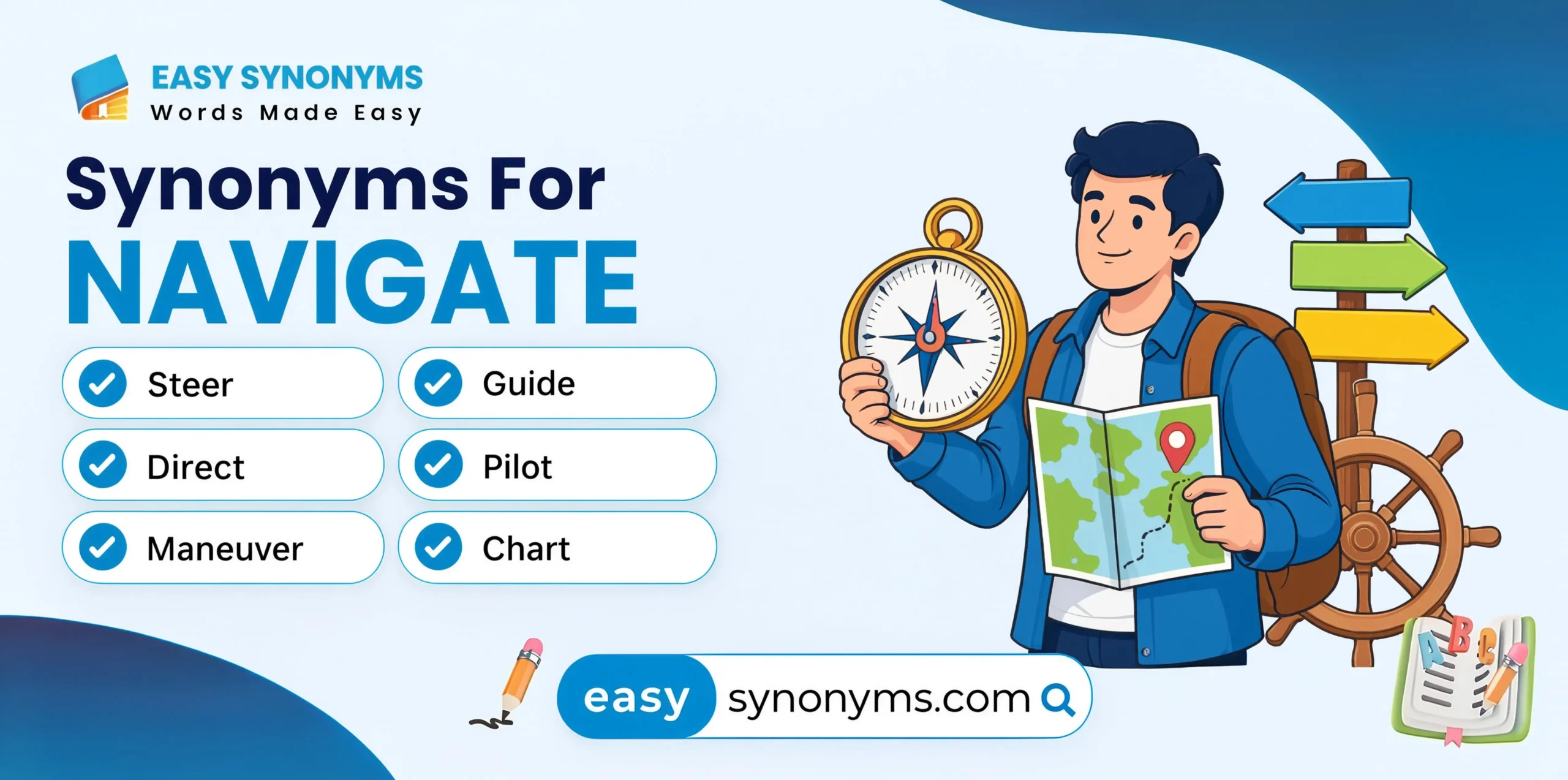
The closest synonyms of navigate include steer, guide, direct, pilot, maneuver, and find your way. For vehicles, steer and pilot can work well. When someone leads another person, guide is usually more natural. In difficult situations, handle or manage may be better choices. Meanwhile, browse and explore can work in certain website contexts.
Core Synonyms of Navigate
The following alternatives cover the most common meanings of navigate. Some are direct synonyms in specific contexts, while others work only when the meaning changes slightly.
| Word | Relationship | Best Context | Main Idea |
|---|---|---|---|
| Steer | Near synonym | Cars, boats, vehicles | Control direction |
| Guide | Near synonym | People, routes, processes | Lead or help |
| Direct | Near synonym | People, traffic, operations | Point or control |
| Pilot | Contextual synonym | Aircraft, ships | Operate and guide |
| Maneuver | Contextual synonym | Tight spaces, vehicles | Move carefully |
| Sail | Contextual synonym | Boats and ships | Travel by water |
| Find your way | Contextual alternative | Places and routes | Reach a destination |
| Plan a route | Contextual alternative | Travel and driving | Choose a path |
| Handle | Contextual alternative | Difficult situations | Deal with something |
| Manage | Contextual alternative | Problems and challenges | Control or deal with |
| Browse | Contextual alternative | Websites | Look through content |
| Explore | Contextual alternative | Places and websites | Discover or investigate |
What Does Navigate Mean?
Definition of Navigate
Navigate is a verb that generally means to find, follow, or control a course or route. The word can describe physical travel, vehicle operation, website use, or the process of dealing with a complicated situation.
For example:
We navigated the narrow streets without a GPS.
Here, navigate means finding and following the correct route.
Navigate in Physical Travel
In travel, navigate often means finding your way from one location to another.
They navigated the unfamiliar city with a paper map.
The emphasis is on successfully finding and following a route.
Navigate a Vehicle
When a person controls the direction or course of a vehicle, navigate can refer to that process.
The captain navigated the ship through rough water.
In this context, steer or pilot may also work, although each word has a slightly different focus.
Navigate a Website
The word also has a common digital meaning.
The new website is easy to navigate.
Here, navigate means moving through pages, menus, or sections to find information.
Navigate a Difficult Situation
In figurative English, navigate can mean dealing successfully with something complicated.
She learned how to navigate difficult workplace situations.
In this sense, handle, manage, or work through may be suitable alternatives.
Best Synonyms of Navigate by Context
Synonyms for Navigate a Vehicle
When the subject is a car, boat, aircraft, or another vehicle, several alternatives can work.
Steer
Steer is one of the closest alternatives when the focus is on controlling direction.
He steered the car around the fallen tree.
Unlike navigate, steer mainly emphasizes directional control.
Pilot
Pilot is particularly useful for aircraft and ships.
She piloted the aircraft through difficult weather.
The word suggests operating and guiding a vehicle, especially one that requires specialized skill.
Maneuver
Maneuver emphasizes careful movement or positioning.
The driver maneuvered the truck into the narrow parking space.
Therefore, maneuver is useful when the movement itself is difficult or precise.
Synonyms for Finding a Route
Sometimes navigate simply means successfully finding a way to a destination.
Find Your Way
This is a natural and conversational alternative.
We eventually found our way back to the hotel.
It works especially well when the destination matters more than the technical process of route planning.
Plan a Route
Use plan a route when the emphasis is on deciding which path to take.
We planned a route that avoided the highway.
This phrase is related to navigation, but it is not a perfect replacement because planning can happen before the actual journey.
Give Directions
When someone tells another person how to reach a destination, give directions may be appropriate.
The receptionist gave us directions to the station.
The phrase focuses on providing route information rather than personally navigating.
Synonyms for Navigate a Difficult Situation
The figurative use of navigate is common in professional and everyday English.
Handle
Handle means to deal with something successfully.
She handled the difficult conversation calmly.
Choose this word when the focus is on managing a problem or situation.
Manage
Manage can also mean dealing successfully with a challenge.
The team managed several unexpected problems during the project.
It is a good alternative when the situation requires organization, control, or decision-making.
Work Through
Work through emphasizes gradual progress toward a solution.
We worked through the technical problems one by one.
This phrase is more conversational than navigate.
Negotiate
Negotiate can work when dealing with competing interests, difficult requirements, or complex agreements.
The company negotiated several complicated contract terms.
However, it should not be treated as a universal synonym for navigate.
Synonyms for Navigate a Website
Digital navigation has its own useful vocabulary.
Browse
Browse means looking through website content.
Visitors can browse the product catalog by category.
It works well when the user is exploring several pages or products.
Explore
Explore emphasizes discovery.
Users can explore the website to learn about the company’s services.
This word sounds more purposeful and active than browse.
Access
Access means reaching or opening information.
Customers can access their accounts from the main menu.
It is useful when the focus is on reaching a particular resource rather than moving around the whole website.
Important Navigate Synonym Differences
Navigate vs Steer
Both words can describe vehicles, but their focus is different.
Navigate usually involves finding or following a route or course. Steer, on the other hand, emphasizes controlling the direction of movement.
The driver navigated the unfamiliar city.
The driver steered the car around the obstacle.
The first sentence focuses on route-finding. The second focuses on directional control.
Navigate vs Guide
Guide means leading or helping someone follow a path.
The instructor guided the students through the museum.
By comparison, navigate focuses more on finding or following the route.
The visitors navigated the museum’s confusing corridors.
Navigate vs Direct
Direct can mean telling someone where to go or controlling the movement of something.
The officer directed traffic away from the accident.
Meanwhile, navigate usually suggests finding or following a course.
The driver navigated around the accident.
Navigate vs Pilot
Pilot is more specialized than navigate. It commonly refers to operating and guiding an aircraft or vessel.
The captain piloted the ship safely into the harbor.
By contrast, navigate can describe route-finding without emphasizing who is operating the vehicle.
Navigate vs Maneuver
Both words can describe movement through a difficult space.
The hikers navigated the rocky trail.
The driver maneuvered the truck through the narrow alley.
In the first sentence, the focus is on successfully following a route. In the second, the focus is on careful physical movement.
Navigate vs Explore
Explore means investigating or discovering something.
We explored the old neighborhood.
Navigate focuses on finding or following a route.
We navigated the neighborhood’s narrow streets.
As a result, explore is not always a direct synonym.
Which Word Should I Use Instead of Navigate?
Choose “Steer” When:
The main idea is controlling direction.
He steered the boat toward the dock.
Choose “Guide” When:
The main idea is leading or helping someone.
The teacher guided the students through the exercise.
Choose “Direct” When:
The meaning involves giving directions or controlling movement.
The officer directed visitors toward the exit.
Choose “Pilot” When:
You are talking about operating an aircraft or vessel.
She piloted the plane safely through the storm.
Choose “Maneuver” When:
The focus is on careful movement or positioning.
He maneuvered the vehicle into a small parking space.
Choose “Find Your Way” When:
You want a natural phrase for reaching a destination.
We found our way through the old town.
Choose “Handle” or “Manage” When:
The word refers to dealing with a difficult situation.
She managed the transition successfully.
Common Collocations With Navigate
Natural word combinations can help you decide whether navigate is appropriate.
Navigate a Route
The hikers carefully navigated the mountain trail.
Navigate a Website
The redesigned website is easier to navigate.
Navigate a City
It can be difficult to navigate a large city for the first time.
Navigate a Difficult Situation
He learned how to navigate difficult workplace situations.
Navigate Complex Issues
The organization must navigate complex regulatory requirements.
Navigate Through Obstacles
The team successfully navigated through several obstacles.
These examples show why navigate works in both literal and figurative contexts.
Common Mistakes With Navigate Synonyms
Treating Every Related Word as a Direct Synonym
Words such as travel, journey, voyage, and explore are related to navigation. However, they do not have exactly the same meaning.
For example:
We traveled across the country.
This sentence describes movement from one place to another. It does not necessarily imply route planning or direction-finding.
Using Sail for Every Type of Navigation
Sail is associated with traveling by boat or ship.
The ship sailed across the Atlantic.
It cannot normally replace navigate in a sentence about a website, city, or business problem.
Using Pilot for Ordinary Route Finding
Pilot has a more specialized meaning.
She piloted the aircraft.
For ordinary travel, navigate, find your way, or plan a route will usually sound more natural.
Assuming Guide and Navigate Are Identical
Although the words overlap, guide often involves helping someone else.
The tour guide led the visitors through the museum.
In contrast, navigate can describe the person’s own process of finding a route.
Pronunciation of Navigate
American English
/ˈnævəɡeɪt/
British English
/ˈnævɪɡeɪt/
The main stress falls on the first syllable.
Etymology of Navigate
Where Does Navigate Come From?
The English word navigate ultimately comes from Latin navigare, meaning to sail or travel by ship. It is related to the Latin word navis, meaning “ship.”
Over time, the meaning expanded beyond maritime travel. Today, English speakers use navigate for roads, cities, websites, organizations, and difficult situations.
Antonyms of Navigate
There is no single opposite that works in every context. The best antonym depends on the meaning.
Lose Your Way
When navigate means finding a route, lose your way is a natural opposite.
We navigated the forest successfully.
We lost our way in the forest.
Stray
Stray means moving away from the intended route or direction.
The hikers strayed from the marked trail.
Misdirect
Misdirect means sending someone or something in the wrong direction.
The incorrect sign misdirected the travelers.
Frequently Asked Questions About Synonyms of Navigate
What is the closest synonym for navigate?
Steer is one of the closest alternatives when navigate means controlling the direction of a vehicle or vessel. However, guide, direct, and find your way can be closer depending on the context.
What is another word for navigate?
Depending on the sentence, alternatives include steer, guide, direct, pilot, maneuver, sail, find your way, plan a route, handle, and manage. Each word has a slightly different meaning or preferred context.
What is a synonym for navigate a difficult situation?
Handle, manage, and work through are natural alternatives when navigate means dealing with a difficult situation. Negotiate can also work when the situation involves agreements, competing interests, or complex requirements.
What is a synonym for navigate a website?
Depending on the meaning, you can use browse, explore, access, or move through. Among these choices, browse is especially natural when users are looking through website content.
Is steer the same as navigate?
Not exactly. Steer focuses on controlling direction, while navigate can involve finding and following a route. The two words overlap when talking about cars, boats, and other vehicles.
Is guide a synonym for navigate?
Guide is a near synonym in certain contexts. Both words can involve leading someone along a route, but guide emphasizes assistance or leadership, whereas navigate emphasizes finding or following a course.
What is a formal synonym for navigate?
There is no single formal replacement for every use of navigate. Depending on the context, direct, pilot, maneuver, or manage may work. In many professional situations, however, navigate itself is completely appropriate.
What is the opposite of navigate?
When navigate means successfully finding a route, natural opposites include lose your way, stray, get lost, and misdirect. The correct choice depends on the sentence.
Conclusion
The best synonym for navigate depends on the exact meaning you want to express. Use steer when you mean controlling direction, guide when you mean leading someone, and direct when you mean giving instructions or controlling movement. For aircraft and ships, pilot can be more precise. Meanwhile, maneuver highlights careful movement, while find your way provides a natural conversational alternative for reaching a destination.
When navigate is used figuratively, handle, manage, and work through may communicate the idea more clearly. Therefore, instead of choosing a word simply because it appears in a thesaurus, consider the context, meaning, tone, and natural usage first.