
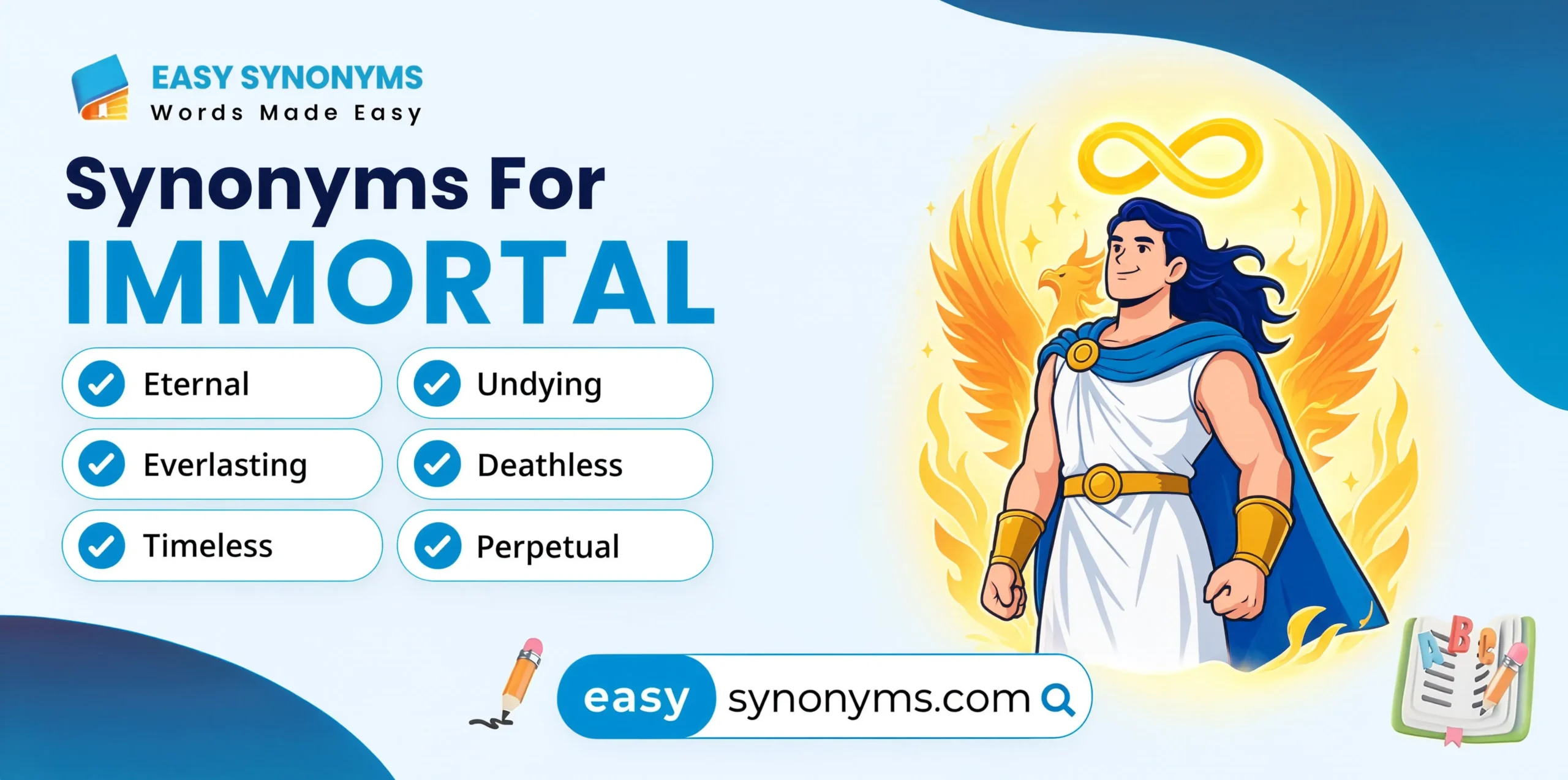

The best synonyms for immortal depend on the meaning you want to express. Words such as eternal, everlasting, undying, deathless, imperishable, timeless, and enduring can describe something that lasts forever. However, “immortal” can also describe a person whose fame continues long after death, so words such as legendary, illustrious, or iconic may work better in that context.
Quick Answer: What Are the Best Synonyms for Immortal?
The closest synonyms for immortal include eternal, everlasting, undying, deathless, imperishable, timeless, enduring, perpetual, infinite, and ever-living. For a famous person remembered long after death, legendary, iconic, monumental figure, or all-time great may be more appropriate. The correct choice depends on whether you mean eternal life, endless duration, or lasting fame.
Immortal Synonyms at a Glance
| Synonym | Main meaning | Best context |
|---|---|---|
| Eternal | Existing forever | Life, spirituality, ideas |
| Everlasting | Continuing forever | Peace, love, life |
| Undying | Never dying or fading | Love, loyalty, fame |
| Deathless | Not subject to death | Literary or poetic writing |
| Imperishable | Unable to perish or be destroyed | Formal writing |
| Timeless | Not limited by time | Art, beauty, ideas |
| Enduring | Continuing for a long time | Qualities, influence |
| Perpetual | Continuing without interruption | Conditions or processes |
| Infinite | Without limits or end | Time, space, abstract ideas |
| Ever-living | Continuing to live forever | Spiritual or literary contexts |
| Indestructible | Unable to be destroyed | Objects, strength, concepts |
| Permanent | Intended or expected to last | Practical situations |
| Unfading | Not losing beauty, strength, or importance | Beauty, memory, fame |
| Long-lasting | Continuing for a long time | General use |
| Abiding | Continuing or remaining over time | Feelings, beliefs |
| Legendary | Famous and remembered | People, achievements |
| Iconic | Widely recognized and influential | People, works, culture |
| Illustrious | Highly respected and famous | People and achievements |
| Monumental | Exceptionally important or memorable | Achievements, figures |
| Divine | Associated with a god or deity | Religious or mythological contexts |
1. Eternal
Eternal is one of the closest alternatives to “immortal.” It describes something that has no end or continues forever.
Example:
“They believed the soul was eternal.”
Use eternal when the focus is on endless existence rather than simply surviving death. Cambridge lists eternal among the direct synonyms associated with “immortal.”
Best for: spirituality, philosophy, time, life, and abstract concepts.
2. Everlasting
Everlasting means continuing forever or for an unlimited period.
Example:
“She promised him everlasting love.”
It works naturally with ideas such as love, peace, life, and happiness.
Cambridge lists “everlasting” as a synonym of “immortal” and also connects it with terms such as “eternal,” “never-ending,” and “undying.”
Best for: emotional, spiritual, and literary writing.
3. Undying
Undying describes something that never dies or never fades away.
Example:
“Her family showed him undying loyalty.”
Unlike “immortal,” undying often works particularly well for abstract things such as love, loyalty, admiration, and fame.
Best for: emotions, devotion, loyalty, admiration, and fame.
4. Deathless
Deathless literally suggests freedom from death.
Example:
“The poet searched for a deathless legacy.”
This word has a strong literary and dramatic tone. Therefore, it can add a more poetic quality to your writing.
Best for: poetry, literature, mythology, and dramatic descriptions.
5. Imperishable
Imperishable means something that cannot perish or disappear.
Example:
“Her work left an imperishable mark on literature.”
The word sounds formal and often focuses on something that remains valuable or lasting.
Best for: formal writing, literature, cultural influence, and abstract ideas.
6. Timeless
Timeless does not always mean literally immortal. Instead, it often describes something that remains valuable, attractive, or relevant despite the passage of time.
Example:
“Her novels have a timeless appeal.”
That distinction matters. A song can be timeless without being literally immortal.
Cambridge lists “immortal” among the synonyms related to “timeless,” alongside words such as eternal, everlasting, endless, enduring, and permanent.
Best for: art, fashion, literature, beauty, ideas, and cultural influence.
7. Enduring
Enduring means continuing over a long period without losing strength or importance.
Example:
“The book has had an enduring influence on modern literature.”
This word is often more practical than “immortal.” It does not necessarily imply that something will literally last forever.
Best for: influence, traditions, relationships, works, and reputations.
8. Perpetual
Perpetual means continuing indefinitely or without stopping.
Example:
“The monument became a symbol of perpetual remembrance.”
The word is formal and works particularly well when describing an ongoing state or condition.
Best for: formal writing, processes, conditions, and abstract concepts.
9. Infinite
Infinite means having no limit or end.
Example:
“The universe seemed to represent infinite possibilities.”
It is related to “immortal,” but it is not a direct replacement in every sentence. Infinite focuses on limitless extent rather than freedom from death.
Best for: time, space, possibilities, mathematics, and philosophy.
10. Ever-Living
Ever-living means continuing to live forever.
Example:
“The legend portrays the hero as an ever-living spirit.”
This expression has a distinctly literary, religious, or mythological feel.
Best for: mythology, spirituality, poetry, and fantasy.
11. Indestructible
Indestructible means unable to be destroyed.
Example:
“The character was portrayed as an indestructible warrior.”
The word does not necessarily mean immortal. Something could be indestructible but not literally alive.
Best for: fictional characters, physical objects, strength, and resilience.
12. Permanent
Permanent means intended or expected to remain for a long time without changing or ending.
Example:
“The discovery had a permanent impact on the field.”
It is usually more practical and less dramatic than “immortal.”
Best for: changes, conditions, records, effects, and decisions.
13. Unfading
Unfading describes something that does not lose its beauty, strength, importance, or freshness.
Example:
“She remained an unfading symbol of courage.”
This is especially effective in poetic or descriptive writing.
Best for: beauty, memories, fame, love, and symbolic influence.
14. Long-Lasting
Long-lasting means continuing for a long period.
Example:
“The artist created a long-lasting legacy.”
It is a useful everyday alternative, but it is weaker than “immortal” because it does not necessarily suggest forever.
Best for: products, effects, relationships, influence, and general descriptions.
Cambridge groups “long-lasting” with terms such as enduring, everlasting, eternal, undying, and imperishable in related vocabulary.
15. Abiding
Abiding describes something that continues for a long time, especially a feeling, belief, or principle.
Example:
“She had an abiding love for classical music.”
The word is formal and often appears with abstract nouns.
Best for: love, faith, beliefs, respect, and principles.
Synonyms for Immortal Meaning “Famous Forever”
“Immortal” has another important meaning. It can describe a person who remains famous and remembered long after death. Cambridge gives this meaning for the noun as well, describing an “immortal” as someone remembered for a long time after death.
In this context, the following words may fit better:
Legendary
Legendary describes someone or something famous because of remarkable achievements or qualities.
Example:
“She became a legendary figure in the sport.”
Iconic
Iconic describes someone or something widely recognized as a symbol of a particular period, style, or field.
Example:
“He became an iconic figure in American cinema.”
Illustrious
Illustrious means highly respected, distinguished, and famous.
Example:
“The university has an illustrious history.”
Monumental Figure
A monumental figure is a person whose importance or influence is exceptionally great.
Example:
“She was a monumental figure in modern literature.”
All-Time Great
All-time great is an informal expression for someone regarded as one of the best or most important people in a particular field.
Example:
“Many fans consider him an all-time great.”
Cambridge’s thesaurus specifically associates the noun “immortal” with expressions such as monumental figure, titan, giant, all-time great, demigod, great, and illustrious name.
Formal Synonyms for Immortal
For formal, academic, or literary writing, these alternatives are especially useful:
- Eternal
- Everlasting
- Imperishable
- Deathless
- Perpetual
- Enduring
- Unfading
- Ever-living
- Timeless
- Infinite
The strongest choice depends on the sentence. For example, imperishable works well for something that cannot fade or perish, while eternal emphasizes endless existence.
Poetic Synonyms for Immortal
If you want a more poetic or emotional tone, consider:
- Undying
- Deathless
- Everlasting
- Eternal
- Ever-living
- Unfading
- Timeless
- Enduring
For example:
“Their undying love survived every hardship.”
This sounds more emotional than:
“Their permanent love survived every hardship.”
The first version fits literary writing much better.
Synonyms for Immortal in Different Contexts
| Context | Best alternatives |
|---|---|
| Eternal life | Eternal, everlasting, deathless |
| Spiritual existence | Eternal, divine, ever-living |
| Love | Undying, everlasting, eternal |
| Fame | Legendary, iconic, illustrious |
| Literature | Timeless, enduring, imperishable |
| Legacy | Enduring, lasting, immortal |
| Beauty | Timeless, unfading, everlasting |
| Mythology | Deathless, divine, ever-living |
| Strength | Indestructible, invincible |
| Influence | Enduring, lasting, monumental |
Immortal vs. Eternal
Immortal usually describes something that does not die.
Eternal focuses more broadly on something that has no beginning or end, or continues forever.
For example:
“The gods were believed to be immortal.”
Here, the focus is freedom from death.
“The soul is eternal.”
Here, the focus is endless existence.
The words overlap, but the emphasis can differ. Cambridge lists both among related synonyms.
Immortal vs. Everlasting
Everlasting emphasizes duration.
Immortal emphasizes freedom from death or continued existence.
For example:
“The warrior was immortal.”
This suggests that the warrior could not die.
“They shared everlasting love.”
This describes love that continues forever.
Therefore, everlasting works particularly well with things that are not living.
Immortal vs. Timeless
These words are often confused.
Immortal can mean living forever or being remembered forever.
Timeless usually means unaffected by changes in time or remaining relevant across generations.
For example:
“The character is immortal.”
The character does not die.
“The novel is timeless.”
The novel remains relevant and admired over time.
A work can be timeless without being immortal in a literal sense.
Immortal vs. Undying
Undying is especially common with emotions and abstract qualities.
“She showed undying devotion.”
The phrase sounds natural.
By contrast:
“She showed immortal devotion.”
This is grammatically possible in some contexts, but it does not sound as natural.
As a result, undying is often the stronger choice for love, loyalty, admiration, and devotion.
Common Mistakes When Choosing an Immortal Synonym
Treating every synonym as identical
Words such as eternal, timeless, permanent, and indestructible have related meanings, but they are not interchangeable in every sentence.
The surrounding noun matters.
Using “permanent” when you mean “forever”
Permanent usually means lasting indefinitely or intended not to change. It does not carry the same poetic or spiritual meaning as “immortal.”
Using “timeless” for literal immortality
A timeless painting does not live forever. Instead, it remains relevant, beautiful, or influential across time.
Using “infinite” for a person
“Infinite” normally describes something without limits. It is not a natural replacement for “immortal person.”
Using “legendary” for literal eternal life
A legendary person is famous or celebrated. The word does not mean that the person cannot die.
Frequently Asked Questions
What is the best synonym for immortal?
The best synonym depends on context. Eternal, everlasting, undying, and deathless work well for endless life or existence. For lasting fame, legendary, iconic, or illustrious may be better.
What is another word for immortal?
Common alternatives include eternal, everlasting, undying, deathless, imperishable, timeless, enduring, perpetual, and ever-living.
What is a formal word for immortal?
Formal alternatives include imperishable, eternal, perpetual, deathless, enduring, and everlasting. The best option depends on the exact meaning.
What is a poetic word for immortal?
Deathless, undying, everlasting, eternal, and ever-living can create a more poetic tone.
What is a synonym for immortal when describing a famous person?
Use legendary, iconic, illustrious, monumental figure, or all-time great, depending on the person’s reputation and context. Cambridge specifically lists several of these as related to the noun “immortal.”
Is eternal the same as immortal?
Not exactly. Immortal usually focuses on freedom from death, while eternal emphasizes endless existence or duration. They overlap in many contexts.
Is timeless a synonym for immortal?
Sometimes, but not always. Timeless usually means something remains relevant, beautiful, or influential over time. It does not necessarily mean that something literally cannot die.
What is the opposite of immortal?
Common antonyms include mortal, temporary, fleeting, ephemeral, transient, and short-lived. Cambridge lists “mortal” and several duration-related terms as antonyms of “immortal.”
Conclusion
The strongest synonyms for immortal depend on the idea behind the word. Choose eternal, everlasting, deathless, or undying for endless life or existence. Use timeless or enduring for lasting relevance and influence. When describing a person whose reputation survives through history, legendary, iconic, and illustrious may communicate the idea more naturally.