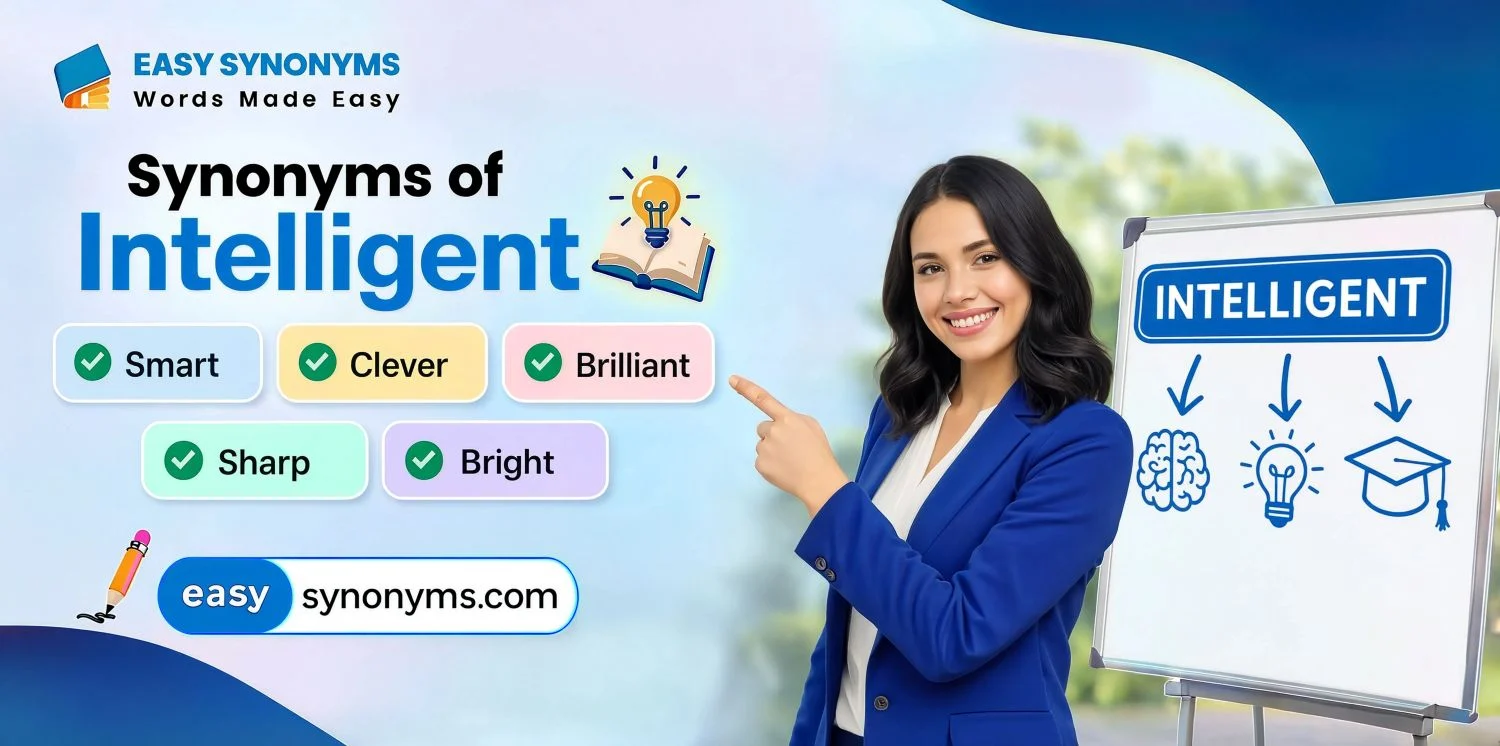

Looking for the right synonyms of intelligent can be surprisingly difficult because words such as smart, clever, bright, brilliant, and wise overlap without meaning exactly the same thing.
The best alternative depends on what kind of intelligence you want to emphasize: quick thinking, deep knowledge, practical judgment, creativity, perception, or exceptional ability.
This guide separates close synonyms from words that only work in particular contexts. You will find natural examples, differences in tone and strength, and practical guidance for choosing the right word.
Quick Answer: What Are the Best Synonyms of Intelligent?
The closest everyday synonyms of intelligent include smart, clever, bright, sharp, brilliant, and quick-witted. More specific alternatives include astute for practical judgment, perceptive for noticing and understanding things, knowledgeable for having substantial knowledge, wise for sound judgment, and gifted for exceptional natural ability. The best choice depends on the exact quality you want to describe.
30 Synonyms of Intelligent at a Glance
| Word | Relationship | Meaning | Strength | Formality | Best Context |
|---|---|---|---|---|---|
| Smart | Direct/near | Quick to learn, understand, or make good decisions | Similar | Neutral/informal | Everyday American English |
| Clever | Direct/near | Quick at learning and understanding | Similar | Neutral | General ability, problem-solving |
| Bright | Direct/near | Intelligent and quick to learn | Similar | Neutral/informal | Children, students, people |
| Sharp | Near synonym | Quick to notice, understand, or respond | Similar | Informal/neutral | Thinking, conversation |
| Brilliant | Near synonym | Exceptionally intelligent or skillful | Stronger | Neutral | Academic or exceptional ability |
| Quick-witted | Contextual | Quick at producing clever responses | Similar | Neutral | Conversation, debate, humor |
| Brainy | Contextual | Very intelligent | Similar | Informal | Casual conversation |
| Astute | Contextual | Quick to understand situations and make sound judgments | Strong | Neutral/formal | Business, decisions |
| Perceptive | Contextual | Good at noticing and understanding subtle things | Specific | Neutral | People, behavior, situations |
| Insightful | Contextual | Showing deep understanding | Specific | Neutral | Ideas, comments, analysis |
| Discerning | Contextual | Good at recognizing differences and judging quality | Specific | Formal/neutral | Taste, judgment |
| Shrewd | Contextual | Clever and practical, especially in difficult situations | Specific | Neutral | Business, negotiation |
| Sagacious | Contextual | Wise and showing excellent judgment | Strong | Formal | Leaders, decisions |
| Wise | Near synonym | Showing good judgment based on knowledge or experience | Different | Neutral | Advice, decisions |
| Gifted | Contextual | Naturally talented or unusually capable | Strong | Neutral | Academic or artistic ability |
| Talented | Contextual | Having a natural ability to do something well | Specific | Neutral | Skills and performance |
| Knowledgeable | Contextual | Having substantial knowledge | Specific | Neutral | Subjects and professions |
| Learned | Contextual | Highly educated and knowledgeable | Specific | Formal | Academic contexts |
| Erudite | Contextual | Highly educated and deeply knowledgeable | Strong | Formal | Scholarship and writing |
| Intellectual | Near/related | Connected with advanced thinking or intellectual interests | Specific | Neutral/formal | Ideas, people, culture |
| Cerebral | Contextual | Characterized by intellectual thought | Specific | Formal | Writing, art, discussion |
| Rational | Contextual | Based on reason rather than emotion | Specific | Neutral/formal | Decisions, arguments |
| Logical | Contextual | Following sound reasoning | Specific | Neutral | Arguments, solutions |
| Reasonable | Contextual | Based on sensible judgment | Weaker | Neutral | Decisions, opinions |
| Sensible | Contextual | Showing practical good judgment | Specific | Neutral | Choices, behavior |
| Clearheaded | Contextual | Able to think calmly and logically | Specific | Neutral | Decisions under pressure |
| Ingenious | Contextual | Cleverly inventive or resourceful | Specific | Neutral | Solutions, inventions |
| Resourceful | Contextual | Good at finding effective solutions | Specific | Neutral | Problems, challenging situations |
| Savvy | Contextual | Practical knowledge and good judgment | Specific | Informal | Business, technology |
| Perspicacious | Contextual | Exceptionally perceptive and discerning | Strong | Formal | Analysis, judgment |
Not every word above is a perfect substitute in every sentence. For example, knowledgeable describes what someone knows, while astute emphasizes judgment. Wise concerns sound judgment, often developed through experience, whereas brilliant suggests an unusually high level of ability.
What Does “Intelligent” Mean?
Intelligent is an adjective describing someone or something with the ability to learn, understand, reason, and think effectively. It can describe people, animals, ideas, questions, decisions, and—in computing—systems capable of responding to information in sophisticated ways. Oxford defines it in terms of learning, understanding, and logical thinking, while Cambridge emphasizes the ability to learn and understand things easily.
Examples:
- She is highly intelligent and learns new concepts quickly.
- That was an intelligent question.
- He made an intelligent decision based on the available evidence.
- Scientists are searching for intelligent life elsewhere in the universe.
The word does not always describe raw intellectual ability. In phrases such as an intelligent decision or an intelligent response, it can also suggest sound reasoning or good judgment. Merriam-Webster specifically notes this connection with good judgment and sound thought.
The Closest Synonyms of Intelligent
1. Smart
Smart is one of the closest everyday alternatives to intelligent, particularly in American English.
It can describe someone who learns quickly, understands things easily, or makes good decisions. Oxford notes that smart can also imply the ability to make good business or personal decisions.
Example:
Maya is a smart student who rarely needs extra help.
Choose smart when: you want a natural, conversational alternative.
2. Clever
Clever usually emphasizes quick understanding or mental ability.
He was clever enough to solve the puzzle in minutes.
There can be a subtle difference in tone. Clever is sometimes used approvingly, but in some contexts it can imply someone is being overly crafty or showing off. Oxford notes that this potentially disapproving nuance occurs especially in British English.
Choose clever when: you want to emphasize quick thinking, ingenuity, or problem-solving.
3. Bright
Bright commonly means intelligent and quick to learn.
She is one of the brightest students in her class.
It is especially common when talking about children, students, and young people, although it can describe adults as well. Oxford specifically notes this common usage.
Choose bright when: describing someone who learns quickly, especially a student.
4. Sharp
Sharp describes someone who is mentally quick and alert.
He’s a sharp analyst who notices details other people miss.
It can emphasize speed of perception rather than overall intellectual ability.
Choose sharp when: someone quickly notices, understands, or responds to things.
5. Brilliant
Brilliant is stronger than ordinary intelligent when it refers to mental ability.
She is a brilliant mathematician.
It can also mean exceptionally skillful, so context matters. Oxford describes brilliant as meaning extremely intelligent or skillful.
Choose brilliant when: you want to express unusually high ability.
6. Quick-Witted
Quick-witted emphasizes speed of thought, especially the ability to respond cleverly in conversation or difficult situations.
His quick-witted response made everyone laugh.
Merriam-Webster distinguishes it from intelligent by emphasizing promptness in finding answers or solutions.
Choose quick-witted when: intelligence appears as fast verbal or situational responses.
7. Brainy
Brainy means intelligent or clever, but it is distinctly informal.
She’s the brainy one in the group.
It works well in casual speech but is usually not the best choice for formal professional or academic writing. Cambridge lists brainy as an informal synonym of intelligent.
More Precise Synonyms for Intelligent
8. Astute
Astute means quick to understand situations and make accurate judgments.
She made an astute decision during the negotiations.
It is particularly useful for business, strategy, leadership, and decision-making.
Intelligent = generally capable of thinking and understanding.
Astute = especially good at judging situations.
9. Perceptive
Perceptive emphasizes the ability to notice and understand things that are not immediately obvious.
He is remarkably perceptive about people’s emotions.
Use it when the person’s intelligence shows through observation and insight rather than simply academic ability.
10. Insightful
Insightful describes something that demonstrates deep understanding.
Her insightful analysis revealed a problem nobody else had noticed.
It is especially natural with:
- analysis
- comments
- observations
- questions
- articles
- discussions
It is not normally a direct replacement for intelligent when describing someone’s general intelligence.
11. Discerning
Discerning means having good judgment, especially when recognizing differences in quality or value.
He is a discerning reader who notices subtle differences in style.
It works particularly well for taste, judgment, quality, and evaluation.
12. Shrewd
Shrewd describes someone who is clever at judging situations and gaining an advantage.
The shrewd investor recognized the opportunity early.
It can carry a slightly calculating or self-interested implication, so it is not always as positive as intelligent.
13. Sagacious
Sagacious means wise and showing very good judgment.
The leader was known for his sagacious decisions.
This is a formal and relatively uncommon word. Collins lists sagacious among the more formal alternatives related to intelligent.
14. Wise
Wise is related to intelligence but is not an exact synonym.
Her grandmother gave her some wise advice.
Someone can be intelligent without being wise. Intelligence concerns mental ability; wisdom is more strongly associated with sound judgment, experience, and knowing how to apply knowledge.
Choose wise when: the focus is good judgment rather than mental quickness.
15. Gifted
Gifted describes someone with exceptional natural ability, particularly in an academic, artistic, mathematical, or other specialized area.
She is a gifted scientist with an unusual ability to solve complex problems.
Cambridge includes gifted among words related to intelligent.
But gifted is more specific than intelligent: it suggests exceptional natural ability, not simply high intelligence.
16. Knowledgeable
Knowledgeable means having a lot of knowledge about a particular subject.
He is extremely knowledgeable about computer security.
This is an important distinction:
Intelligent = capable of understanding and reasoning.
Knowledgeable = possesses substantial information or expertise.
A person can be knowledgeable because of study and experience without necessarily being exceptionally intelligent.
17. Learned
Learned describes someone who has acquired extensive knowledge, especially through study.
She is a learned scholar of medieval history.
It is more formal than intelligent and is strongly associated with education and scholarship.
18. Erudite
Erudite means highly educated and possessing extensive knowledge, particularly in academic or scholarly subjects.
The professor gave an erudite lecture on ancient philosophy.
Use it when you want to emphasize deep learning and scholarship, not merely quick thinking.
19. Intellectual
Intellectual is related to intelligence but has a broader and somewhat different meaning.
He has a strong intellectual curiosity.
It often refers to a person’s engagement with complex ideas, knowledge, culture, or abstract thought rather than simply saying that the person has a high level of intelligence.
20. Cerebral
Cerebral describes something characterized by intellectual thought.
The novel is cerebral and explores difficult philosophical questions.
It is more formal and often used for books, films, discussions, art, or people with strongly intellectual interests.
Synonyms for Intelligent in Specific Contexts
For an Intelligent Person
The most natural choices are:
- smart
- clever
- bright
- sharp
- brilliant
- brainy
- quick-witted
Example:
She’s an intelligent student.
Possible alternatives:
She’s a bright student.
She’s a smart student.
She’s a brilliant student.
The meaning changes slightly with each choice. Bright emphasizes quick learning; brilliant raises the level of praise.
For an Intelligent Decision
The best alternatives are more specific:
- smart
- sensible
- rational
- astute
- wise
- prudent
- sound
That was an intelligent decision.
Possible alternatives:
That was a smart decision.
That was a sensible decision.
That was a rational decision.
That was an astute decision.
Here, smart, sensible, rational, or astute may be more natural than simply using another word for intellectual ability.
For an Intelligent Question
Good alternatives include:
- insightful
- perceptive
- thoughtful
- well-considered
- astute
- penetrating
She asked an intelligent question.
She asked an insightful question.
The second sentence suggests that the question demonstrates particularly deep understanding.
For Intelligent Conversation
Natural alternatives include:
- thoughtful
- insightful
- stimulating
- sophisticated
- intellectually engaging
We had an intelligent conversation about economics.
We had a thoughtful discussion about economics.
Here, intelligent describes the quality of the discussion, not someone’s IQ.
Which Word Should I Use?
Choose smart when:
You want the most natural everyday alternative, especially in American English.
Choose clever when:
You want to emphasize quick understanding or problem-solving.
Choose bright when:
You are describing someone who learns quickly, especially a child or student.
Choose sharp when:
The person is mentally quick, observant, or responsive.
Choose brilliant when:
You want to emphasize exceptionally high intelligence or ability.
Choose quick-witted when:
The person responds quickly and cleverly, especially in conversation.
Choose astute when:
The person’s intelligence appears through good judgment or strategic decisions.
Choose perceptive when:
The person notices and understands subtle things.
Choose insightful when:
A comment, question, observation, or analysis demonstrates deep understanding.
Choose wise when:
The emphasis is on sound judgment and experience.
Choose knowledgeable when:
The emphasis is on what someone knows rather than how quickly they think.
Choose gifted when:
Someone has exceptional natural ability in a particular area.
Intelligent vs. Smart
Intelligent and smart are often interchangeable, but there is a useful distinction.
It is the more general and neutral term for mental ability.
She is highly intelligent.
Smart is more conversational and can additionally emphasize practical decision-making.
She is smart enough to know when to walk away.
Oxford specifically distinguishes smart as especially associated with quick learning and good business or personal decisions, while intelligent emphasizes learning, understanding, and logical thinking.
Best choice: Use intelligent for a neutral description; use smart for everyday speech or practical judgment.
Intelligent vs. Clever
Both describe mental ability, but clever often emphasizes quickness or ingenuity.
He is intelligent enough to understand the theory.
He is clever enough to find a shortcut.
There can also be a negative nuance to clever when someone appears too crafty or self-satisfied. Oxford notes this possible disapproving use.
Intelligent vs. Brilliant
The main difference is degree.
She’s intelligent.
This describes high mental ability without necessarily suggesting exceptional ability.
She’s brilliant.
This usually expresses a much stronger judgment of intelligence or skill.
Collins and Oxford both distinguish brilliant as suggesting unusually or extremely high ability.
Intelligent vs. Wise
These words describe different qualities.
| Intelligent | Wise |
|---|---|
| Mental ability | Sound judgment |
| Learning and understanding | Applying knowledge well |
| Reasoning | Experience and judgment |
| Problem-solving | Knowing what is appropriate |
Someone can be intelligent but unwise or wise without being exceptionally intelligent.
He is intelligent enough to understand the problem.
She was wise enough not to make the same mistake twice.
Intelligent vs. Knowledgeable
Intelligent describes the capacity to understand and reason.
Knowledgeable describes the amount of knowledge someone possesses.
Maria is intelligent and quickly understands new concepts.
Maria is knowledgeable about marine biology.
Knowledge can come from years of education and experience, so knowledgeable should not automatically be treated as a direct synonym for intelligent.
Intelligent vs. Perceptive
Intelligent is broad.
Perceptive is specific: it emphasizes noticing and understanding subtle information.
He is intelligent.
He is perceptive enough to notice when people are uncomfortable.
Use perceptive when the person’s intelligence is visible through observation and insight.
Common Mistakes When Choosing a Synonym for Intelligent
1. Using “wise” to mean simply “highly intelligent”
Wise focuses on judgment and experience, not just mental capacity.
2. Using “knowledgeable” as an exact synonym
Knowing a lot and being able to learn or reason quickly are different qualities.
3. Calling “brilliant” a neutral replacement
Brilliant is stronger and more emphatic than intelligent when describing mental ability.
4. Using “clever” in every formal context
Clever is perfectly normal English, but it can occasionally carry a crafty or slightly disapproving tone, particularly in British English.
5. Using “brainy” in formal writing
Brainy is informal. Use intelligent, highly capable, knowledgeable, or another precise term in professional or academic writing.
6. Confusing talent with intelligence
Someone can be talented at music, sports, art, or programming without that word necessarily describing their overall intelligence.
7. Using “logical” as a universal synonym
Logical describes reasoning that follows sound principles. An intelligent person can also be creative, intuitive, or emotionally perceptive.
Pronunciation of “Intelligent”
US: /ɪnˈtel.ə.dʒənt/
UK: /ɪnˈtel.ɪ.dʒənt/
Cambridge and Oxford both give closely corresponding pronunciations for the word.
Word Origin of “Intelligent”
Intelligent entered English in the early 16th century from Latin intelligent- / intelligens, related to intelligere, meaning “to understand.” Merriam-Webster gives the first known English use as around 1540.
The word is therefore historically connected with the idea of understanding, which remains central to its modern meaning.
Antonyms of Intelligent
The most direct antonym is unintelligent.
Depending on context, contrasting words include:
- reckless
- foolish
- dull
- ignorant
- irrational
- unreasonable
- obtuse
These are not interchangeable opposites. For example, ignorant usually means lacking knowledge, while unintelligent concerns intellectual ability. Cambridge and Merriam-Webster list several of these as antonyms or contrasting terms.
Frequently Asked Questions
What is the best synonym for intelligent?
The best general synonym is usually smart or clever. For a stronger compliment, use brilliant. For good judgment, astute may be more precise; for subtle understanding, choose perceptive or insightful.
What is a strong word for intelligent?
Brilliant, exceptionally bright, highly capable, astute, sagacious, and perspicacious can express stronger or more specific forms of intelligence. Brilliant is the most natural strong choice in everyday English, while sagacious and perspicacious are more formal.
What is a formal synonym for intelligent?
Depending on the intended meaning, formal alternatives include astute, perceptive, discerning, sagacious, perspicacious, erudite, and cerebral. However, intelligent itself is completely appropriate in formal writing.
What is another word for a highly intelligent person?
Depending on context, you can say brilliant, gifted, exceptionally bright, highly capable, intellectually gifted, astute, or genius. Be careful with genius: it is a much stronger label and generally implies exceptional intellectual ability.
Is smart the same as intelligent?
Often, yes, but they are not identical in nuance. Intelligent is a broad and relatively neutral description of mental ability. Smart is more conversational and can also suggest practical good judgment or good decisions. Oxford specifically highlights this distinction.
Is clever a positive word for intelligent?
Usually, yes. Clever commonly expresses approval of someone’s ability to learn, understand, or solve problems. However, it can sometimes suggest craftiness or self-satisfaction, especially in British English.
What is the difference between intelligent and brilliant?
Brilliant is generally stronger. Intelligent indicates high mental ability, while brilliant often suggests an unusually or exceptionally high level of intelligence or skill.
What is the difference between intelligent and knowledgeable?
Intelligent describes the ability to learn, understand, and reason. Knowledgeable describes having substantial knowledge about a subject. Someone can be knowledgeable because of education and experience without the word necessarily describing their general intelligence.
Conclusion
The best synonym for intelligent depends on the exact quality you want to express. Smart, clever, bright, and sharp are natural everyday alternatives. Brilliant is stronger, while quick-witted emphasizes speed of response. For specific forms of intelligence, use astute for judgment, perceptive for observation, insightful for deep understanding, wise for sound judgment, and knowledgeable for subject expertise.
Good vocabulary is not about replacing a word with the fanciest synonym available. It is about choosing the word that communicates the right meaning, strength, tone, and context.