
If you are looking for synonyms for cringe, the best choice depends on what you mean. In informal modern English, cringe can describe something that causes embarrassment, awkwardness, or secondhand embarrassment.
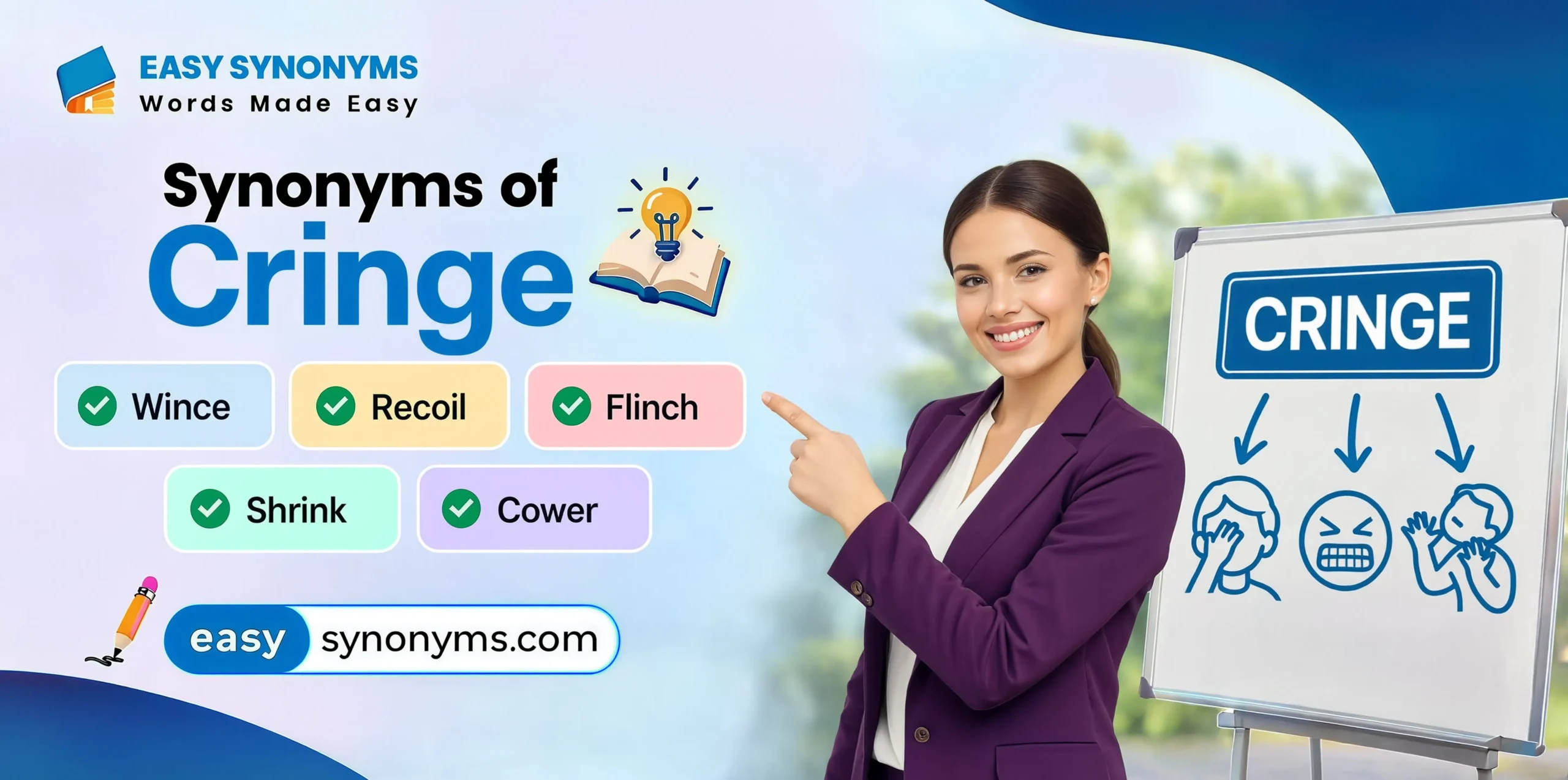
It can also describe your reaction to something uncomfortable or frightening. Common alternatives include embarrassing, awkward, humiliating, mortifying, uncomfortable, cringeworthy, wince, flinch, recoil, and cower. However, these words are not interchangeable in every situation.
This guide separates true synonyms from near-synonyms and contextual alternatives so you can choose the word that sounds natural for the situation.
Quick Answer: What Are the Best Synonyms for Cringe?
The closest alternative depends on how cringe is being used. For something that causes embarrassment, embarrassing, awkward, cringeworthy, and mortifying are useful choices. For the physical reaction of pulling back or shrinking, wince, flinch, recoil, and cower may be better. Cringe itself is informal, while words such as embarrassing and uncomfortable work in a wider range of contexts.
Cringe Synonyms at a Glance
| Word | Relationship | Meaning | Strength | Formality | Best Context |
|---|---|---|---|---|---|
| Embarrassing | Near synonym | Causing shame or self-consciousness | Medium | Neutral | General situations |
| Awkward | Near synonym | Socially uncomfortable or difficult | Medium | Neutral | Social situations |
| Cringeworthy | Direct/contextual | Causing embarrassment or discomfort | Strong | Informal | Content, behavior, situations |
| Cringey / Cringy | Direct synonym | Causing an informal sense of embarrassment | Strong | Very informal | Social media, conversation |
| Mortifying | Near synonym | Extremely embarrassing | Very strong | Neutral | Serious embarrassment |
| Humiliating | Near synonym | Causing loss of dignity or public shame | Very strong | Neutral | Public embarrassment |
| Uncomfortable | Near synonym | Producing discomfort or unease | Mild–medium | Neutral | Broad situations |
| Awkwardly embarrassing | Contextual | Socially uncomfortable and embarrassing | Medium–strong | Neutral | Social behavior |
| Shameful | Contextual | Deserving or causing shame | Strong | Neutral/formal | Morally negative behavior |
| Ridiculous | Contextual | Absurd or foolish | Medium | Neutral | Actions, ideas |
| Corny | Contextual | Excessively sentimental or clichéd | Medium | Informal | Humor, romance, dialogue |
| Tacky | Contextual | Lacking taste or sophistication | Medium | Informal | Style, behavior |
| Wince | Contextual reaction | React with a brief physical or emotional jerk | Medium | Neutral | Pain, embarrassment |
| Flinch | Contextual reaction | Make a sudden movement from fear or discomfort | Medium | Neutral | Fear, shock, discomfort |
| Recoil | Contextual reaction | Move suddenly away from something unpleasant | Medium–strong | Neutral | Physical or emotional reaction |
| Cower | Contextual reaction | Shrink back because of fear | Strong | Neutral | Fear or intimidation |
| Shrink back | Contextual reaction | Move backward because of fear or discomfort | Medium | Neutral | Physical reaction |
| Squirm | Contextual reaction | Move uneasily because of embarrassment or discomfort | Medium | Neutral | Awkward situations |
| Guilty | Related | Feeling responsible or ashamed | Variable | Neutral | Personal mistakes |
| Ashamed | Related | Feeling shame about oneself or an action | Strong | Neutral | Personal behavior |
| Distasteful | Contextual | Unpleasant or offensive | Medium | Neutral/formal | Conduct, content |
| Off-putting | Contextual | Causing dislike or discomfort | Medium | Neutral | People, behavior, ideas |
| Unpalatable | Contextual | Difficult to accept or tolerate | Medium–strong | Formal | Ideas, facts, situations |
| Indecorous | Contextual | Not appropriate or socially proper | Strong | Formal | Formal writing |
| Cringe-making | Direct/contextual | Causing someone to cringe | Strong | Informal | Mainly British English |
The most useful choices are embarrassing, awkward, cringeworthy, mortifying, humiliating, and uncomfortable when cringe refers to embarrassment. For the physical reaction, wince, flinch, recoil, and cower are more appropriate.
What Does “Cringe” Mean?
Cringe has more than one meaning.
As a verb, it can mean to move away or shrink back because you are frightened. It can also mean to feel very embarrassed or uncomfortable about something. Oxford gives both meanings, while Cambridge also identifies the modern informal adjective cringe as meaning very embarrassing because something is bad or silly.
For example:
- I cringe whenever I remember that speech.
- She cringed when she heard the embarrassing comment.
- The child cringed when the dog barked loudly.
In contemporary informal English, cringe can also function as an adjective:
That video is so cringe.
In this use, it means that something is extremely embarrassing, awkward, or silly. Cambridge lists cringeworthy and cringey among the related alternatives for this informal adjective.
1. Embarrassing
Embarrassing is probably the safest general alternative when cringe means something that causes embarrassment.
Example:
His attempt to impress everyone was embarrassing.
Use embarrassing when you want a neutral, widely understood word. It works in casual, professional, and educational writing.
Unlike cringe, it does not necessarily sound slangy.
Best for: general writing, conversations, mistakes, social situations.
2. Awkward
Awkward is one of the closest alternatives, but it has a broader meaning.
Something can be awkward without being embarrassing. An awkward silence, for example, may simply feel uncomfortable or difficult to handle.
Example:
There was an awkward silence after his joke.
Use awkward when the problem is primarily social discomfort rather than intense embarrassment.
Best for: conversations, relationships, social situations, uncomfortable moments.
3. Cringeworthy
Cringeworthy is one of the closest alternatives to modern cringe.
It describes something that makes people feel embarrassed or uncomfortable. Oxford specifically defines it as something that makes you feel embarrassed or uncomfortable.
Example:
The commercial was so cringeworthy that I had to look away.
It is particularly useful when describing a performance, video, joke, speech, post, or behavior.
Best for: informal reviews, entertainment, social media, performances.
4. Cringey / Cringy
Cringey and cringy are informal adjectives derived from cringe. Dictionary.com describes cringey as something that causes awkwardness, discomfort, or embarrassment and notes its widespread informal use.
Example:
That pickup line was incredibly cringey.
These are excellent alternatives when you want to preserve the casual tone of cringe.
Best for: conversation, social media, casual writing.
Avoid in: formal academic or professional writing.
5. Mortifying
Mortifying is considerably stronger than ordinary embarrassing.
It describes something that causes intense embarrassment or humiliation.
Example:
Forgetting her name during the interview was mortifying.
Choose mortifying when the embarrassment is severe.
Best for: extremely embarrassing experiences, public mistakes, personal stories.
6. Humiliating
Humiliating focuses on a loss of dignity or status, often in front of other people.
Example:
Being laughed at in front of the entire class was humiliating.
Something can be embarrassing without being humiliating. Humiliating usually suggests a more serious attack on someone’s dignity.
Best for: public embarrassment, bullying, criticism, degrading situations.
7. Uncomfortable
Uncomfortable is broader and weaker than cringe.
Example:
The conversation became uncomfortable when he started discussing private matters.
It is useful when the feeling is unpleasant but not necessarily embarrassing.
Best for: professional writing, sensitive situations, social discomfort.
Synonyms for “Cringe” by Context
For Cringe Behavior
If you are describing behavior that makes other people uncomfortable or embarrassed, consider:
- embarrassing
- awkward
- cringeworthy
- cringey
- humiliating
- ridiculous
- shameful
- off-putting
Example:
Instead of:
His behavior was so cringe.
You could write:
His behavior was incredibly embarrassing.
Or:
His behavior was awkward and difficult to watch.
The best choice depends on whether you want to emphasize embarrassment, social discomfort, absurdity, or moral disapproval.
For a Cringe Feeling
When cringe describes your own reaction, these alternatives may work:
- wince
- flinch
- squirm
- recoil
- feel embarrassed
- feel uncomfortable
- feel ashamed
Example:
I cringed when I heard my old presentation.
Possible alternatives:
I winced when I heard my old presentation.
I felt embarrassed when I heard my old presentation.
I squirmed when I heard my old presentation.
These are not identical. Wince suggests a brief reaction, while feel embarrassed directly names the emotion.
For Something That Is “Cringe”
When cringe is being used as an adjective, the most natural alternatives are:
- embarrassing
- awkward
- cringeworthy
- cringey
- corny
- tacky
- ridiculous
- uncomfortable
For example:
That advertisement is so cringe.
Could become:
That advertisement is so embarrassing.
That advertisement is incredibly awkward.
That advertisement is painfully cringeworthy.
That advertisement is really corny.
But corny is not a universal synonym. It usually suggests something overly sentimental, clichéd, or unsophisticated rather than simply embarrassing.
Physical Synonyms for “Cringe”
The meaning changes when cringe refers to physically recoiling from fear, pain, or something unpleasant.
Wince
To wince is to make a small involuntary movement because of pain, embarrassment, or discomfort.
She winced when she saw the damage.
Wince is especially useful for brief reactions.
Flinch
To flinch means to make a sudden movement because of fear, pain, or surprise.
He flinched when the door slammed.
It emphasizes a sudden physical response.
Recoil
To recoil means to move suddenly away from something unpleasant, frightening, or shocking.
She recoiled from the strong smell.
It often suggests stronger avoidance than flinch.
Cower
To cower means to shrink back or crouch because of fear.
The frightened dog cowered under the table.
This is not a synonym for ordinary social embarrassment. It belongs mainly to the fear sense of cringe. Oxford explicitly associates cringe in this sense with cower.
Cringe vs. Awkward
Cringe and awkward overlap, but they are not exact synonyms.
| Word | Main idea |
|---|---|
| Cringe | A strong reaction to embarrassment, awkwardness, or discomfort |
| Awkward | Socially uncomfortable, difficult, or lacking ease |
Compare:
His joke was awkward.
This means the joke created an uncomfortable social situation.
His joke was cringe.
This is more informal and expresses a stronger judgment that the joke was embarrassing or painfully awkward.
Choose “awkward” for neutral descriptions.
Choose “cringe” for informal, stronger reactions.
Cringe vs. Embarrassing
These words are closely related but grammatically different.
Embarrassing describes something that causes embarrassment:
That was an embarrassing mistake.
Cringe can describe your reaction:
I cringed when I saw the mistake.
Modern informal English also uses cringe as an adjective:
That was cringe.
So:
- embarrassing = causes embarrassment
- cringe = informal description of something extremely embarrassing/awkward, or the reaction itself
- cringeworthy = likely to cause someone to cringe
Cringe vs. Mortifying
Mortifying is stronger.
It was embarrassing to forget his name.
It was mortifying to forget his name in front of hundreds of people.
Use mortifying when the experience causes particularly intense embarrassment.
Cringe vs. Wince
These words describe reactions, but they are not interchangeable.
Wince often describes a brief physical response to pain, discomfort, or embarrassment:
I winced when I heard the recording.
Cringe can describe a broader emotional reaction:
I cringed when I remembered what I had said.
If the emphasis is on a quick physical reaction, wince may be more precise.
Which Word Should You Use?
Choose embarrassing when:
You want a neutral, universally understood word.
Choose awkward when:
The main problem is social discomfort.
Choose cringeworthy when:
Something actively makes people feel embarrassed or uncomfortable.
Choose cringey when:
You want casual, internet-friendly language.
Choose mortifying when:
The embarrassment is extremely intense.
Choose humiliating when:
Someone’s dignity or reputation has been seriously damaged.
Choose wince when:
You are describing a brief physical reaction.
Choose flinch when:
The reaction is sudden and connected to fear, pain, or surprise.
Choose recoil when:
Someone physically or emotionally pulls away from something unpleasant.
Choose cower when:
Fear causes someone to shrink back.
Common Mistakes With “Cringe” Synonyms
Mistake 1: Treating “awkward” as an exact synonym
Not everything awkward is cringe. An awkward situation may simply be uncomfortable or difficult.
Mistake 2: Using “humiliating” for every embarrassing situation
Humiliating is stronger and often implies a serious loss of dignity.
Mistake 3: Calling “wince” a universal synonym
Wince describes a reaction, not necessarily the quality of the thing that caused the reaction.
Mistake 4: Using “cower” for social embarrassment
Cower is primarily associated with fear and submission. It does not naturally replace cringe in sentences such as “I cringe at my old posts.”
Mistake 5: Using “cringey” in formal writing
Cringey is deliberately informal. In a professional report, embarrassing, awkward, or uncomfortable will usually be more appropriate.
Mistake 6: Assuming every negative word means “cringe”
Words such as tacky, corny, ridiculous, shameful, and distasteful describe particular qualities. They can overlap with cringe in certain situations but are not universal synonyms.
Frequently Asked Questions
What is the best synonym for cringe?
The best synonym depends on the meaning. Embarrassing is the safest general alternative when cringe means causing embarrassment. Cringeworthy is closer when describing something that makes people feel embarrassed, while wince, flinch, and recoil are better for physical reactions.
What is another word for cringe in slang?
Cringey or cringy are the closest informal alternatives. Other casual expressions include awkward, embarrassing, and painfully awkward, depending on the context. Cambridge recognizes cringe as an informal adjective meaning very embarrassing because something is bad or silly.
What is a stronger word than cringe?
For embarrassment, mortifying or humiliating can be stronger choices. Mortifying emphasizes intense embarrassment, while humiliating emphasizes a loss of dignity or status.
Is awkward a synonym for cringe?
Sometimes, but not always. Awkward describes social discomfort or a lack of ease, while modern informal cringe often expresses a stronger reaction to something embarrassing, silly, or painfully awkward.
Is embarrassing the same as cringe?
Not exactly. Embarrassing describes something that causes embarrassment. Cringe can describe the reaction to that thing and, informally, the thing itself. For example, “I cringed at the video” describes a reaction, while “That video is cringe” describes the video.
What is a formal synonym for cringe?
There is no single formal replacement for every use of cringe. Depending on context, feel embarrassed, feel uncomfortable, recoil, or shrink back may be more appropriate. For something that causes embarrassment, embarrassing is generally more suitable than the informal cringe.
What is the difference between cringe and cringeworthy?
Cringe can be a verb, noun, or informal adjective. Cringeworthy is an adjective describing something that causes embarrassment or discomfort. Oxford specifically defines cringeworthy as something that makes you feel embarrassed or uncomfortable.
What is the opposite of cringe?
The opposite depends on the sense. If cringe means feeling embarrassed or uncomfortable, possible contrasting ideas include feel confident, approve, admire, enjoy, or feel comfortable. If it means physically shrinking from fear, the opposite could be approach, advance, or stand firm.
Conclusion
The best synonym for cringe depends on exactly what you want to express. Use embarrassing for a neutral description, awkward for social discomfort, cringeworthy or cringey for something that strongly triggers embarrassment, and mortifying when the embarrassment is intense. For the physical reaction associated with fear or discomfort, wince, flinch, recoil, and cower are more precise.
The key is not to choose the most negative-sounding word. Choose the word that preserves the original meaning, tone, intensity, and context.