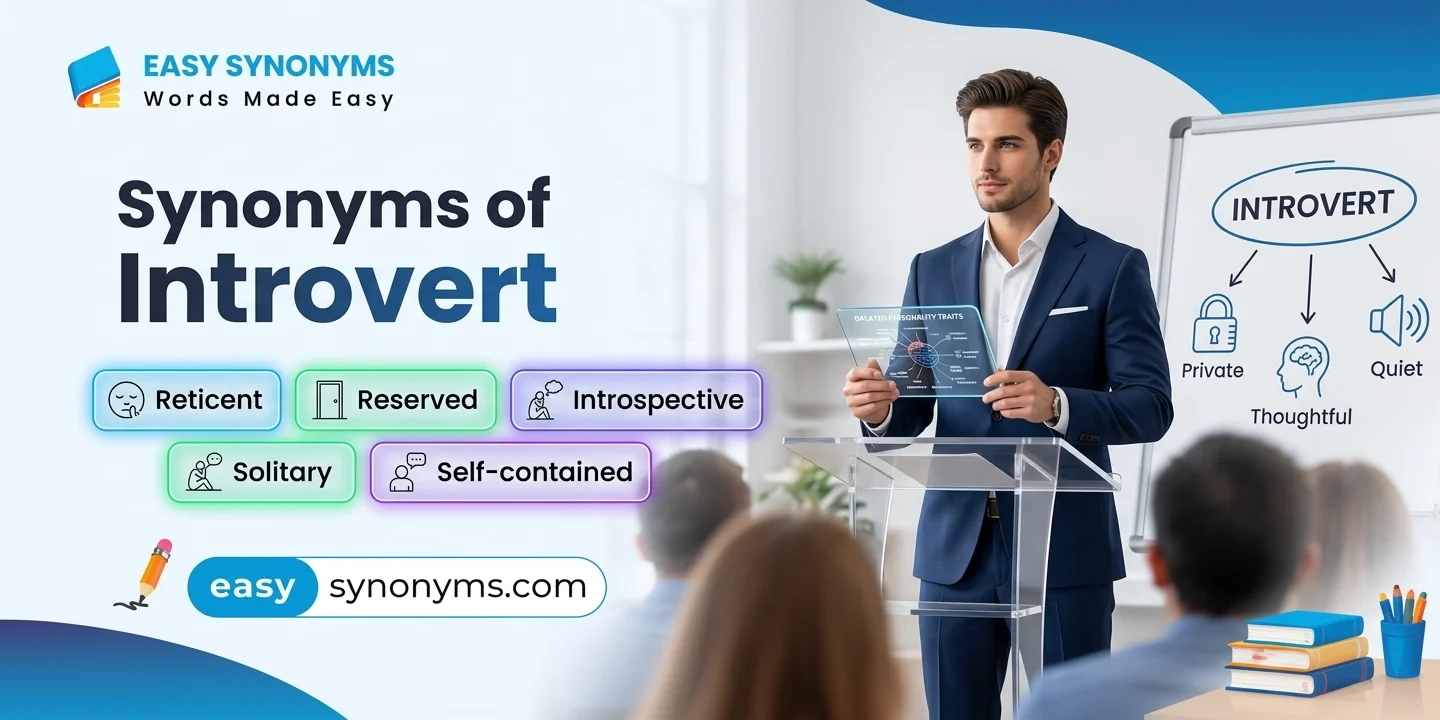

Looking for synonyms for introvert can be surprisingly difficult because several related words describe people who prefer quiet environments or limited social interaction, but they do not all mean exactly the same thing.
Someone who is reserved may simply speak less, while a recluse actively avoids social contact. A loner emphasizes spending time alone, whereas an introvert describes a broader personality tendency.
The best alternative therefore depends on what you want to emphasize: a preference for solitude, quiet behavior, limited communication, social withdrawal, or simply a private personality.
This guide explains the most useful alternatives and shows when each one sounds natural.
Quick Answer: What Are the Best Synonyms for Introvert?
Common synonyms or close alternatives for introvert include reserved, solitary, private, retiring, withdrawn, loner, and recluse. However, they are not interchangeable in every sentence. Reserved usually describes someone who does not readily express themselves, while solitary emphasizes being alone. Loner is more informal, and recluse suggests a much stronger withdrawal from society.
Core Synonym Resource
| Word | Relationship | Part of Speech | Meaning | Strength | Best Context |
|---|---|---|---|---|---|
| Reserved | Near synonym | Adjective | Not openly expressive or talkative | Similar | Personality, communication |
| Solitary | Near synonym | Adjective/Noun | Preferring or experiencing time alone | Similar | Lifestyle, personality |
| Private | Contextual alternative | Adjective | Not inclined to share personal thoughts or details | Similar | Personality, personal life |
| Retiring | Near synonym | Adjective | Shy, quiet, and not socially assertive | Similar | Formal descriptions |
| Withdrawn | Contextual alternative | Adjective | Socially distant or less communicative | Stronger | Behavior, social interaction |
| Loner | Contextual alternative | Noun | Someone who prefers spending time alone | Similar | Informal descriptions |
| Recluse | Contextual alternative | Noun | Someone who deliberately lives apart from society | Stronger | Extreme social isolation |
| Hermit | Contextual alternative | Noun | Someone who lives in isolation, traditionally away from society | Stronger | Literary, historical, figurative |
| Quiet person | Descriptive alternative | Noun phrase | Someone who speaks or interacts relatively little | Broader | Everyday language |
| Shy person | Related term | Noun phrase | Someone uncomfortable or nervous in social situations | Different | Social anxiety or lack of confidence |
Collins specifically groups solitary, hermit, loner, and recluse with introvert, while also identifying private, reserved, and retiring as related alternatives. The important point is that these words overlap without being exact replacements in every context.
What Does Introvert Mean?
Introvert is primarily a noun referring to a person who tends to prefer spending time alone or in small groups and who is generally quieter or less socially oriented. Cambridge defines an introvert as someone who is shy and quiet and prefers spending time alone rather than frequently being with other people.
Pronunciation:
- US: /ˈɪn.trə.vɝːt/
- UK: /ˈɪn.trə.vɜːt/
The related adjective is introverted, as in:
She is naturally introverted and enjoys working independently.
It is important not to assume that every introvert is shy. Introversion and shyness can overlap, but they describe different ideas. Someone can prefer quiet environments without feeling nervous around other people.
The Best Synonyms for Introvert by Meaning
1. Reserved
Reserved is one of the most useful alternatives when you want to describe someone who does not readily express their feelings, opinions, or personality.
James is reserved and usually listens rather than speaking first.
Choose reserved when the focus is on someone’s outward communication style rather than their preference for solitude.
Best for: personality, communication, professional descriptions.
2. Solitary
Solitary emphasizes being alone or preferring to spend time alone. It can describe a person, lifestyle, activity, or situation.
She has a solitary personality and enjoys reading in the evenings.
It is close to introvert, but it places more emphasis on solitude than personality type. Collins lists solitary among the alternatives associated with introvert.
Best for: solitude, lifestyle, quiet activities.
3. Private
A private person tends not to reveal much about their personal life, thoughts, or feelings.
Mark is very private and rarely talks about his personal life.
This can overlap with introversion, but privacy is specifically about what someone chooses to share. A private person may still be highly social.
Best for: personal information, emotions, relationships, professional descriptions.
4. Retiring
Retiring is a more formal or literary word for someone who is shy, quiet, or inclined to avoid social attention.
Despite being highly talented, she has a retiring personality.
It can work well in formal descriptions, biographies, and literary writing. Collins includes retiring among words related to the quiet, private sense of introvert.
Best for: formal and literary descriptions.
5. Withdrawn
Withdrawn suggests that someone is socially distant or does not readily participate in interaction.
He became increasingly withdrawn after moving to the new city.
This is not always a neutral synonym for introvert. It can imply a change in behavior, emotional difficulty, or social disengagement.
Best for: describing behavior, especially when someone has become less communicative.
6. Loner
A loner is someone who prefers to spend time alone rather than with other people. It is informal and focuses strongly on someone’s lifestyle or social habits.
He is something of a loner and enjoys spending weekends by himself.
Unlike introvert, loner does not necessarily describe a personality preference for quieter environments. It simply emphasizes being alone.
Collins identifies loner as an informal synonym associated with introvert.
Best for: casual conversation and informal writing.
7. Recluse
A recluse is a much stronger term. It describes someone who deliberately lives apart from society or avoids contact with other people.
The author became a recluse later in life.
Calling an ordinary introvert a recluse can exaggerate the situation. Most introverts are not recluses.
Best for: substantial social withdrawal or deliberate isolation.
8. Hermit
A hermit traditionally refers to someone who lives in isolation, often away from ordinary society. It can also be used figuratively for someone who rarely socializes.
After retiring, he became something of a hermit.
Like recluse, hermit is considerably stronger than introvert. It should not be used simply because someone enjoys quiet evenings at home.
9. Quiet Person
Quiet person is a simple, everyday description rather than a precise synonym.
She’s a quiet person who prefers listening to talking.
Someone can be quiet without being an introvert. For example, an extroverted person may be quiet in an unfamiliar environment.
Best for: everyday descriptions when psychological precision is not important.
10. Shy Person
Shy is closely related to introvert, but it is not an exact synonym. Shyness usually involves discomfort, nervousness, or self-consciousness in social situations.
He is shy around strangers but very talkative with close friends.
An introvert may be completely comfortable talking to others but still prefer smaller groups and quieter environments. Cambridge’s definition of introvert includes “shy” and “quiet,” but that overlap should not be interpreted as complete equivalence.
Which Word Should I Use?
The easiest way to choose the right alternative is to identify what you actually want to describe.
Choose reserved when:
You want to emphasize that someone does not openly express themselves.
Choose solitary when:
You want to emphasize a preference for being alone.
Choose private when:
The person does not readily share personal information or feelings.
Choose retiring when:
You need a more formal or literary description of a quiet, socially unobtrusive person.
Choose withdrawn when:
The person seems socially distant or has pulled away from interaction.
Choose loner when:
You want an informal word emphasizing that someone prefers to spend time alone.
Choose recluse when:
The person avoids society to an unusual or extreme degree.
Choose hermit when:
The person lives in substantial isolation, literally or figuratively.
Choose shy when:
The main issue is nervousness or discomfort in social situations rather than a preference for solitude.
Introvert vs. Shy
These words are often confused, but the distinction matters.
An introvert generally prefers lower levels of social stimulation or more time alone. A shy person may want social interaction but feel uncomfortable, nervous, or self-conscious while doing it.
For example:
Introvert: Maya enjoys spending Saturday night at home reading a book.
Shy: Maya wants to join the conversation but feels nervous speaking to strangers.
A person can be both introverted and shy, but neither characteristic automatically implies the other.
Introvert vs. Loner
Both introvert and loner can describe someone who spends a lot of time alone. The difference is emphasis.
| Word | Main emphasis | Tone |
|---|---|---|
| Introvert | Personality and social preference | Neutral |
| Loner | Habit of being alone | Informal |
Calling someone an introvert does not imply that they dislike people. Calling someone a loner more strongly suggests that they usually operate alone.
Introvert vs. Recluse
A recluse represents a much more extreme form of social isolation.
An introvert may enjoy spending time alone but still maintain friendships, attend events, work with colleagues, and participate in social activities. A recluse is much more likely to avoid society or live apart from it.
Therefore, recluse is a contextual alternative, not a universal synonym for introvert.
Introvert vs. Reserved
These terms overlap, but they describe different aspects of personality.
An introvert is generally characterized by a preference for quieter environments or limited social stimulation. A reserved person is less likely to openly communicate thoughts or feelings.
For example:
She is an introvert, but she speaks confidently during meetings.
She is reserved and rarely discusses her personal life.
The first sentence describes social preference; the second describes communication style.
Common Mistakes When Choosing an Introvert Synonym
Mistake 1: Treating “shy” as an exact synonym
Not every introvert is shy. Introversion and shyness can overlap, but they are not identical concepts.
Mistake 2: Calling every introvert a “recluse”
Recluse implies much stronger social isolation. Using it for someone who simply enjoys quiet time can sound exaggerated.
Mistake 3: Using “hermit” casually without considering the strength
A hermit traditionally lives in isolation. The word can work figuratively, but it is much stronger than introvert.
Mistake 4: Assuming “private” means introverted
Privacy concerns how much someone shares. A private person can still be highly outgoing and socially active.
Mistake 5: Using “loner” in formal writing
Loner is common and understandable, but it is informal. In professional or academic writing, reserved, solitary, or a more precise description may be better.
Common Collocations With Introvert
Natural phrases can help you choose an alternative more accurately.
- a natural introvert
- a quiet introvert
- an introverted personality
- an introverted person
- a socially reserved person
- a private individual
- a solitary lifestyle
- a withdrawn personality
- a retiring personality
- a social recluse
The best replacement depends on the noun that follows. For example, private individual sounds natural when discussing someone’s personal life, while reserved personality focuses more on communication and behavior.
Practice: Choose the Best Word
Choose the most appropriate word for each sentence: reserved, shy, loner, private, recluse, or introvert.
- Sarah enjoys parties but needs plenty of quiet time afterward.
- David rarely discusses his family or personal relationships.
- Emma wants to speak to new people but becomes nervous around strangers.
- Tom spends most of his free time alone and prefers it that way.
- The famous writer rarely left his isolated home and avoided almost all visitors.
Answers
- Introvert — the emphasis is on a preference for quiet and limited social stimulation.
- Private — the focus is on keeping personal information to himself.
- Shy — nervousness around unfamiliar people is the key characteristic.
- Loner — the emphasis is on regularly spending time alone.
- Recluse — the description suggests unusually strong social isolation.
FAQ
What is another word for introvert?
Common alternatives include reserved, solitary, private, retiring, withdrawn, loner, and recluse. However, they are not all exact synonyms. Reserved describes communication style, solitary emphasizes being alone, loner is informal, and recluse suggests much stronger social isolation.
What is a positive synonym for introvert?
Reserved, thoughtful, private, or self-contained can work when you want a neutral or positive description. The best choice depends on the quality you want to emphasize rather than simply replacing introvert with another label.
Is “shy” a synonym for introvert?
Not exactly. Shy describes discomfort, nervousness, or self-consciousness in social situations, while introvert generally describes a person who prefers quieter environments or spending time alone. Someone can be introverted without being shy.
Is “loner” another word for introvert?
Loner is a close, informal alternative when the emphasis is on someone who prefers spending time alone. It is not an exact replacement because introvert describes a broader personality tendency.
What is a formal synonym for introvert?
Depending on the context, reserved, retiring, solitary, or socially withdrawn can work in formal writing. Retiring is particularly useful for describing someone who is quiet and avoids drawing attention to themselves.
What is the opposite of introvert?
The usual opposite is extrovert. An extrovert generally tends to seek or enjoy social interaction and outward stimulation. Introvert and extrovert describe different personality orientations, rather than simply “antisocial” versus “social.”
What is the difference between an introvert and a recluse?
An introvert may enjoy solitude while still having friendships, social activities, and regular interactions with others. A recluse is much more socially isolated and may deliberately avoid contact with society. Recluse is therefore a stronger and more specific term.
Conclusion
The best synonym for introvert depends on the exact quality you want to describe. Reserved works well for a quiet communication style, solitary emphasizes time spent alone, private focuses on personal boundaries, and loner is a casual way to describe someone who prefers being alone. Stronger terms such as recluse and hermit should be used carefully because they imply much greater isolation.
When accuracy matters, do not simply replace introvert with the closest-looking word. First identify whether you mean quietness, solitude, privacy, shyness, social withdrawal, or personality preference. That small distinction will usually lead you to the most natural word.