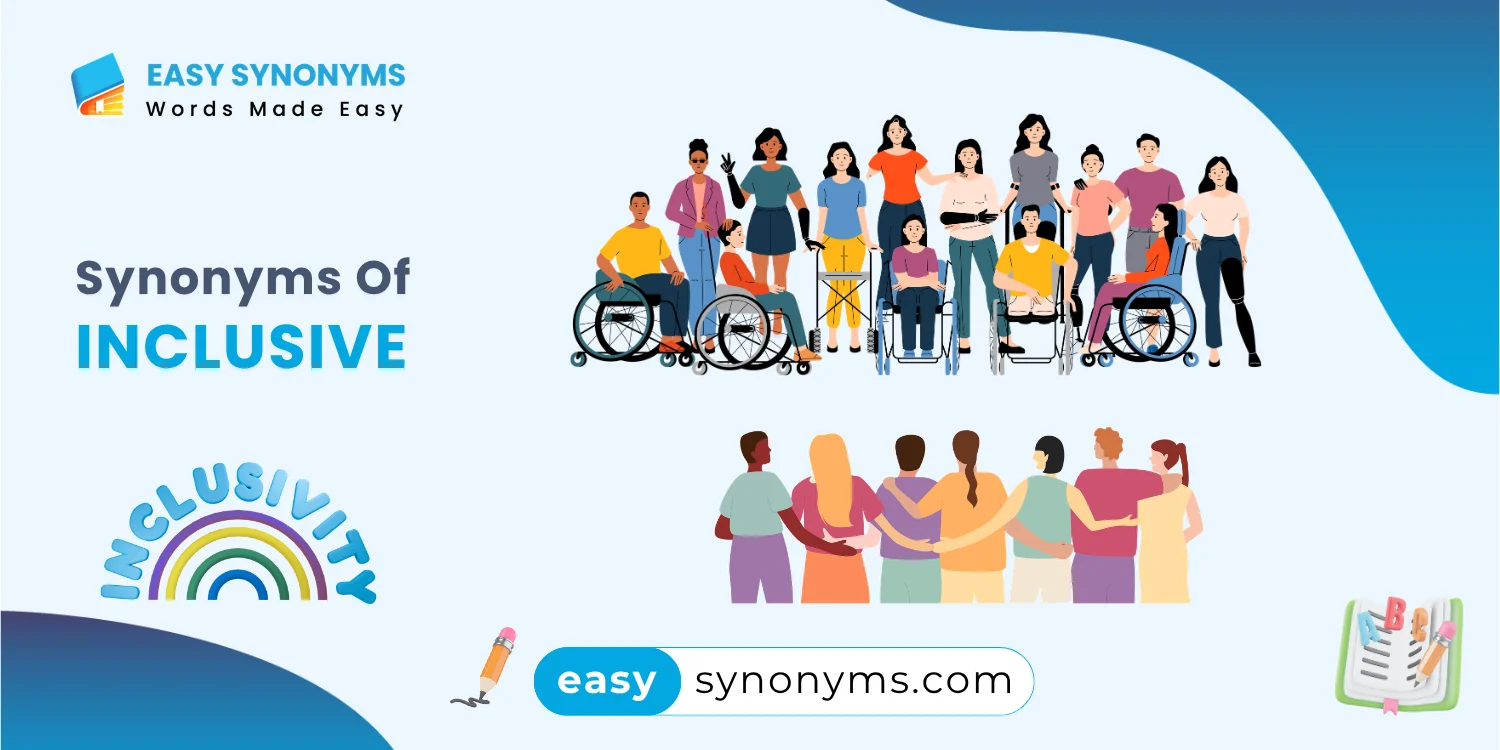

Synonyms of inclusive become useful when you want to describe people, groups, ideas, or environments that welcome everyone. Imagine joining a team where every voice matters and everyone feels valued.
Many people use the word inclusive in workplaces, schools, communities, and everyday conversations. Learning synonyms of inclusive helps you communicate with greater accuracy and variety.
For example, instead of repeatedly saying a classroom is “inclusive,” you might describe it as welcoming, open, accommodating, or accessible. Small word changes make writing more engaging.
Understanding synonyms of inclusive benefits students, bloggers, content writers, professionals, and daily English users. It strengthens vocabulary and improves both spoken and written communication.
📚 What Does “Inclusive” Really Mean?
The word inclusive describes something that welcomes, accepts, or involves everyone rather than excluding people.
Native speakers often use it when discussing diversity, teamwork, education, leadership, communities, and social participation.
Part of Speech: Adjective
Simple Definition: Including all people, groups, ideas, or things without leaving anyone out.
Common Contexts
- Inclusive workplaces
- Inclusive classrooms
- Inclusive communities
- Inclusive language
- Inclusive leadership
- Inclusive policies
Native Speaker Understanding
When native speakers hear inclusive, they usually think of fairness, belonging, participation, openness, and equal opportunities.
🧠 Connotative Meaning
Positive Tone
- Welcoming
- Accepting
- Supportive
- Fair
- Open-minded
Negative Tone
The word itself rarely carries a negative meaning. However, some people may use it critically if they believe inclusiveness is superficial rather than genuine.
Neutral Tone
In formal writing, inclusive can simply mean “including everything within a stated range or group.”
What is Connotation?
(Connotation is the emotional or cultural meaning attached to a word beyond its basic dictionary definition.)
📖 Etymology
The word inclusive comes from the Latin word includere, meaning “to shut in,” “to enclose,” or “to contain.”
Old English (450–1100)
No direct form existed in Old English, but related ideas appeared through words meaning “contain” or “hold together.”
Middle English (1100–1500)
French and Latin influences introduced forms related to inclusion and containment.
Modern English (1500–Present)
The term evolved into inclusive, meaning something that contains or welcomes all members of a group.
Pronunciation
US: /ɪnˈkluː.sɪv/
UK: /ɪnˈkluː.sɪv/
Syllables
in-clu-sive
Affixation Pattern
Root
include
Prefix
in-
Suffix
-sive
📖 SYNONYMS LIST
Welcoming (Adjective) — US /ˈwelkəmɪŋ/ | UK /ˈwelkəmɪŋ/
Meaning: Describes something that makes people feel accepted and comfortable.
Examples:
- The new teacher created a welcoming classroom.
- Our neighbors gave us a welcoming reception.
Accepting (Adjective) — US /əkˈseptɪŋ/ | UK /əkˈseptɪŋ/
Meaning: Willing to receive or recognize people without judgment.
Examples:
- She works in an accepting environment.
- The group remained accepting of different opinions.
Open (Adjective) — US /ˈoʊpən/ | UK /ˈəʊpən/
Meaning: Ready to consider different people, ideas, or experiences.
Examples:
- He keeps an open attitude toward new cultures.
- The discussion stayed open and respectful.
Accessible (Adjective) — US /əkˈsesəbəl/ | UK /əkˈsesəbəl/
Meaning: Easy for everyone to use, reach, or participate in.
Examples:
- The website is accessible to all users.
- They built accessible entrances throughout the building.
Accommodating (Adjective) — US /əˈkɑːmədeɪtɪŋ/ | UK /əˈkɒmədeɪtɪŋ/
Meaning: Willing to adjust to meet the needs of others.
Examples:
- The staff remained accommodating during the event.
- She offered an accommodating solution.
Embracing (Adjective) — US /ɪmˈbreɪsɪŋ/ | UK /ɪmˈbreɪsɪŋ/
Meaning: Actively welcoming people, ideas, or differences.
Examples:
- The company has an embracing culture.
- Their community is embracing of diversity.
Broad-Minded (Adjective) — US /ˌbrɔːd ˈmaɪndɪd/ | UK /ˌbrɔːd ˈmaɪndɪd/
Meaning: Open to different views and lifestyles.
Examples:
- She is broad-minded and respectful.
- Broad-minded leaders encourage innovation.
Unifying (Adjective) — US /ˈjuːnɪfaɪɪŋ/ | UK /ˈjuːnɪfaɪɪŋ/
Meaning: Bringing people together as one group.
Examples:
- The event had a unifying effect.
- Sports can be a unifying force.
Integrative (Adjective) — US /ˈɪntəɡreɪtɪv/ | UK /ˈɪntɪɡreɪtɪv/
Meaning: Combining people or elements into a whole.
Examples:
- The school uses an integrative approach.
- Integrative programs support participation.
All-Encompassing (Adjective) — US /ˌɔːl ɪnˈkʌmpəsɪŋ/ | UK /ˌɔːl ɪnˈkʌmpəsɪŋ/
Meaning: Including everything within a scope.
Examples:
- The policy is all-encompassing.
- They developed an all-encompassing strategy.
Comprehensive (Adjective) — US /ˌkɑːmprɪˈhensɪv/ | UK /ˌkɒmprɪˈhensɪv/
Meaning: Covering all important parts.
Examples:
- The report provides a comprehensive overview.
- She created a comprehensive plan.
Universal (Adjective) — US /ˌjuːnɪˈvɜːrsəl/ | UK /ˌjuːnɪˈvɜːsəl/
Meaning: Relevant to or involving everyone.
Examples:
- The message has universal appeal.
- Education is a universal need.
Egalitarian (Adjective) — US /ɪˌɡælɪˈteriən/ | UK /ɪˌɡælɪˈteəriən/
Meaning: Supporting equal rights and opportunities.
Examples:
- The organization promotes egalitarian values.
- Their leadership style is egalitarian.
Participatory (Adjective) — US /pɑːrˈtɪsɪpətɔːri/ | UK /pɑːˈtɪsɪpətəri/
Meaning: Encouraging everyone to take part.
Examples:
- The workshop was highly participatory.
- Teachers use participatory activities.
Nonexclusive (Adjective) — US /ˌnɑːnɪkˈskluːsɪv/ | UK /ˌnɒnɪkˈskluːsɪv/
Meaning: Not limited to a specific group.
Examples:
- Membership is nonexclusive.
- The club remains nonexclusive.
Collective (Adjective) — US /kəˈlektɪv/ | UK /kəˈlektɪv/
Meaning: Shared by or involving many people.
Examples:
- They made a collective decision.
- Success required collective effort.
Cooperative (Adjective) — US /koʊˈɑːpərətɪv/ | UK /kəʊˈɒpərətɪv/
Meaning: Working together toward a common goal.
Examples:
- The project encouraged cooperative learning.
- The team stayed cooperative throughout.
Harmonious (Adjective) — US /hɑːrˈmoʊniəs/ | UK /hɑːˈməʊniəs/
Meaning: Existing together peacefully and successfully.
Examples:
- The workplace remained harmonious.
- They built a harmonious community.
Neighborly (Adjective) — US /ˈneɪbərli/ | UK /ˈneɪbəli/
Meaning: Friendly and welcoming toward others.
Examples:
- Everyone showed neighborly kindness.
- The town has a neighborly atmosphere.
Community-Oriented (Adjective) — US /kəˈmjuːnəti ˈɔːrientɪd/ | UK /kəˈmjuːnəti ˈɔːrientɪd/
Meaning: Focused on supporting all members of a community.
Examples:
- The organization is community-oriented.
- They launched a community-oriented program.
Inclusive (Adjective) — US /ɪnˈkluːsɪv/ | UK /ɪnˈkluːsɪv/
Meaning: Including all people, groups, or perspectives without exclusion.
Examples:
- The company promotes an inclusive culture.
- Their event felt inclusive and welcoming.
Involving (Adjective) — US /ɪnˈvɑːlvɪŋ/ | UK /ɪnˈvɒlvɪŋ/
Meaning: Bringing people into an activity, process, or discussion.
Examples:
- The teacher used involving activities.
- The meeting had an involving format.
Receptive (Adjective) — US /rɪˈseptɪv/ | UK /rɪˈseptɪv/
Meaning: Open and willing to accept ideas, people, or suggestions.
Examples:
- She remained receptive to feedback.
- The audience was receptive to change.
Open-Minded (Adjective) — US /ˌoʊpən ˈmaɪndɪd/ | UK /ˌəʊpən ˈmaɪndɪd/
Meaning: Willing to consider different views and experiences.
Examples:
- Open-minded leaders encourage dialogue.
- He stayed open-minded during the debate.
Democratic (Adjective) — US /ˌdeməˈkrætɪk/ | UK /ˌdeməˈkrætɪk/
Meaning: Allowing equal participation and representation.
Examples:
- The organization follows democratic principles.
- They created a democratic decision-making process.
Equitable (Adjective) — US /ˈekwɪtəbəl/ | UK /ˈekwɪtəbəl/
Meaning: Fair and impartial toward everyone.
Examples:
- The policy ensures equitable treatment.
- Schools aim for equitable opportunities.
Fair (Adjective) — US /fer/ | UK /feə/
Meaning: Treating all people equally and justly.
Examples:
- The manager made a fair decision.
- Everyone deserves a fair chance.
Impartial (Adjective) — US /ɪmˈpɑːrʃəl/ | UK /ɪmˈpɑːʃəl/
Meaning: Not favoring one person or group over another.
Examples:
- The judge remained impartial.
- Good leaders stay impartial.
Diverse (Adjective) — US /daɪˈvɜːrs/ | UK /daɪˈvɜːs/
Meaning: Including many different types of people or ideas.
Examples:
- The team is diverse and talented.
- They built a diverse workforce.
Multicultural (Adjective) — US /ˌmʌltiˈkʌltʃərəl/ | UK /ˌmʌltiˈkʌltʃərəl/
Meaning: Representing many cultural backgrounds.
Examples:
- The city has a multicultural population.
- Students enjoy a multicultural environment.
Representative (Adjective) — US /ˌreprɪˈzentətɪv/ | UK /ˌreprɪˈzentətɪv/
Meaning: Reflecting all members of a group.
Examples:
- The committee is representative of the community.
- They formed a representative panel.
All-Inclusive (Adjective) — US /ˌɔːl ɪnˈkluːsɪv/ | UK /ˌɔːl ɪnˈkluːsɪv/
Meaning: Including everything or everyone within a scope.
Examples:
- The package is all-inclusive.
- They designed an all-inclusive program.
Encompassing (Adjective) — US /ɪnˈkʌmpəsɪŋ/ | UK /ɪnˈkʌmpəsɪŋ/
Meaning: Covering many elements within one whole.
Examples:
- The strategy is encompassing and flexible.
- The guide offers encompassing advice.
Holistic (Adjective) — US /hoʊˈlɪstɪk/ | UK /həʊˈlɪstɪk/
Meaning: Considering the complete picture rather than separate parts.
Examples:
- The school follows a holistic approach.
- They use holistic planning methods.
Collaborative (Adjective) — US /kəˈlæbəreɪtɪv/ | UK /kəˈlæbəreɪtɪv/
Meaning: Encouraging people to work together.
Examples:
- The workplace encourages collaborative learning.
- They adopted a collaborative culture.
Supportive (Adjective) — US /səˈpɔːrtɪv/ | UK /səˈpɔːtɪv/
Meaning: Providing encouragement and help to everyone.
Examples:
- She works in a supportive environment.
- The team remained supportive.
Friendly (Adjective) — US /ˈfrendli/ | UK /ˈfrendli/
Meaning: Kind and welcoming toward others.
Examples:
- The community feels friendly.
- Everyone offered a friendly greeting.
Hospitable (Adjective) — US /hɑːˈspɪtəbəl/ | UK /hɒˈspɪtəbəl/
Meaning: Warm and welcoming to guests or newcomers.
Examples:
- The hosts were hospitable.
- The village is hospitable to visitors.
Considerate (Adjective) — US /kənˈsɪdərət/ | UK /kənˈsɪdərət/
Meaning: Thinking about the needs of others.
Examples:
- She made a considerate adjustment.
- Considerate policies improve inclusion.
Respectful (Adjective) — US /rɪˈspektfəl/ | UK /rɪˈspektfəl/
Meaning: Showing regard for different people and opinions.
Examples:
- The conversation stayed respectful.
- Respectful workplaces encourage participation.
Tolerant (Adjective) — US /ˈtɑːlərənt/ | UK /ˈtɒlərənt/
Meaning: Accepting differences without hostility.
Examples:
- The community is tolerant of diversity.
- Tolerant attitudes reduce conflict.
Pluralistic (Adjective) — US /ˌplʊrəˈlɪstɪk/ | UK /ˌplʊərəˈlɪstɪk/
Meaning: Supporting the coexistence of different groups and viewpoints.
Examples:
- The nation values pluralistic ideals.
- Their approach remains pluralistic.
Integrated (Adjective) — US /ˈɪntɪɡreɪtɪd/ | UK /ˈɪntɪɡreɪtɪd/
Meaning: Combined into a unified whole.
Examples:
- The school has integrated programs.
- Teams work in an integrated environment.
Connected (Adjective) — US /kəˈnektɪd/ | UK /kəˈnektɪd/
Meaning: Bringing people together through relationships or shared goals.
Examples:
- The event helped people feel connected.
- Connected communities thrive.
Participative (Adjective) — US /pɑːrˈtɪsəpeɪtɪv/ | UK /pɑːˈtɪsɪpeɪtɪv/
Meaning: Allowing active involvement from everyone.
Examples:
- The workshop was highly participative.
- Teachers prefer participative learning.
Belonging-Oriented (Adjective) — US /bɪˈlɔːŋɪŋ ˈɔːrientɪd/ | UK /bɪˈlɒŋɪŋ ˈɔːrientɪd/
Meaning: Focused on helping people feel accepted and valued.
Examples:
- The company promotes a belonging-oriented culture.
- Leaders created belonging-oriented policies.
People-Centered (Adjective) — US /ˈpiːpəl ˈsentərd/ | UK /ˈpiːpəl ˈsentəd/
Meaning: Designed around the needs and experiences of people.
Examples:
- The organization uses a people-centered approach.
- People-centered leadership improves trust.
Unified (Adjective) — US /ˈjuːnɪfaɪd/ | UK /ˈjuːnɪfaɪd/
Meaning: Joined together as one group.
Examples:
- The team remained unified.
- Unified communities solve problems faster.
Native Usage Tip
Native speakers often prefer:
- Inclusive → workplaces, education, diversity
- Welcoming → people, communities, environments
- Accessible → buildings, websites, services
- Open-minded → attitudes and beliefs
- Equitable → fairness and opportunities
Using the right synonym improves precision and sounds more natural.
Welcoming (Adjective) — US: /ˈwel.kə.mɪŋ/ | UK: /ˈwel.kə.mɪŋ/
Meaning: Creating a friendly environment where people feel accepted and valued.
Examples:
- The school has a welcoming atmosphere for new students.
- She gave everyone a welcoming smile.
Accepting (Adjective) — US: /əkˈsep.tɪŋ/ | UK: /əkˈsep.tɪŋ/
Meaning: Open to different people, ideas, or lifestyles without judgment.
Examples:
- Our community is accepting of cultural differences.
- He remains accepting of other viewpoints.
Accommodating (Adjective) — US: /əˈkɑː.mə.deɪ.tɪŋ/ | UK: /əˈkɒm.ə.deɪ.tɪŋ/
Meaning: Willing to adjust to meet the needs of others.
Examples:
- The venue is accommodating for wheelchair users.
- The manager was accommodating during the schedule change.
Accessible (Adjective) — US: /əkˈses.ə.bəl/ | UK: /əkˈses.ə.bəl/
Meaning: Easy for everyone to reach, use, or understand.
Examples:
- The website is accessible to people with disabilities.
- She writes in an accessible style.
Open-Minded (Adjective) — US: /ˌoʊ.pən ˈmaɪn.dɪd/ | UK: /ˌəʊ.pən ˈmaɪn.dɪd/
Meaning: Ready to consider different ideas and experiences.
Examples:
- Open-minded leaders encourage innovation.
- Try to stay open-minded during discussions.
Broad-Minded (Adjective) — US: /ˌbrɔːd ˈmaɪn.dɪd/ | UK: /ˌbrɔːd ˈmaɪn.dɪd/
Meaning: Tolerant and understanding of diverse perspectives.
Examples:
- She is broad-minded about social issues.
- A broad-minded teacher welcomes questions.
Egalitarian (Adjective) — US: /ɪˌɡæl.əˈter.i.ən/ | UK: /ɪˌɡæl.ɪˈteə.ri.ən/
Meaning: Supporting equality for all people.
Examples:
- The organization follows egalitarian principles.
- They created an egalitarian workplace culture.
All-Encompassing (Adjective) — US: /ˌɔːl ɪnˈkʌm.pə.sɪŋ/ | UK: /ˌɔːl ɪnˈkʌm.pə.sɪŋ/
Meaning: Covering every part, group, or aspect.
Examples:
- The policy takes an all-encompassing approach.
- Her research provides an all-encompassing review.
Comprehensive (Adjective) — US: /ˌkɑːm.prɪˈhen.sɪv/ | UK: /ˌkɒm.prɪˈhen.sɪv/
Meaning: Including many details, topics, or people.
Examples:
- The guide offers comprehensive information.
- We need a comprehensive strategy.
Integrative (Adjective) — US: /ˈɪn.tə.ɡreɪ.tɪv/ | UK: /ˈɪn.tɪ.ɡreɪ.tɪv/
Meaning: Bringing different groups together into one whole.
Examples:
- The program uses an integrative approach.
- Integrative policies strengthen communities.
Synonyms of Inclusive by Tone
Positive Tone
- Welcoming
- Accepting
- Accessible
- Egalitarian
- Open-minded
- Accommodating
- Integrative
These words highlight kindness, fairness, and respect.
Neutral Tone
- Comprehensive
- Broad
- Extensive
- All-encompassing
- Wide-ranging
- General
These words focus on coverage rather than emotion.
Formal Tone
- Egalitarian
- Integrative
- Comprehensive
- Universal
- Representative
These work well in academic and professional writing.
Informal Tone
- Open to everyone
- Friendly
- Welcoming
- For all
These fit conversations and casual content.
⚖️ “Inclusive” vs Close Alternatives
| Word | Main Meaning | Best Use |
|---|---|---|
| Inclusive | Includes everyone or everything relevant | Diversity, communities, policies |
| Comprehensive | Covers all details or topics | Reports, guides, research |
| Welcoming | Makes people feel accepted | Events, workplaces, schools |
| Accessible | Easy to use or reach | Websites, services, information |
Key Tip: Native speakers often use inclusive when discussing people, while comprehensive usually refers to information or content.
Common Mistakes Learners Make
Using “inclusive” when “comprehensive” is better
❌ The report is inclusive of all details.
✅ The report is comprehensive and detailed.
Using “welcoming” as a direct replacement everywhere
❌ An inclusive research paper.
✅ A comprehensive research paper.
Overusing “inclusive”
Repeating the same word can make writing feel flat. Mix it with alternatives such as welcoming, accessible, integrative, and comprehensive.
🧠 Context-Based Usage
How “Inclusive” Changes by Context
Daily Conversation
In everyday English, inclusive often describes people, groups, or events that welcome everyone.
Example:
“The party felt inclusive because everyone joined the activities.”
Writing or Blogging
Writers use inclusive to discuss diversity, accessibility, and community engagement.
Example:
“Using inclusive language helps readers feel represented.”
Professional or Academic Tone
In business and education, inclusive often relates to policies, leadership, hiring, and participation.
Example:
“The university adopted more inclusive admission practices.”
Creative or Informal Use
Storytellers may use inclusive to describe characters, communities, or fictional worlds where different people belong.
Example:
“The novel presents an inclusive society with diverse characters.”
⚠️ Common Mistakes & Native Usage
Confusing Inclusive and Comprehensive
Many learners use these words interchangeably.
- Inclusive = includes people or groups.
- Comprehensive = includes information or details.
Using Inclusive for Physical Access Only
While accessibility can be part of inclusion, they are not identical.
- Accessible = easy to reach or use.
- Inclusive = making people feel involved and valued.
Overusing One Synonym
Repeating inclusive too often makes writing sound repetitive.
Try alternatives such as:
- welcoming
- accepting
- accessible
- equitable
- integrative
- open-minded
Register Notes
Formal
- Egalitarian
- Integrative
- Equitable
- Representative
- Participatory
Informal
- Friendly
- Welcoming
- Open
- Accepting
Spoken English
Native speakers often choose:
- welcoming
- open
- friendly
- accepting
Written English
Writers frequently use:
- inclusive
- equitable
- comprehensive
- integrative
- accessible
🧩 Real-Life Examples Using “Inclusive”
Workplace
A manager invites every team member to share ideas during meetings.
The workplace becomes more inclusive and collaborative.
Social Situations
A new student joins a group.
Everyone introduces themselves and includes the student in activities.
The atmosphere feels welcoming and inclusive.
Media and Pop Culture
A television show features characters from different backgrounds.
Audiences often describe the show as inclusive and representative.
Writing and Storytelling
An author creates characters with different experiences and perspectives.
Readers appreciate the inclusive approach.
Inclusive Synonym and Antonym
Synonyms
- Welcoming
- Accepting
- Accessible
- Open-minded
- Equitable
- Integrative
Antonyms
- Exclusive
- Restrictive
- Selective
- Closed
- Discriminatory
- Segregated
Another Word for Inclusive Environment
- Welcoming environment
- Supportive environment
- Accessible environment
- Open environment
- Diverse environment
Inclusive Meaning
It means involving all people without excluding anyone.
Inclusive in a Sentence
- Our school promotes an inclusive culture.
- The conference created an inclusive atmosphere.
- Inclusive leadership improves teamwork.
Inclusive Adjective Forms
Related forms include:
- Inclusively (adverb)
- Inclusion (noun)
- Inclusiveness (noun)
✅ Conclusion
Learning synonyms of inclusive helps you communicate with more precision and confidence. Instead of repeating one word, you can choose alternatives that fit different situations naturally.
Students, bloggers, professionals, and daily English users benefit from a wider vocabulary. Better word choices make writing clearer and more engaging for readers.
Understanding subtle differences between words such as welcoming, accessible, equitable, and integrative helps you sound more natural and fluent in English.
Practice these synonyms in conversations, emails, essays, and social media posts. The more you use them, the more confident and expressive your English will become. 🌟
📝 Practice Exercises
1. Which synonym best describes a workplace where everyone can share ideas?
2. Which word would fit a website designed for all users, including people with disabilities?
3. Choose the best synonym for a community that welcomes newcomers.
4. Which synonym sounds most formal in an academic paper?
5. What word best describes equal opportunities for everyone?
6. Which synonym would you use for a friendly neighborhood event?
7. Choose a synonym that emphasizes cooperation.
8. Which word best describes a group that values different opinions?
9. What synonym would fit a school that supports all students?
10. Which synonym focuses on participation?
11. Which word best describes a policy covering every group?
12. What synonym highlights fairness?
13. Which word suggests bringing different groups together?
14. Which synonym sounds most suitable for diversity training?
15. Which word would you use for an organization that values belonging?
Reflection Task
Write five sentences describing a school, workplace, family, community, or online group using five different synonyms of inclusive.
Answer Key
1 Welcoming | 2 Accessible | 3 Accepting | 4 Egalitarian | 5 Equitable | 6 Friendly | 7 Collaborative | 8 Open-minded | 9 Inclusive | 10 Participatory | 11 All-encompassing | 12 Fair | 13 Integrative | 14 Inclusive | 15 Belonging-oriented