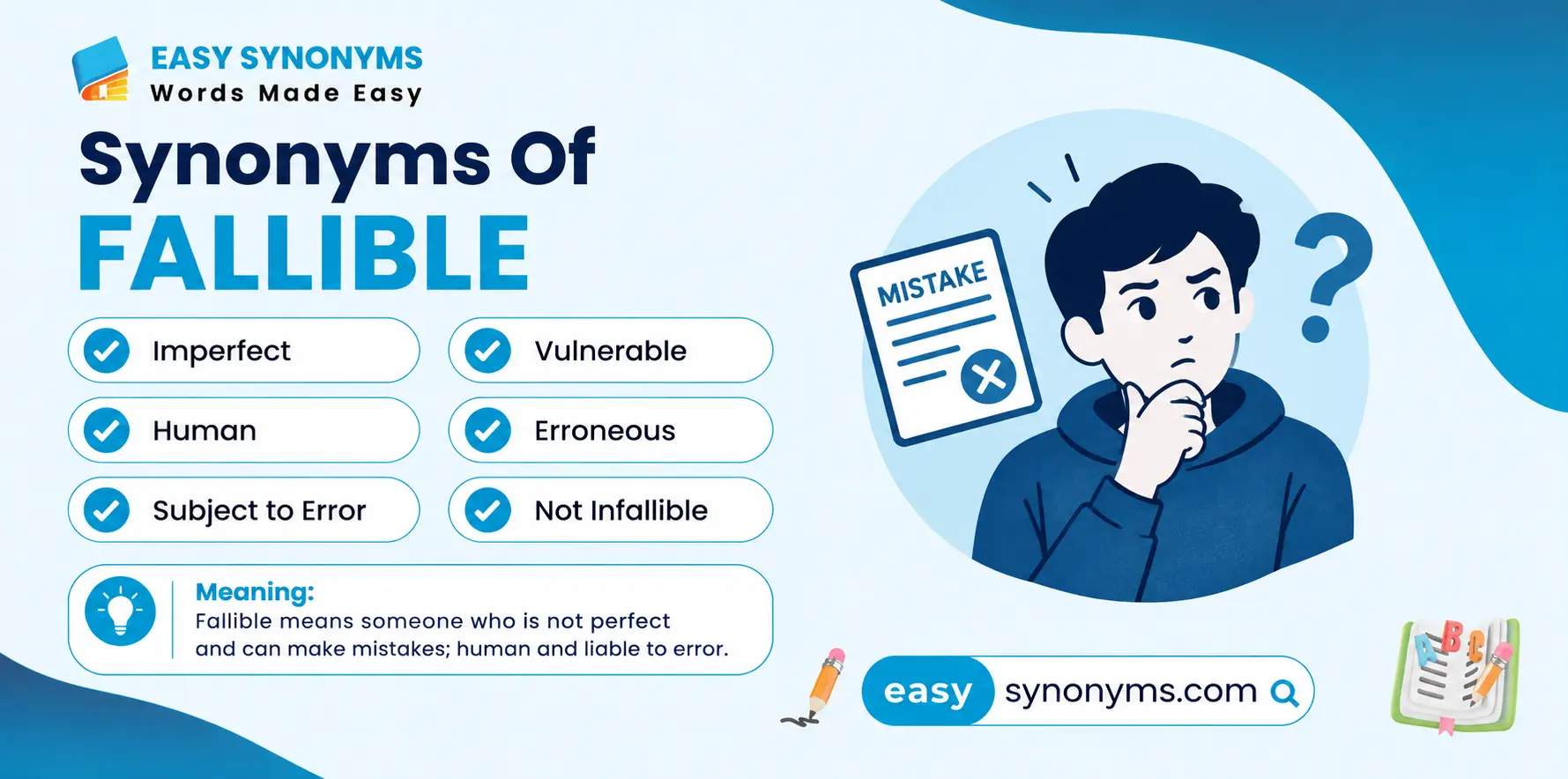

The best synonyms of fallible include imperfect, error-prone, unreliable, flawed, mistaken, inexact, and capable of making mistakes. The right alternative depends on the context.
For example, imperfect is a broad and gentle alternative, while error-prone suggests that mistakes happen often. Similarly, flawed points to a weakness or defect, whereas mistaken usually describes a person or belief that is wrong.
This guide explains the meaning of fallible and shows how to use its synonyms naturally in everyday, academic, professional, and formal writing.
What Does Fallible Mean?
Fallible means capable of making mistakes or being wrong.
The word often describes people, judgments, decisions, systems, or methods that are not perfect. It does not always mean that something is usually wrong. Instead, it means that mistakes are possible.
For example:
“Even experienced doctors are fallible.”
This means that experienced doctors can still make mistakes.
Therefore, fallible is often used when you want to acknowledge human limitations.
Quick Answer: Synonyms of Fallible
| Synonym | Meaning | Best Context |
|---|---|---|
| Imperfect | Not completely perfect | General |
| Error-prone | Likely to make mistakes | Systems, people, processes |
| Flawed | Having a weakness or defect | Ideas, methods, arguments |
| Mistaken | Wrong about something | People, beliefs, judgments |
| Unreliable | Not consistently dependable | People, systems, information |
| Inexact | Not completely accurate | Measurements, information |
| Defective | Having a fault | Objects, systems |
| Limited | Restricted in ability or accuracy | People, knowledge |
| Human | Naturally capable of mistakes | Informal/general |
| Uncertain | Not completely dependable or known | Predictions, conclusions |
| Inaccurate | Containing errors | Information, statements |
| Vulnerable to error | Open to mistakes | Formal/technical |
| Mistake-prone | Likely to make mistakes | People, processes |
| Capable of error | Able to make mistakes | Formal |
1. Imperfect
Imperfect is one of the closest general synonyms of fallible.
It means that something is not completely perfect. When describing a person, it can suggest that the person has limitations or makes mistakes.
For example:
“Human judgment is imperfect.”
This sounds softer than saying that human judgment is unreliable.
As a result, imperfect works well when you want a neutral or gentle tone.
2. Error-Prone
Error-prone means likely to produce or make mistakes.
This term is especially useful for systems, processes, methods, and tasks. It can also describe people who frequently make mistakes.
For example:
“The manual process is error-prone.”
Another example is:
“Even an experienced worker can be error-prone when tired.”
Therefore, error-prone is stronger than the general word fallible because it suggests a higher chance of mistakes.
3. Flawed
Flawed means having a fault, weakness, or imperfection.
It commonly describes ideas, arguments, plans, methods, systems, and reasoning. It can also describe people, although that use can sound more critical.
For example:
“The study was based on a flawed assumption.”
Here, flawed focuses on a weakness rather than simply the possibility of making a mistake.
4. Mistaken
Mistaken means wrong in one’s understanding, belief, judgment, or action.
It is particularly useful when a person reaches an incorrect conclusion.
For example:
“The analyst was mistaken about the results.”
Unlike fallible, mistaken usually describes an actual error rather than the possibility of making one.
Therefore, these words are related but not interchangeable in every sentence.
5. Unreliable
Unreliable describes someone or something that cannot always be trusted to give accurate, consistent, or dependable results.
For example:
“The witness was considered unreliable.”
The word is stronger than fallible. A fallible person can make occasional mistakes. An unreliable person may regularly fail to provide dependable results.
Because of that difference, choose unreliable carefully.
6. Inexact
Inexact means not completely accurate or precise.
This synonym works especially well for measurements, information, descriptions, estimates, and calculations.
For example:
“The available figures are inexact.”
Here, inexact focuses on accuracy rather than a person’s ability to make mistakes.
7. Defective
Defective means having a fault or problem that affects how something works.
It is mainly used for products, machines, systems, or technical components.
For example:
“The testing method was defective.”
However, defective can sound much stronger than fallible. Therefore, it is not a suitable replacement in every context.
8. Limited
Limited means restricted in ability, knowledge, range, or effectiveness.
When used as a contextual alternative to fallible, it emphasizes human limitations.
For example:
“Human knowledge is limited.”
This sentence does not directly say that people make mistakes. Instead, it highlights the limits of what people can know.
9. Human
In some contexts, human can serve as a softer alternative to fallible.
The idea is that making mistakes is a natural part of being human.
For example:
“Everyone is human and capable of making mistakes.”
Similarly, you might say:
“Doctors are human, too.”
This usage is informal and contextual rather than a direct dictionary synonym.
10. Uncertain
Uncertain means not known, definite, or reliable enough to be certain.
It can sometimes replace fallible when discussing predictions, judgments, or conclusions.
For example:
“The prediction is uncertain.”
However, uncertain focuses on doubt rather than the ability to make mistakes.
Therefore, use it only when that meaning fits the sentence.
11. Inaccurate
Inaccurate means containing an error or failing to represent something correctly.
For example:
“The report contained inaccurate information.”
This word describes incorrect information rather than the person or system that may produce it.
As a result, it works better for statements, records, measurements, and information.
12. Vulnerable to Error
Vulnerable to error is a useful formal alternative to fallible.
It means that mistakes can occur because of limitations or weaknesses.
For example:
“Human judgment is vulnerable to error.”
This phrase works particularly well in academic, technical, and professional writing.
13. Mistake-Prone
Mistake-prone means likely to make mistakes.
It is similar to error-prone, but it is usually more natural when describing people or behavior.
For example:
“The new employee was mistake-prone during the first week.”
Although understandable, this term can sound more critical than fallible.
14. Capable of Error
Capable of error is a formal phrase that directly expresses the core meaning of fallible.
For example:
“No measurement system is completely accurate or incapable of error.”
This phrase is useful when precision matters and you want to avoid a more literary word.
Synonyms of Fallible for a Person
When fallible describes a person, these alternatives can work:
- Imperfect
- Human
- Error-prone
- Mistake-prone
- Limited
- Capable of error
- Prone to mistakes
- Capable of making mistakes
For example:
Original:
“Even experts are fallible.”
Alternative:
“Even experts are capable of making mistakes.”
Another natural option is:
“Even experts are human and can make mistakes.”
The second version sounds more conversational.
Synonyms of Fallible for Humans
When discussing human nature, imperfect, human, and capable of making mistakes are useful choices.
For example:
“Human judgment is imperfect.”
You could also write:
“Human judgment can be mistaken.”
Or:
“Human judgment is vulnerable to error.”
The first option sounds general. The last option sounds more formal.
Synonyms of Fallible in Formal Writing
For academic, professional, or formal writing, consider:
- Imperfect
- Error-prone
- Inexact
- Vulnerable to error
- Capable of error
- Limited
- Subject to error
- Prone to error
For example:
“Human decision-making is subject to error.”
This sounds more formal than:
“People can make mistakes.”
Synonyms of Fallible in Simple English
If your readers prefer simple English, replace fallible with phrases such as:
- Able to make mistakes
- Capable of making mistakes
- Not perfect
- Sometimes wrong
- Prone to mistakes
- Able to be wrong
For example:
Formal:
“Human judgment is fallible.”
Simple:
“People can make mistakes in their judgment.”
The second version is easier for most readers to understand.
Fallible vs. Imperfect
Fallible means capable of making mistakes or being wrong.
Imperfect means not completely perfect.
These meanings overlap, but they are not identical.
For example:
“Human memory is fallible.”
This suggests that memory can produce mistakes.
On the other hand:
“Human memory is imperfect.”
This is broader and does not specifically emphasize mistakes.
Therefore, fallible is more precise when error is the main idea.
Fallible vs. Flawed
Fallible emphasizes the possibility of making mistakes.
Flawed emphasizes an actual weakness, defect, or problem.
For example:
“Experts are fallible.”
This means experts can be wrong.
“The expert’s argument was flawed.”
This means the argument had a specific weakness.
Thus, flawed should not automatically replace fallible.
Fallible vs. Error-Prone
Fallible means capable of making mistakes.
Error-prone means likely to make mistakes.
For example:
“Humans are fallible.”
This simply recognizes human limitations.
“The manual system is error-prone.”
This suggests that the system frequently creates or allows errors.
Consequently, error-prone usually has a stronger negative meaning.
Fallible vs. Unreliable
Fallible and unreliable can overlap, but their meanings differ.
A fallible source can make an occasional mistake. An unreliable source is not consistently dependable.
For example:
“Human memory is fallible.”
This is a neutral statement about the possibility of memory errors.
“The source is unreliable.”
This suggests that the source cannot be trusted consistently.
Therefore, unreliable is generally stronger.
Fallible vs. Mistaken
Fallible describes the possibility of being wrong.
Mistaken describes someone or something that is actually wrong.
For example:
“Scientists are fallible.”
This means scientists can make mistakes.
“The scientist was mistaken about the result.”
Here, an actual error occurred.
Therefore, the words should not always be substituted for one another.
Positive or Gentle Alternatives to Fallible
Sometimes, fallible may sound too formal or critical.
In that case, consider:
- Imperfect
- Human
- Limited
- Still learning
- Capable of mistakes
- Not infallible
- Open to error
For example:
“Everyone is imperfect.”
This sounds gentler than:
“Everyone is fallible.”
Likewise, “Everyone can make mistakes” is simple and conversational.
Negative or Stronger Alternatives
When you want to emphasize a serious problem, stronger words may fit better:
- Error-prone
- Flawed
- Unreliable
- Inaccurate
- Defective
- Mistake-prone
- Faulty
However, these words carry stronger negative meanings.
Therefore, avoid using them when you only want to say that mistakes are possible.
Examples of Fallible in Sentences
Here are some natural examples:
- “Even experts are fallible.”
- “Human memory is fallible.”
- “The system is error-prone.”
- “Her judgment was mistaken.”
- “The argument was flawed.”
- “The source proved unreliable.”
- “The measurements were inexact.”
- “Human knowledge is limited.”
- “The report contained inaccurate information.”
- “The process is vulnerable to error.”
- “No decision-making process is completely perfect.”
- “People are naturally capable of making mistakes.”
Common Mistakes When Using Fallible Synonyms
Choosing a synonym based only on similar wording can change the meaning of your sentence.
Instead, identify whether you mean possible error, actual error, frequent error, or general imperfection.
Mistake 1: Using Mistaken for Fallible
These words do not have the same meaning.
Fallible:
“Human judgment is fallible.”
Mistaken:
“His judgment was mistaken.”
The first sentence describes a possibility. The second describes an actual wrong judgment.
Mistake 2: Using Unreliable for Every Context
Unreliable is stronger than fallible.
A fallible person can make mistakes. An unreliable person may regularly fail to provide dependable results.
Therefore, use unreliable only when consistency or trust is the issue.
Mistake 3: Using Flawed for a Person
Flawed can describe people, but it may sound critical.
For a neutral statement, imperfect or capable of making mistakes may be better.
Mistake 4: Confusing Fallible With False
Fallible does not mean false.
A fallible source can sometimes be wrong. That does not mean everything the source says is false.
Related Words to Fallible
Words related to fallible include:
- Error
- Mistake
- Fault
- Failure
- Imperfection
- Accuracy
- Inaccuracy
- Judgment
- Reliability
- Uncertainty
- Human error
- Limitation
- Flaw
- Weakness
These words help describe different aspects of mistakes and limitations.
Antonyms of Fallible
The main antonym of fallible is infallible.
Other contrasting words include:
- Perfect
- Error-free
- Reliable
- Accurate
- Certain
- Unerring
- Flawless
- Dependable
- Trustworthy
However, the best antonym depends on context.
For example, reliable contrasts with fallible when dependability is the focus. Meanwhile, infallible directly contrasts with the idea of being capable of mistakes.
Frequently Asked Questions
What is the best synonym for fallible?
Imperfect is one of the closest general synonyms. Depending on context, error-prone, flawed, mistaken, and capable of making mistakes can also work.
What is another word for fallible person?
You can describe a fallible person as imperfect, human, error-prone, mistake-prone, or capable of making mistakes.
What is a simple synonym for fallible?
A simple alternative is able to make mistakes.
You can also say not perfect or capable of being wrong.
Is imperfect a synonym for fallible?
Yes, in many contexts. However, imperfect is broader, while fallible specifically emphasizes the possibility of being wrong or making mistakes.
Is error-prone the same as fallible?
Not exactly. Fallible means capable of making mistakes, while error-prone suggests that mistakes are more likely or happen frequently.
What is the opposite of fallible?
The direct opposite is infallible. Other contrasting terms include flawless, error-free, accurate, reliable, and unerring.
What does fallible mean in simple English?
In simple English, fallible means able to make mistakes or be wrong.
Can fallible describe a person?
Yes. It commonly describes people because humans can make mistakes.
For example:
“Even the most experienced professional is fallible.”
Is fallible a negative word?
Not necessarily. The word is often neutral and simply recognizes that mistakes are possible. However, the tone can become negative when it is used to criticize someone’s judgment or reliability.
Conclusion
The best synonyms of fallible depend on the exact meaning and tone you need.
Use imperfect for a broad and gentle alternative. Choose error-prone when something is likely to produce mistakes. Meanwhile, flawed emphasizes a weakness, and mistaken describes an actual error.
For formal writing, phrases such as vulnerable to error, subject to error, and capable of error can work well. In simple English, able to make mistakes is a clear and natural choice.
Ultimately, fallible does not mean that someone or something is always wrong. Instead, it means that mistakes are possible. Choosing the right synonym, therefore, depends on whether you want to emphasize imperfection, error, unreliability, or a specific mistake.