


The word exposition has different meanings depending on the context. In literature, exposition refers to the part of a story that introduces characters, setting, background information, and important details needed to understand the plot. In general writing, it means a detailed explanation or presentation of an idea.
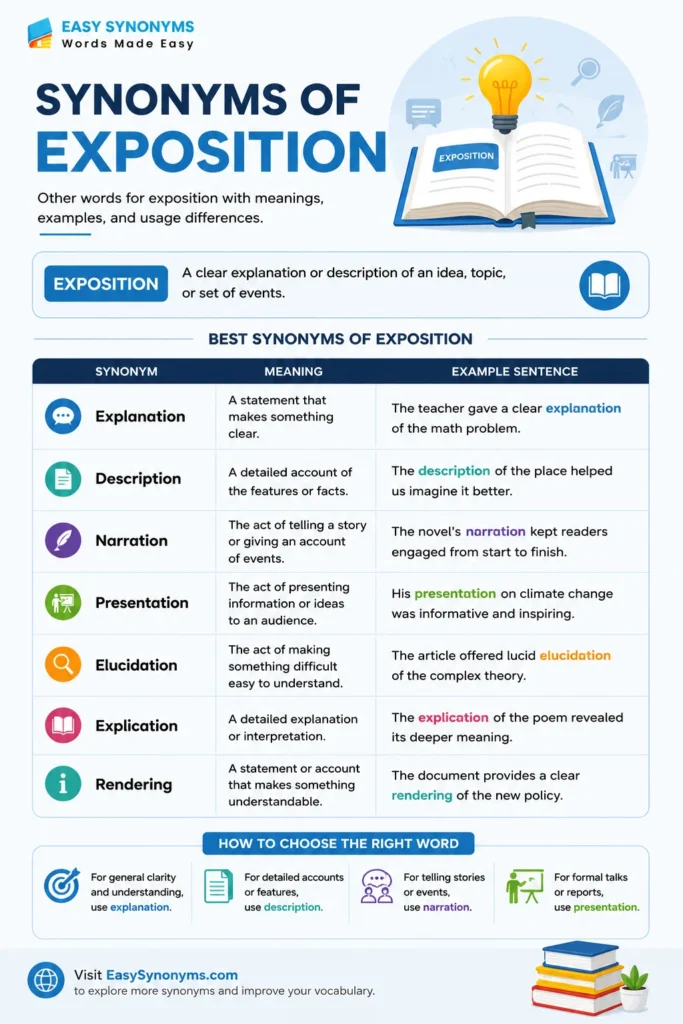
Because of these different uses, the best synonym for exposition depends on where the word appears. A story may use introduction or background, while an academic article may use explanation or elaboration.
This guide explores the most accurate synonyms of exposition, especially those used in literature and storytelling, with examples to help you choose the right word.
Quick Answer: What Are Synonyms of Exposition?
The closest synonyms of exposition include:
- Explanation
- Introduction
- Background
- Presentation
- Description
- Elaboration
- Clarification
- Narration
- Disclosure
- Interpretation
In literature, the most suitable alternatives are usually introduction, background, setup, opening, and context because exposition reveals information about the story world before the main events develop.
Synonyms of Exposition in Literature
In storytelling, exposition has a specific meaning. It introduces the reader to the world of the story by providing essential information about:
- Characters
- Setting
- Historical background
- Relationships
- Important events before the main plot
Because of this, general synonyms like “explanation” do not always work. Writers usually replace exposition with words that describe a story’s opening information.
1. Introduction
Introduction is one of the closest literary synonyms for exposition.
It refers to the beginning section where readers meet the characters, setting, and basic situation.
Example:
- The novel’s introduction explains the main character’s childhood and family background.
Best used for:
- Opening chapters
- Character introductions
- Beginning sections of stories
2. Background
Background refers to information that helps readers understand the circumstances behind the story.
It focuses more on history, context, or previous events.
Example:
- The author provides background about the war that shaped the main character’s decisions.
Best used for:
- Historical details
- Character history
- Previous events
3. Setup
Setup is a modern storytelling term for the information established before the main conflict begins.
It is common in film, television, and creative writing discussions.
Example:
- The opening scenes provide the setup for the hero’s journey.
Best used for:
- Movies
- Screenwriting
- Plot structure
4. Context
Context refers to the surrounding information that helps explain meaning.
It does not always replace exposition, but it describes the purpose of the information being given.
Example:
- The author gives historical context before introducing the central conflict.
Best used for:
- Historical fiction
- Academic analysis
- Literary criticism
5. Opening
Opening is a simple alternative when referring to the first part of a story.
However, it is broader than exposition because an opening may include action, dialogue, or conflict.
Example:
- The opening introduces the village where the story takes place.
Synonyms for Exposition in a Story
When someone asks for a synonym for exposition in a story, these words are usually the best choices:
| Synonym | Meaning in Storytelling | Example |
| Introduction | Beginning information about characters and setting | The introduction presents the hero’s background |
| Background | Previous events or history | The background explains the character’s motivation |
| Setup | Information preparing readers for the plot | The setup creates expectations for the conflict |
| Context | Details that explain the situation | The context reveals why the characters behave this way |
| Opening | The beginning section of the story | The opening introduces the main setting |
Exposition Meaning
Exposition means a detailed explanation, description, or presentation of information.
It comes from the Latin word exponere, meaning “to set forth” or “to explain.”
The word is commonly used in three ways:
1. Literature
The introduction of essential story information.
Example:
The exposition introduces the characters before the conflict begins.
2. Academic Writing
A detailed explanation of an idea or argument.
Example:
The essay provides an exposition of the author’s theory.
3. Public Display
A formal exhibition or presentation.
Example:
The technology exposition displayed new inventions.
Exposition Synonym and Antonym
Synonyms
Depending on context:
- Explanation
- Introduction
- Background
- Presentation
- Description
- Clarification
- Elaboration
- Interpretation
Antonyms
Words with opposite meanings include:
- Concealment
- Confusion
- Obscurity
- Mystery
- Silence
- Uncertainty
Example:
- Exposition reveals information.
- Concealment hides information.
Exposition in a Sentence
Here are examples showing different meanings:
Literature:
- The exposition introduces the protagonist and explains the events that shaped his personality.
Academic:
- The professor’s exposition of the theory helped students understand the concept.
General:
- The museum’s exposition displayed historical artifacts from ancient civilizations.
Synonyms of Exposition Beginning With T
A common related search is for an exposition synonym beginning with “T.”
The closest possibility is:
Treatment
Meaning:
A detailed discussion or presentation of a subject.
Example:
- The book offers a detailed treatment of environmental issues.
However, treatment is not a direct synonym in every context. It works mainly when referring to the way a topic is discussed or handled.
Exposition vs Rising Action
A common literary confusion is the difference between exposition and rising action.
| Exposition | Rising Action |
| Introduces characters and setting | Builds tension and conflict |
| Provides background information | Moves the plot forward |
| Usually appears at the beginning | Comes after the introduction |
| Explains the story world | Develops the main problem |
Example:
- Exposition: Introducing a detective and explaining a past mystery.
- Rising action: The detective discovers new clues and faces obstacles.
Common Mistakes When Finding Synonyms for Exposition
Mistake 1: Using “description” everywhere
Description only focuses on details. Exposition often explains meaning and background.
Mistake 2: Treating “narration” as an exact synonym
Narration tells events, while exposition introduces information.
Mistake 3: Using “beginning” as a replacement
A beginning is a location in the story, but exposition is a storytelling function.
Frequently Asked Questions
What is the best synonym for exposition in literature?
The best literary synonyms for exposition are introduction, background, setup, and context because they describe the information provided to readers before the main story develops.
What is another word for exposition in a story?
Another word for exposition in a story is introduction. Other alternatives include background, setup, opening, and context.
Is exposition the same as introduction?
Not exactly. An introduction is the beginning of something, while exposition specifically provides information needed to understand the story, characters, or situation.
What is the opposite of exposition?
The opposite of exposition is concealment or obscurity because exposition reveals information while concealment hides it.
What are examples of exposition?
Examples include introducing a character’s past, explaining the setting of a novel, describing historical events, or presenting background information before the main plot begins.
Conclusion
The meaning of exposition changes depending on the context. In literature, the strongest synonyms are introduction, background, setup, and context because they describe how writers reveal important story information. In academic and general writing, explanation, presentation, and elaboration are more suitable alternatives.
Choosing the right synonym depends not only on meaning but also on purpose, tone, and situation. A precise word makes writing clearer and more effective.