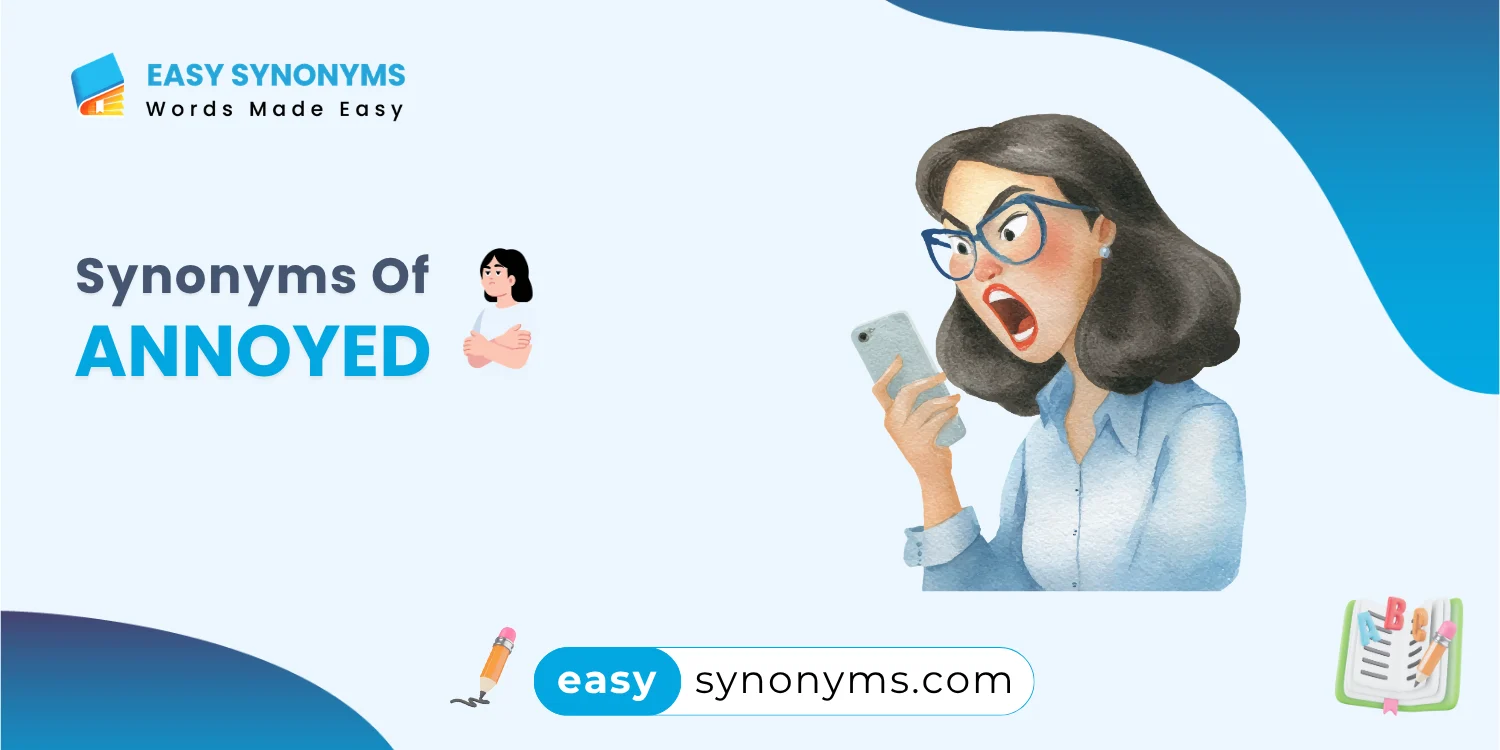

Synonyms of annoyed often come up when you try to describe that small moment when something gets under your skin. Imagine waiting in line, and someone cuts in front. You feel annoyed instantly.
We use synonyms of annoyed daily, even without noticing. A student may feel annoyed during a noisy class, while a writer may feel annoyed by constant interruptions.
Learning synonyms of annoyed helps you express feelings better. Instead of repeating one word, you can sound more natural, clear, and engaging in conversations or writing.
This word is common because everyone feels it. For students, bloggers, and daily English users, knowing better alternatives improves speaking, storytelling, and emotional expression.
📚 What Does “Synonyms of Annoyed” Really Mean?
The word annoyed describes a mild feeling of irritation or discomfort. It is not extreme anger. It sits between calm and angry.
Native speakers use it when something bothers them repeatedly. It often appears in daily conversations, emails, and casual writing.
Part of speech: adjective
Simple definition: feeling slightly angry or irritated because of something unpleasant.
🧠 Connotative Meaning
Positive tone: Rare, but sometimes playful annoyance in jokes.
Negative tone: Common, shows irritation or frustration.
Neutral tone: Used casually to describe mild discomfort.
What is connotation? (It is the emotional meaning a word carries beyond its basic definition.)
📖 Etymology
The word annoyed comes from Old French anoier, meaning “to trouble or harm.”
- Old English (450–1100): No direct form, but similar ideas existed for discomfort.
- Middle English (1100–1500): “Anoien” meant to irritate or harm.
- Modern English (1500–Present): Became “annoy,” meaning to irritate mildly.
Pronunciation:
- US: /əˈnɔɪd/
- UK: /əˈnɔɪd/
Syllables: an-noyed
Affixation Pattern:
- Root: annoy
- Suffix: -ed
📖 SYNONYMS LIST
Irritated (adjective) — /ˈɪrɪteɪtɪd/ | /ˈɪrɪteɪtɪd/
Meaning: feeling slightly angry or bothered.
Examples:
- She felt irritated by the noise.
- He sounded irritated during the call.
Frustrated (adjective) — /ˈfrʌstreɪtɪd/ | /frʌˈstreɪtɪd/
Meaning: feeling upset because something does not work.
Examples:
- She felt frustrated with slow internet.
- He looked frustrated during the task.
Bothered (adjective) — /ˈbɑːðərd/ | /ˈbɒðəd/
Meaning: slightly worried or annoyed.
Examples:
- She seemed bothered by the comment.
- He felt bothered by the delay.
Agitated (adjective) — /ˈædʒɪteɪtɪd/ | /ˈædʒɪteɪtɪd/
Meaning: feeling uneasy and annoyed.
Examples:
- She became agitated quickly.
- He felt agitated in the crowd.
Exasperated (adjective) — /ɪɡˈzæspəreɪtɪd/ | /ɪɡˈzɑːspəreɪtɪd/
Meaning: extremely annoyed after repeated problems.
Examples:
- She felt exasperated by the delays.
- He sounded exasperated on the phone.
Peeved (adjective) — /piːvd/ | /piːvd/
Meaning: slightly annoyed in a quiet way.
Examples:
- She felt peeved about the mistake.
- He looked peeved after the meeting.
Nettled (adjective) — /ˈnɛtəld/ | /ˈnɛtəld/
Meaning: annoyed or irritated.
Examples:
- She felt nettled by the joke.
- He looked nettled at the remark.
Upset (adjective) — /ʌpˈsɛt/ | /ʌpˈsɛt/
Meaning: emotionally disturbed or annoyed.
Examples:
- She felt upset after the comment.
- He looked upset during the talk.
Displeased (adjective) — /dɪsˈpliːzd/ | /dɪsˈpliːzd/
Meaning: not happy or slightly annoyed.
Examples:
- She seemed displeased with the result.
- He felt displeased at the outcome.
Grumpy (adjective) — /ˈɡrʌmpi/ | /ˈɡrʌmpi/
Meaning: easily annoyed and in a bad mood.
Examples:
- She felt grumpy in the morning.
- He sounded grumpy today.
Testy (adjective) — /ˈtɛsti/ | /ˈtɛsti/
Meaning: easily irritated or annoyed.
Examples:
- She gave a testy reply.
- He became testy during the talk.
Cross (adjective) — /krɔːs/ | /krɒs/
Meaning: slightly angry or annoyed.
Examples:
- She looked cross at him.
- He sounded cross on the call.
Cranky (adjective) — /ˈkræŋki/ | /ˈkræŋki/
Meaning: easily annoyed or uncomfortable.
Examples:
- She felt cranky due to lack of sleep.
- He acted cranky all day.
Vexed (adjective) — /vɛkst/ | /vɛkst/
Meaning: annoyed or worried.
Examples:
- She felt vexed by the issue.
- He looked vexed at the mistake.
Annoyed to death (phrase) — /əˈnɔɪd tə dɛθ/
Meaning: extremely annoyed.
Examples:
- She felt annoyed to death by noise.
- He was annoyed to death by delays.
Synonyms of Annoyed Person
When describing a synonyms of annoyed person, native speakers often use words that reflect behavior, not just emotion.
Common choices include:
- Irritable person
- Grumpy individual
- Short-tempered person
- Easily frustrated person
👉 Example:
“He’s a bit irritable today” sounds more natural than repeating “annoyed person.”
Synonyms for Annoyed and Angry
There is a slight difference between annoyed and angry, but some synonyms overlap.
- Annoyed: irritated, bothered, peeved
- Angry: furious, enraged, mad
👉 Bridge words (between both):
- Frustrated
- Agitated
- Exasperated
Annoyed Synonyms and Antonyms
Understanding contrast improves vocabulary.
Synonyms of annoyed:
- Irritated
- Vexed
- Nettled
- Displeased
Antonyms of annoyed:
- Calm
- Pleased
- Relaxed
- Content
Another Word for Annoyed Expression
Instead of repeating “annoyed expression,” try:
- Irritated look
- Frustrated face
- Displeased expression
- Grumpy expression
👉 Example:
“She gave an irritated look” feels more vivid and natural.
Very Annoyed Synonyms
When emotion becomes stronger, use:
- Exasperated
- Furious
- Infuriated
- Aggravated
👉 Example:
“I felt exasperated after waiting for hours.”
Exasperate Meaning
Exasperate (verb) means to make someone extremely annoyed after repeated actions.
👉 Example:
“The constant noise exasperated her.”
Annoyed With Meaning
We often say “annoyed with” or “annoyed at.”
- Annoyed with (a person)
- Annoyed at (a situation)
👉 Examples:
“I’m annoyed with him.”
“I’m annoyed at the delay.”
Annoyed Synonym Starting with “Ne”
A useful but less common synonym is:
- Nettled
👉 Meaning: slightly irritated or offended
👉 Example:
“She felt nettled by the comment.”
🧠 Synonyms for “Synonyms of Annoyed” by Tone
Positive / playful:
- Peeved
- Grumpy
Neutral:
- Bothered
- Upset
- Displeased
Negative / strong:
- Exasperated
- Frustrated
- Agitated
Informal:
- Cranky
- Cross
👉 Tone matters because the wrong word can sound too strong or too weak in context.
⚖️ MINI COMPARISON
Annoyed vs Frustrated vs Exasperated
- Annoyed: mild irritation
- Frustrated: problem blocks progress
- Exasperated: repeated irritation leads to strong emotion
👉 Use annoyed for small issues, frustrated for obstacles, and exasperated for repeated problems.
🧠 CONTEXT-BASED USAGE
Daily conversation:
People say “I’m annoyed” for small issues like noise or delays.
Writing or blogging:
Writers use varied synonyms to avoid repetition and improve readability.
Professional tone:
Use softer words like “displeased” or “concerned.”
Creative writing:
Use stronger words like “exasperated” to show emotion clearly.
⚠️ COMMON MISTAKES & NATIVE USAGE
Mistakes learners make:
- Using “annoyed” for extreme anger
- Repeating the same word too often
- Ignoring tone differences
Register notes:
- Formal: displeased
- Informal: cranky
- Spoken: annoyed, irritated
- Written: varied synonyms
🧩 REAL-LIFE MINI SCENARIOS
Workplace:
You feel annoyed when emails keep coming during meetings.
Social situation:
You feel annoyed when someone interrupts you.
Media:
Characters often look annoyed in tense scenes.
Writing:
Authors use synonyms to show emotional depth.
📝 EXERCISE SECTION
Choose the best synonym:
- She felt ___ when the phone kept ringing.
- He looked ___ after repeated mistakes.
- She became ___ due to noise.
- He felt ___ with slow progress.
- She gave a ___ reply.
- He sounded ___ on the call.
- She felt ___ by the delay.
- He became ___ during the meeting.
- She looked ___ at the comment.
- He felt ___ all day.
🧠 Reflection Task
Write 3 sentences using different synonyms of annoyed in daily situations.
Answer Key: irritated, exasperated, annoyed, frustrated, testy, cross, displeased, agitated, nettled, grumpy
✅ CONCLUSION
Learning synonyms of annoyed helps you express emotions clearly. It makes your speech sound natural and your writing more engaging.
Using different words keeps your content fresh. It also helps you match the right tone in every situation.
Students, bloggers, and speakers benefit from this skill. It improves clarity, confidence, and communication.
Start practicing these words in daily conversations, emails, and writing. The more you use them, the more natural they feel 😊