

Introduction
Finding the right synonym for psychic depends on what you mean by the word. A person described as psychic might supposedly predict future events, perceive information beyond the ordinary senses, communicate mentally, or have unusual intuitive abilities. Those ideas overlap, but they are not identical.
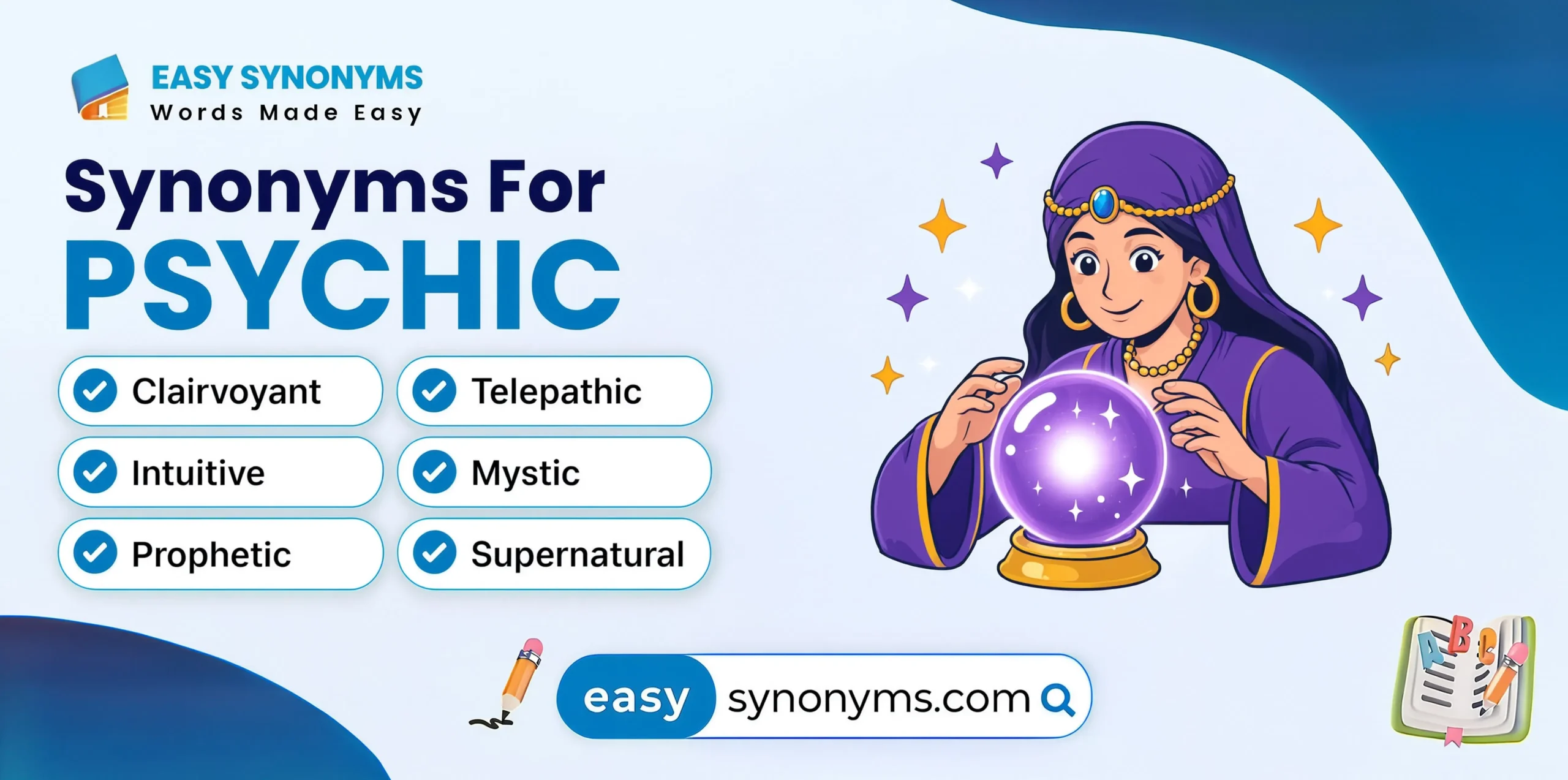
The closest alternatives include clairvoyant, telepathic, seer, diviner, fortune-teller, soothsayer, and medium. Words such as intuitive, perceptive, prophetic, and precognitive can also work in specific contexts, although they do not always mean exactly the same thing.
Choosing carefully matters because each term highlights a different ability, role, or degree of certainty.
Quick Answer
The closest synonyms for psychic include clairvoyant, seer, diviner, fortune-teller, soothsayer, and telepathic, depending on context. Clairvoyant is especially useful for someone believed to perceive hidden information or future events. Telepathic focuses on communicating or knowing thoughts without ordinary physical signals, while intuitive usually suggests instinctive understanding rather than a supernatural power.
Core Synonym Resource
| Word | Relationship | Main Meaning | Best Context | Formality |
|---|---|---|---|---|
| Clairvoyant | Direct/near synonym | Supposed ability to perceive hidden or future information | Future events, visions, supernatural perception | Neutral |
| Seer | Near synonym | Person believed to foresee events | Prophecy, literature, history | Neutral/Formal |
| Diviner | Near synonym | Person who seeks hidden knowledge or predicts events | Traditional or spiritual practices | Formal/Literary |
| Fortune-teller | Contextual alternative | Person who claims to predict someone’s future | Readings, popular culture | Neutral |
| Soothsayer | Contextual alternative | Person who predicts or foretells events | Historical, literary, dramatic contexts | Formal/Literary |
| Telepathic | Specialized alternative | Involving apparent mind-to-mind communication | Mind-reading or mental communication | Neutral |
| Medium | Contextual alternative | Person claiming to communicate with spirits | Spiritualism, séances | Neutral |
| Intuitive | Near synonym | Based on instinctive understanding | Instinct, perception, judgment | Neutral |
| Prophetic | Related/near synonym | Predicting or seeming to predict future events | Statements, warnings, visions | Formal |
| Precognitive | Specialized alternative | Relating to supposed knowledge of future events | Paranormal or scientific discussion | Formal |
| Visionary | Context-dependent | Able to imagine or foresee possibilities | Ideas, leadership, future possibilities | Neutral/Formal |
| Oracle | Contextual alternative | Person or source believed to provide prophecy | Ancient history, mythology, literature | Formal/Literary |
What Does “Psychic” Mean?
Psychic has more than one meaning.
In its supernatural sense, it describes a person or ability associated with supposedly special mental powers, such as knowing what will happen in the future or knowing what another person is thinking. Cambridge also lists psychic as a noun for a person believed to have such abilities.
For example:
She visited a psychic who claimed to know what would happen next.
The word can also relate more broadly to the mind or mental life, so not every use of psychic refers to supernatural abilities. This distinction is important when choosing an alternative.
The Best Synonyms for Psychic
1. Clairvoyant
Clairvoyant is one of the closest alternatives when psychic refers to someone who supposedly perceives things beyond ordinary sensory experience.
It is particularly associated with seeing future events or information that other people cannot see. Cambridge defines a clairvoyant as a person who claims such powers.
Example:
The clairvoyant claimed to have seen a vision of the missing person’s location.
Best choice when: the emphasis is on seeing or perceiving hidden or future information.
2. Seer
A seer is a person believed to have the ability to foresee events, especially future events.
The word often has a literary, historical, or prophetic tone.
Example:
The ancient king consulted a seer before going to war.
Best choice when: you want a concise, somewhat elevated word for someone who supposedly sees the future.
3. Diviner
A diviner is someone who attempts to discover hidden information or predict events through divination.
The word can refer to traditional or spiritual practices and is more specialized than psychic.
Example:
The diviner interpreted the signs before making his prediction.
Best choice when: the context involves a specific method of divination.
4. Fortune-Teller
A fortune-teller is a person who claims to predict someone’s future.
This is often the most familiar everyday alternative when discussing tarot cards, palm reading, crystal balls, or similar practices.
Example:
We visited a fortune-teller who offered to read our futures.
Best choice when: the focus is explicitly on predicting someone’s future.
Unlike psychic, fortune-teller describes a particular role rather than a broad category of supposed supernatural ability.
5. Soothsayer
A soothsayer is a person who predicts or foretells future events.
It is more literary and old-fashioned than psychic or fortune-teller.
Example:
The soothsayer warned the ruler that disaster was approaching.
Best choice when: writing historical fiction, literary prose, mythology, or dramatic descriptions.
6. Telepathic
Telepathic is not a complete synonym for psychic. It is more specific.
It refers to the supposed ability to know what another person is thinking or communicate mentally without ordinary physical signals. Cambridge specifically defines telepathic around this type of mental communication.
Example:
Their communication seemed almost telepathic.
Best choice when: the psychic ability involves thoughts or mental communication.
Do not automatically replace psychic with telepathic. A person can be described as psychic without the claim involving mind-reading.
7. Medium
A medium is a person who claims to communicate with spirits.
This makes it a contextual alternative rather than a universal synonym for psychic.
Example:
The medium claimed that she could communicate with the spirit of the deceased.
Best choice when: the context involves spirits, séances, or communication with the dead.
8. Intuitive
Intuitive means based on intuition or an immediate understanding that does not appear to come from deliberate reasoning.
It can overlap with psychic in casual descriptions, but the two words are not equivalent.
Example:
She had an intuitive sense that something was wrong.
Best choice when: you want to describe strong instinct or perception without necessarily suggesting supernatural powers.
This distinction is especially useful in professional or everyday writing.
9. Prophetic
Prophetic describes something that predicts or appears to predict a future event.
It normally describes a statement, warning, prediction, vision, or message, rather than simply naming a person.
Example:
His warning proved remarkably prophetic.
Best choice when: something appears to have accurately anticipated a future event.
10. Precognitive
Precognitive is a specialized term associated with supposed knowledge of future events before they happen.
Example:
The novel explores the idea of precognitive dreams.
Best choice when: writing about paranormal phenomena, psychology-related discussions, or speculative fiction.
It is more technical than psychic.
Psychic Synonyms by Context
For Someone Who Predicts the Future
Use:
- clairvoyant
- seer
- fortune-teller
- soothsayer
- diviner
- prophet
Example:
She consulted a clairvoyant about her future.
A fortune-teller sounds more everyday, while seer and soothsayer have stronger literary or historical associations.
For Someone Who Claims to Read Minds
Use:
- telepathic as an adjective
- telepath
- psychic
- mind reader as an informal descriptive phrase
Example:
He seemed almost telepathic, as if he knew exactly what she was thinking.
Telepathic is more precise than psychic when the specific ability is mental communication.
For Someone Who Communicates With Spirits
Use:
- medium
- psychic
- spiritualist in appropriate contexts
Example:
The medium claimed to communicate with spirits.
A medium should not be treated as a universal synonym because the term describes a specific claimed ability.
For Strong Instinct or Perception
Use:
- intuitive
- perceptive
- insightful
- discerning
Example:
She was remarkably intuitive about people’s emotions.
These words are usually safer choices in everyday and professional writing because they do not necessarily imply supernatural powers.
Which Word Should You Use?
Choose “clairvoyant” when:
You mean someone who supposedly sees or perceives information unavailable through ordinary senses.
Choose “fortune-teller” when:
The person specifically claims to predict someone’s future.
Choose “seer” when:
You want a concise word with a prophetic or literary tone.
Choose “diviner” when:
The person uses a traditional form of divination.
Choose “telepathic” when:
The ability involves knowing or communicating thoughts.
Choose “medium” when:
The person claims to communicate with spirits.
Choose “intuitive” when:
You mean strong instinctive understanding without necessarily implying supernatural powers.
Choose “soothsayer” when:
You want a historical, literary, or dramatic term for a person who predicts the future.
Psychic vs. Clairvoyant
These words overlap strongly, but clairvoyant is more specific.
Psychic is a broader term for a person or ability associated with supposedly unusual mental or extrasensory powers.
Clairvoyant focuses more specifically on the supposed ability to perceive hidden information or future events. Cambridge also lists psychic as a synonym in the relevant sense of clairvoyant.
Example:
She says she is psychic.
She says she is clairvoyant and can see future events.
The second sentence gives the reader more information about the claimed ability.
Psychic vs. Telepathic
Psychic is broader. Telepathic is specific to supposed mental communication or awareness of another person’s thoughts.
He claimed to have psychic abilities.
He claimed to be telepathic and able to read people’s thoughts.
Use telepathic when mind-to-mind communication is the important detail.
Psychic vs. Intuitive
These words can overlap in casual language, but they carry different implications.
Psychic commonly suggests an unusual or supposedly supernatural ability.
Intuitive generally describes an instinctive understanding or judgment.
Compare:
She has psychic abilities.
She has an intuitive understanding of people’s emotions.
The second sentence does not imply anything supernatural.
Psychic vs. Fortune-Teller
A psychic may claim several different abilities, including predicting the future, perceiving hidden information, or knowing people’s thoughts.
A fortune-teller specifically focuses on telling or predicting a person’s future.
Therefore, fortune-teller is narrower.
Common Mistakes When Choosing a Psychic Synonym
Treating “intuitive” as an exact synonym
Intuitive can describe instinctive understanding without any supernatural implication.
Using “telepathic” for every psychic ability
Telepathy specifically concerns mental communication or knowledge of another person’s thoughts. It does not cover every claimed psychic phenomenon.
Calling every psychic a “medium”
A medium specifically claims to communicate with spirits. The terms overlap, but they describe different roles.
Using “prophetic” as a noun for a person
Prophetic is normally an adjective.
Correct:
Her prediction was prophetic.
For a person, use a noun such as prophet, seer, or soothsayer, depending on context.
Using “fortune-teller” in a technical context
Fortune-teller is natural in everyday language, but a more precise term may be better when discussing a particular supernatural claim or traditional practice.
Related Words
These words are connected to psychic but should not automatically be treated as direct synonyms:
- paranormal — relating to phenomena that are difficult or impossible to explain through established scientific understanding
- extrasensory — involving supposed perception beyond the ordinary senses
- mystical — relating to spiritual or mysterious experiences
- supernatural — attributed to forces beyond ordinary natural explanation
- prophetic — apparently predicting a future event
- precognitive — relating to supposed knowledge of future events
- perceptive — quick to notice or understand things
- insightful — showing deep understanding
These terms become useful when describing the broader concept rather than replacing psychic directly.
Pronunciation of Psychic
Psychic is pronounced:
- US: /ˈsaɪ.kɪk/
- UK: /ˈsaɪ.kɪk/
The initial p is silent.
Frequently Asked Questions
What is the closest synonym for psychic?
Clairvoyant is one of the closest synonyms when psychic refers to someone who supposedly perceives hidden information or future events. Other close alternatives include seer and diviner, although each has a slightly different emphasis.
What is another word for a psychic person?
Depending on the context, you can use clairvoyant, seer, diviner, fortune-teller, soothsayer, or medium. The best choice depends on the claimed ability. A clairvoyant is associated with unusual perception, while a medium specifically claims communication with spirits.
What is a formal synonym for psychic?
Clairvoyant, diviner, seer, and precognitive can work in more formal or specialized contexts. The right choice depends on whether you are describing a person, an ability, or a phenomenon.
What is a synonym for someone who can see the future?
Good choices include clairvoyant, seer, prophet, soothsayer, diviner, and fortune-teller. Clairvoyant is especially appropriate when the person is said to perceive future events through a supernatural ability.
Is telepathic the same as psychic?
Not exactly. Telepathic is narrower. It refers specifically to supposed communication or knowledge between minds without ordinary physical signals. Psychic is a broader term that can cover several claimed unusual abilities.
Is intuitive the same as psychic?
No. Intuitive usually refers to instinctive understanding or judgment. Psychic commonly suggests a supposed supernatural or extrasensory ability. The two can overlap in informal writing, but they should not be treated as exact synonyms.
What is the difference between a psychic and a clairvoyant?
A psychic is a broad term for someone believed to possess unusual mental or extrasensory abilities. A clairvoyant is more specifically associated with supposedly seeing or perceiving information that others cannot, especially future or hidden events.
What is the opposite of psychic?
There is no single perfect antonym. Depending on the intended contrast, you might use ordinary, nonpsychic, conventional, rational, or empirical. The best opposite depends on whether you mean ordinary perception, scientific explanation, or reliance on evidence rather than supernatural claims.
Conclusion
The best synonym for psychic depends on the exact ability or context you want to describe. Clairvoyant is a strong choice for supposed perception of hidden or future information. Telepathic is better for mind-to-mind communication, while fortune-teller emphasizes predicting the future. Seer, diviner, and soothsayer provide more literary or historical alternatives, and medium is appropriate when communication with spirits is central.