
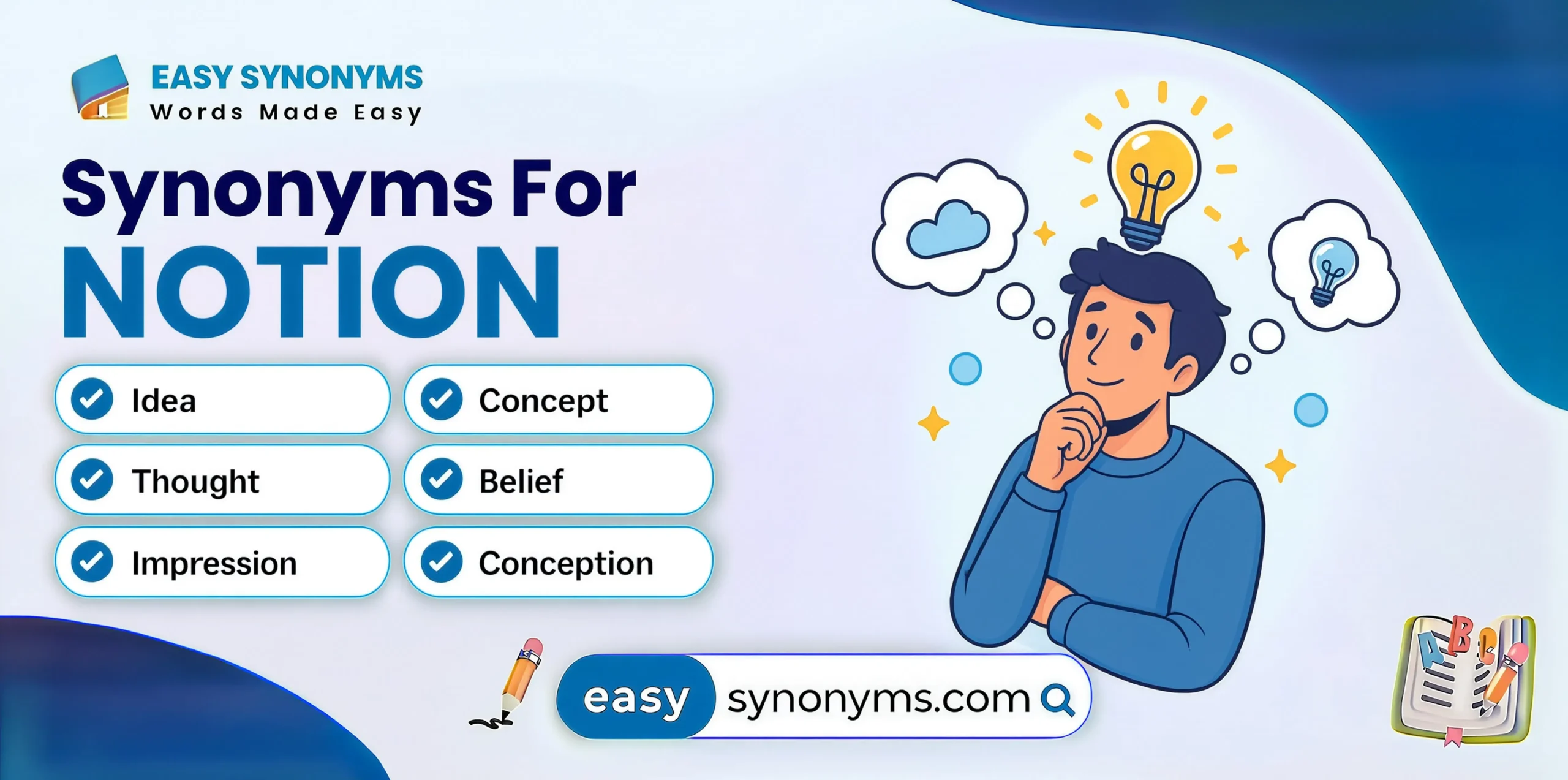

The word notion can mean an idea, belief, opinion, or general understanding. The best synonym depends on what you want to express. For example, idea works well for a general thought, while belief is better when someone accepts something as true.
This guide covers useful synonyms for notion, explains their differences, and shows how to use them naturally in everyday and formal English.
Quick Answer: Synonyms for Notion
Common synonyms for notion include:
- Idea
- Concept
- Thought
- Belief
- Opinion
- View
- Impression
- Understanding
- Assumption
- Conception
- Feeling
- Impression
- Fancy
- Whim
- Inclination
However, these words are not always interchangeable. Each one carries a slightly different meaning or tone.
What Does Notion Mean?
A notion is an idea, belief, or understanding about something. The word often suggests that the idea is general, uncertain, or not fully developed.
For example:
She had a notion that something was wrong.
Here, notion means an idea or belief.
The word can also describe a belief that someone accepts without strong evidence:
He rejected the notion that success comes easily.
In this sentence, notion is close to belief or idea.
Core Synonyms for Notion
| Synonym | Meaning | Best Context |
|---|---|---|
| Idea | A thought or suggestion | General use |
| Concept | An organized or abstract idea | Academic and formal writing |
| Thought | Something that comes to mind | Everyday use |
| Belief | Something accepted as true | Personal views |
| Opinion | A personal judgment or view | Discussions and debates |
| View | A way of thinking about something | Formal and general use |
| Impression | An idea formed from what you notice | First reactions |
| Understanding | Knowledge or awareness of something | Learning and explanation |
| Assumption | Something accepted without proof | Arguments and analysis |
| Conception | A particular way of understanding something | Formal writing |
| Whim | A sudden or unusual desire | Informal contexts |
| Fancy | An imagined idea or desire | Literary or informal use |
1. Idea
Idea is the most common and flexible synonym for notion. It can describe a thought, suggestion, plan, or general belief.
For example:
- I have an idea for a new project.
- She had the idea that he was hiding something.
- That is an interesting idea.
Unlike notion, idea does not usually suggest uncertainty or vagueness.
Best for: everyday English, writing, conversations, plans, and suggestions.
2. Concept
Concept refers to a general or abstract idea. It often appears in academic, technical, business, and professional writing.
For example:
- The concept of equality is important in modern society.
- Scientists are studying a new concept.
- The course explains the basic concept of economics.
Therefore, concept is more precise and formal than notion in many contexts.
Best for: academic writing, professional writing, theories, and abstract ideas.
3. Thought
Thought refers to something that comes into your mind. It can be a simple idea, reflection, or mental process.
For example:
- I had a strange thought this morning.
- The thought never crossed my mind.
- She shared her thoughts about the proposal.
In casual conversation, thought often sounds more natural than notion.
Best for: everyday speech, personal reflections, and casual writing.
4. Belief
Use belief when you mean an idea that someone accepts as true.
For example:
- He has a strong belief in hard work.
- She rejected the belief that money brings happiness.
- Their beliefs are very different.
The key difference is certainty. A belief usually has more personal conviction than a notion.
Best for: personal convictions, values, religion, opinions, and accepted ideas.
5. Opinion
Opinion means a personal judgment or view about something.
For example:
- What is your opinion on this issue?
- In my opinion, the plan needs more work.
- She expressed her opinion clearly.
Notion and opinion can overlap, but opinion usually refers to a person’s judgment about a particular subject.
Best for: discussions, debates, reviews, and personal views.
6. View
View can mean an opinion, position, or way of thinking about something.
For example:
- He has a different view of the problem.
- My view is that we should wait.
- She explained her views on education.
Because it sounds neutral and professional, view works well in both spoken and written English.
Best for: opinions, professional discussions, essays, and formal communication.
7. Impression
An impression is an idea or feeling formed from what you see, hear, or experience.
For example:
- I got the impression that she was upset.
- His first impression was positive.
- The book left a strong impression on me.
Unlike belief, an impression can be based on limited information.
Best for: first reactions, observations, and personal experiences.
8. Understanding
Understanding refers to the way someone knows or interprets something.
For example:
- Our understanding of the problem has changed.
- She has a clear understanding of the subject.
- This explanation improved my understanding.
As a result, understanding is useful when notion refers to knowledge rather than a simple idea.
Best for: education, explanations, knowledge, and formal writing.
9. Assumption
An assumption is something that people accept as true without having complete proof.
For example:
- That conclusion is based on an assumption.
- We should not make assumptions about other people.
- His assumption turned out to be wrong.
This word has a stronger meaning than notion when you want to highlight a lack of evidence.
Best for: analysis, arguments, research, and critical thinking.
10. Conception
Conception can mean a person’s understanding or idea of something. It is more formal than notion.
For example:
- Her conception of success changed over time.
- The theory changed our conception of the universe.
Because the word has a formal tone, it fits better in academic and serious writing.
Best for: academic writing, philosophy, theory, and formal discussions.
Notion as a Vague Idea
One common use of notion is to describe an idea that is not very clear or specific.
For example:
I have only a vague notion of how the system works.
Here, notion means a general understanding.
Other useful alternatives include:
- Idea
- Impression
- Understanding
- Sense
- Concept
The right choice depends on how clear the idea is.
For instance, understanding suggests knowledge, while impression suggests a personal reaction.
Notion as a Belief
Sometimes, notion refers to a belief that may not have strong evidence behind it.
For example:
She challenged the notion that expensive products are always better.
In this context, you could use:
- Belief
- Idea
- Assumption
- View
- Opinion
However, each option changes the tone slightly.
Belief suggests stronger personal conviction. Assumption suggests that the idea may have been accepted without proof. Meanwhile, opinion simply presents a personal view.
Notion as an Opinion or View
The word can also describe someone’s general opinion.
For example:
He has a strange notion about what makes a good leader.
Possible alternatives include:
- Opinion
- View
- Idea
- Belief
- Perspective
Perspective is especially useful when you want to emphasize someone’s particular way of looking at an issue.
Notion as a Whim or Desire
In some contexts, notion can describe a sudden desire or unusual idea.
For example:
She had a notion to travel across the country alone.
Here, words such as whim, fancy, or impulse may work better.
Examples include:
- He acted on a sudden whim.
- She had a fancy for something sweet.
- He followed an impulse and bought the ticket.
These alternatives are more specific than the general word notion.
Notion vs. Idea
Notion and idea are often interchangeable. Still, there is a small difference in tone.
Idea is broader and more common. It can describe a plan, suggestion, thought, or belief.
Notion often sounds more general, uncertain, or abstract.
Compare:
I have an idea for a website.
I have a notion that something is wrong.
The first sentence presents a clear thought or plan. The second suggests a feeling or belief that may not be certain.
Notion vs. Concept
A concept is usually more structured and abstract than a notion.
For example:
The concept of supply and demand is central to economics.
Here, concept is more precise.
On the other hand:
He had a vague notion of how the process worked.
In this sentence, notion fits because the understanding is not complete.
Notion vs. Belief
A belief is something a person accepts as true. A notion can be a simple idea that someone has about something.
For example:
Her belief in honesty is strong.
She had a notion that the meeting would be difficult.
The first sentence shows conviction. The second expresses a less certain expectation.
Notion vs. Opinion
An opinion is a personal judgment. A notion can be broader and may refer to an idea or belief.
For example:
What is your opinion about the new policy?
He rejected the notion that the change would help.
Therefore, opinion works best when someone is giving a personal judgment. Notion works well when discussing a general idea or belief.
Notion vs. Assumption
An assumption is an idea accepted without enough proof. The word often has a critical tone.
For example:
The plan was based on the assumption that prices would remain stable.
By contrast:
She had a notion that prices might increase.
The second sentence sounds less definite.
Common Collocations With Notion
Some combinations with notion are especially common in English.
The notion that
This phrase is often used before a belief or idea.
Example:
He rejected the notion that success happens overnight.
A vague notion
Use this phrase when someone has only a general understanding.
Example:
I have a vague notion of what happened.
A preconceived notion
This means an opinion formed before someone has enough information.
Example:
Try to approach the subject without a preconceived notion.
The very notion
This phrase adds strong emphasis.
Example:
The very notion of giving up was unacceptable to her.
Abandon the notion
This means to stop believing or thinking about an idea.
Example:
He eventually abandoned the notion of moving abroad.
Entertain the notion
This means to consider an idea, even if you may not act on it.
Example:
She began to entertain the notion of starting her own company.
Common Mistakes When Using Notion
Mistake 1: Treating every synonym as identical
Not every synonym carries the same meaning.
For example, concept, belief, and assumption are related to notion, but they serve different purposes.
Mistake 2: Using concept for every idea
A concept is usually more developed or abstract.
For a simple thought, idea or thought may sound more natural.
Mistake 3: Using belief when there is no strong conviction
If someone simply suspects something, notion, impression, or idea may be more suitable.
Mistake 4: Using opinion for a vague understanding
An opinion is a judgment. A vague understanding is better expressed with notion or impression.
Formal Synonyms for Notion
If you need a more formal alternative, consider:
- Concept
- Conception
- Understanding
- Perspective
- Assumption
- Principle
- View
The best choice depends on the sentence.
For academic writing, concept and conception are often useful. In analytical writing, assumption or perspective may be more precise.
Informal Alternatives for Notion
For casual English, these words can work well:
- Idea
- Thought
- Feeling
- Whim
- Fancy
For example:
I had a thought about your problem.
This sounds more natural in conversation than a formal word such as conception.
Example Sentences With Notion Synonyms
Here are simple examples that show how the words differ:
- Idea: She had an idea for a new business.
- Concept: The concept is easy to understand.
- Thought: A strange thought came to mind.
- Belief: His belief in teamwork is strong.
- Opinion: Everyone has an opinion about the issue.
- View: She shared her view during the meeting.
- Impression: I got the impression that he was tired.
- Understanding: Her understanding of the topic improved.
- Assumption: The decision was based on an assumption.
- Conception: His conception of freedom changed.
- Whim: He bought the car on a whim.
- Fancy: She had a fancy for an unusual dessert.
Related Words to Notion
Several words are closely connected to notion but are not always direct synonyms.
These include:
- Thought
- Theory
- Principle
- Perspective
- Mindset
- Judgment
- Perception
- Interpretation
- Belief
- Opinion
- Understanding
- Impression
These words can help expand your vocabulary, but context still matters.
How to Choose the Right Synonym
Start by asking what notion means in your sentence.
If you mean a general thought, choose idea.
If you mean an abstract or structured idea, use concept.
When you mean something accepted as true, belief is often better.
For a personal judgment, choose opinion or view.
If the idea comes from limited observation, impression may fit.
When the idea lacks proof, assumption can be more precise.
Finally, if the meaning involves a sudden desire, whim, fancy, or impulse may work better.
Frequently Asked Questions
What is the closest synonym for notion?
Idea is usually the closest general synonym for notion. Depending on the context, concept, belief, thought, or opinion may be more accurate.
What is a formal synonym for notion?
Common formal alternatives include concept, conception, understanding, perspective, and assumption.
What is a synonym for notion meaning belief?
When notion means belief, useful alternatives include belief, view, opinion, assumption, and conviction.
What is a synonym for notion meaning idea?
When notion means idea, the most natural alternatives are idea, thought, concept, and conception.
Is notion a positive or negative word?
Notion is generally neutral. However, the surrounding words can give it a negative or positive tone. Phrases such as false notion, strange notion, and preconceived notion often suggest criticism.
Can notion mean opinion?
Yes. In some contexts, notion can refer to an opinion or personal view. Still, opinion is usually more direct when you specifically mean a person’s judgment.
What is the difference between notion and idea?
Idea is the broader and more common word. Notion can suggest a general, vague, or uncertain idea, depending on the sentence.
Conclusion
The best synonym for notion depends on its meaning and context. Idea is the most flexible choice, while concept works well for abstract ideas. Similarly, belief fits accepted ideas, opinion suits personal judgments, and assumption highlights an idea without full proof.