

The best synonyms for concerning depend on how the word is used. When concerning means “about,” useful alternatives include regarding, about, related to, pertaining to, with regard to, and in relation to.
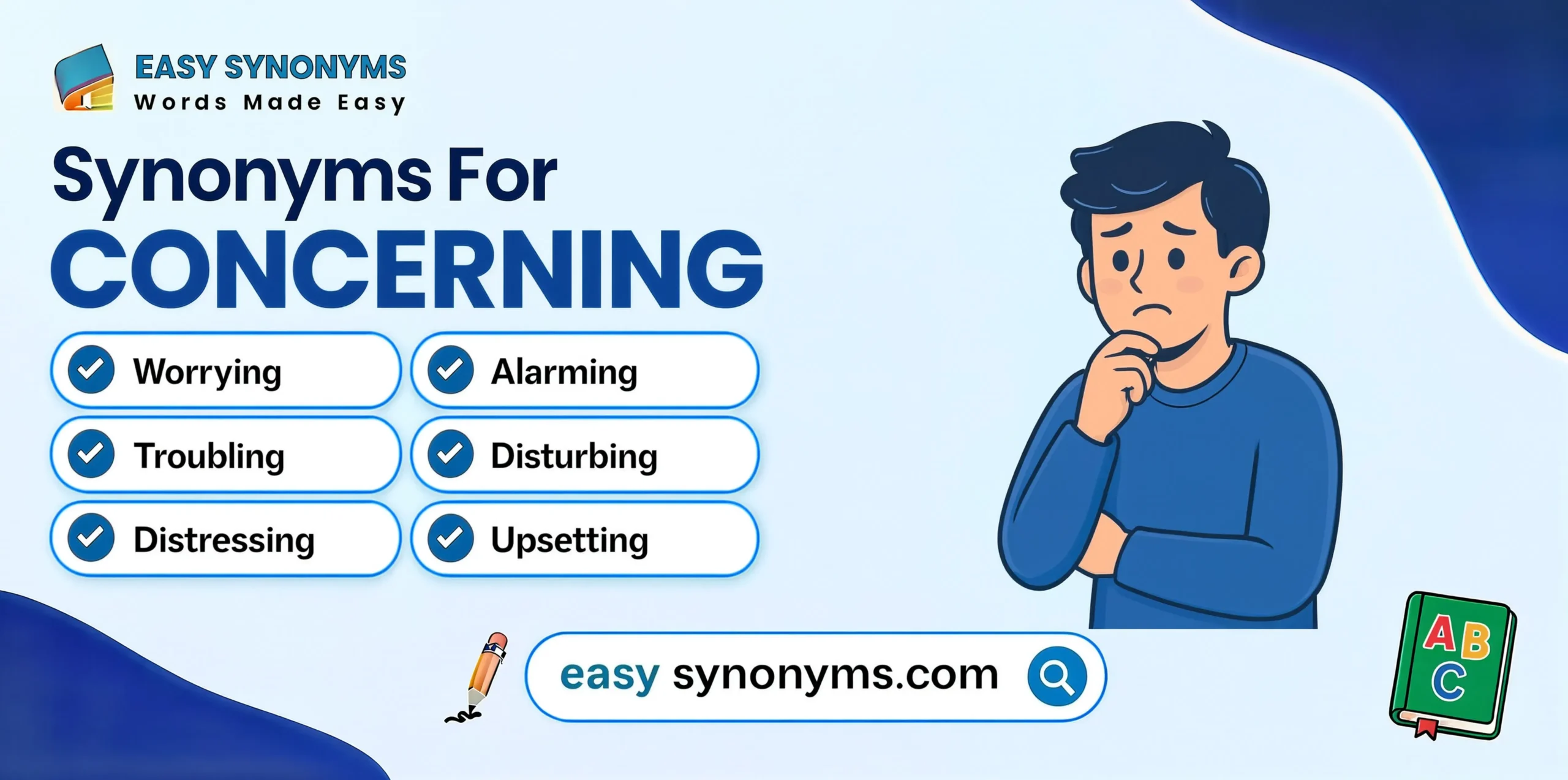
However, concerning can also mean “causing worry.” In that context, alternatives include worrying, troubling, alarming, disturbing, unsettling, and worrisome.
Therefore, context is important when choosing a synonym for concerning. A word that means “about” will not work when concerning means “worrying.”
What Does Concerning Mean?
Concerning has two main meanings in English.
First, it can mean about, regarding, or relating to a particular subject.
For example:
I have a question concerning your application.
Here, concerning simply means “about.”
Second, concerning can mean causing worry, concern, or unease.
For instance:
The sudden change in his behavior is concerning.
In this sentence, concerning means “worrying.”
As a result, you should always consider the sentence before choosing an alternative.
Quick Answer: Synonyms for Concerning
Here are the most useful alternatives:
| Synonym | Meaning | Best Context |
|---|---|---|
| Regarding | About a subject | Formal / General |
| About | On the subject of | Everyday |
| Related to | Connected with | General |
| Pertaining to | Relating to | Formal |
| With regard to | About or relating to | Formal |
| In relation to | Connected with | Formal |
| Relevant to | Connected or applicable | Academic / Professional |
| Worrying | Causing concern | Negative |
| Troubling | Causing unease | Negative |
| Alarming | Causing serious concern | Strong negative |
| Disturbing | Causing emotional concern | Negative |
| Unsettling | Making someone feel uneasy | Negative |
| Worrisome | Likely to cause worry | Negative |
Synonyms for Concerning Meaning “About”
When concerning means about or regarding, the following alternatives are useful.
1. Regarding
Regarding is one of the closest and most common synonyms for concerning when introducing a subject.
For example:
I am writing concerning your recent request.
You can replace concerning with:
I am writing regarding your recent request.
The meaning remains almost the same. Therefore, regarding works especially well in professional emails, business writing, and formal communication.
2. About
About is the simplest everyday alternative to concerning.
For example:
We spoke concerning the new project.
A more natural conversational version would be:
We spoke about the new project.
Although about is less formal, it sounds natural in everyday English. As a result, it is often the best choice for casual writing.
3. Related To
Related to means connected with a particular subject, issue, or situation.
For example:
We received several questions concerning the policy.
You could also write:
We received several questions related to the policy.
This phrase is useful when the relationship between two subjects is important. Moreover, it works well in professional and academic writing.
4. Pertaining To
Pertaining to is a formal alternative to concerning. It means relating to or being connected with something.
For example:
Please review the documents concerning the contract.
A formal alternative would be:
Please review the documents pertaining to the contract.
Because it has a formal tone, pertaining to is common in legal, administrative, and academic contexts.
5. With Regard To
With regard to means about or in relation to a specific matter.
For example:
I have a question concerning your order.
You could write:
I have a question with regard to your order.
This expression is more formal than about. Therefore, it can work well in business communication.
6. In Relation To
In relation to means connected with or concerning a particular subject.
For example:
The company released a statement concerning the incident.
Another option is:
The company released a statement in relation to the incident.
This phrase works well in formal reports, official statements, and professional writing.
7. With Respect To
With respect to is another formal expression meaning about or regarding.
For example:
We have several concerns concerning the agreement.
A formal version could be:
We have several concerns with respect to the agreement.
However, this phrase can sound more formal than necessary in everyday writing. Thus, about or regarding may be more natural in casual contexts.
8. Relevant To
Relevant to means directly connected with or applicable to a particular matter.
For example:
Please provide any information concerning the case.
You could also say:
Please provide any information relevant to the case.
The meanings overlap, but they are not always identical. Relevant to emphasizes usefulness or connection rather than simply introducing a topic.
Synonyms for Concerning Meaning “Worrying”
When concerning means causing worry or concern, different alternatives are needed.
1. Worrying
Worrying is one of the closest everyday synonyms for concerning in this sense.
For example:
The latest results are concerning.
You could write:
The latest results are worrying.
Both sentences express concern about something negative or uncertain. Therefore, worrying is a natural replacement in many situations.
2. Troubling
Troubling describes something that causes worry, discomfort, or concern.
For example:
The report contains some concerning information.
Another option is:
The report contains some troubling information.
This word can sound slightly stronger than ordinary concerning. As a result, it works well when something deserves serious attention.
3. Alarming
Alarming means causing strong concern or fear.
For example:
The sudden increase in complaints is concerning.
A stronger version would be:
The sudden increase in complaints is alarming.
Because alarming has greater intensity, it should not replace concerning in every sentence.
4. Disturbing
Disturbing describes something that causes worry, discomfort, or emotional unease.
For example:
The investigation revealed some concerning details.
You could instead say:
The investigation revealed some disturbing details.
This alternative often carries a stronger emotional meaning. Therefore, use it when the information is particularly troubling.
5. Unsettling
Unsettling means causing someone to feel uneasy or uncomfortable.
For example:
His sudden change in behavior was concerning.
A softer alternative might be:
His sudden change in behavior was unsettling.
Unlike alarming, unsettling does not necessarily suggest serious danger. Instead, it emphasizes a feeling of discomfort or unease.
6. Worrisome
Worrisome means likely to cause worry.
For example:
The decline in sales is concerning.
You could also write:
The decline in sales is worrisome.
This word is common in both everyday and professional English. Moreover, it clearly communicates a negative concern.
7. Distressing
Distressing means causing strong emotional pain, worry, or sadness.
For example:
The news was concerning for the family.
A stronger expression could be:
The news was distressing for the family.
However, distressing focuses more on emotional impact. Therefore, it is not always a direct replacement for concerning.
Concerning vs. Regarding
Concerning and regarding are often interchangeable when they mean “about.”
For example:
I sent an email concerning the meeting.
You can also say:
I sent an email regarding the meeting.
Both sentences mean that the email was about the meeting.
However, regarding is often more natural in professional communication. Meanwhile, concerning can sometimes sound slightly more formal.
Concerning vs. About
About is the simplest alternative to concerning.
For example:
She asked a question concerning the project.
More naturally, in casual English:
She asked a question about the project.
Therefore, choose about when you want a simple and conversational style.
Concerning vs. Pertaining To
Both expressions can mean “relating to.”
For example:
The rules concerning membership are available online.
A more formal version is:
The rules pertaining to membership are available online.
However, pertaining to sounds more formal. Therefore, it is more suitable for legal, academic, or official writing.
Concerning vs. Worrying
These two words can have completely different meanings.
Consider:
I have a question concerning the project.
Here, concerning means about.
Now consider:
The delay is concerning.
In this sentence, concerning means worrying.
Therefore, you should not automatically replace concerning with worrying. The surrounding sentence determines the correct meaning.
Formal Synonyms for Concerning
When concerning means “about,” formal alternatives include:
- Regarding
- Pertaining to
- With regard to
- With respect to
- In relation to
- Relative to
For example:
We received correspondence concerning the agreement.
A formal alternative is:
We received correspondence regarding the agreement.
Similarly, pertaining to can work in legal or administrative writing.
Informal Alternatives for Concerning
For everyday communication, these alternatives sound more natural:
- About
- Related to
- On
- Regarding
For example:
I have a question about your message.
This sentence sounds simpler than:
I have a question concerning your message.
Consequently, everyday English often favors shorter expressions.
Strong Synonyms for Concerning Meaning “Worrying”
If you want to express a stronger level of concern, consider:
- Worrisome
- Troubling
- Disturbing
- Alarming
- Distressing
- Unsettling
However, these words have different levels of intensity.
For example, unsettling can describe mild unease. In contrast, alarming usually suggests a more serious situation.
Example Sentences With Concerning Synonyms
Here are examples for both meanings of concerning:
- Regarding: I contacted the office regarding my application.
- About: She asked a question about the new policy.
- Related to: We received several emails related to the project.
- Pertaining to: The documents pertaining to the case are confidential.
- With regard to: I have some questions with regard to the agreement.
- In relation to: They released a statement in relation to the incident.
- Worrying: The latest figures are worrying.
- Troubling: The report contains some troubling details.
- Alarming: The sudden increase is alarming.
- Unsettling: His behavior was unsettling.
- Disturbing: The investigation uncovered disturbing information.
- Worrisome: The decline in performance is worrisome.
As these examples show, the correct synonym depends on the intended meaning.
Common Collocations With Concerning
When concerning means “about,” common combinations include:
- information concerning
- questions concerning
- issues concerning
- concerns concerning
- rules concerning
- regulations concerning
- details concerning
- documents concerning
- evidence concerning
- decisions concerning
For example:
The report contains important information concerning the project.
When concerning means “worrying,” it commonly appears after verbs such as:
- is concerning
- seems concerning
- remains concerning
- appears concerning
- looks concerning
- is increasingly concerning
For instance:
The latest development is increasingly concerning.
Common Mistakes With Concerning Synonyms
Choosing the wrong alternative can change the meaning of your sentence. Therefore, check whether concerning means “about” or “worrying.”
Mistake 1: Using worrying when concerning means “about”
Incorrect replacement:
I sent an email worrying your application.
The correct alternative is:
I sent an email regarding your application.
Mistake 2: Using regarding when concerning means “worrying”
Consider:
The situation is concerning.
Here, regarding does not have the same meaning. The sentence is describing something that causes concern.
Mistake 3: Using alarming for every negative situation
Alarming is stronger than concerning. Therefore, use it only when the situation creates significant concern or fear.
Mistake 4: Overusing formal expressions
Words such as pertaining to and with respect to are useful in formal writing. However, they may sound unnecessarily complicated in casual communication.
Related Words for Concerning
Depending on the meaning, related words include:
- Concern
- Regarding
- Relevant
- Related
- Pertaining
- Worry
- Trouble
- Anxiety
- Unease
- Alarm
- Distress
- Uncertainty
These words can help you describe both meanings of concerning more precisely.
Antonyms of Concerning
The opposite of concerning depends on its meaning.
When concerning means worrying, possible opposites include:
- Reassuring
- Comforting
- Calming
- Encouraging
- Reassuring
For example:
The latest report was concerning.
The opposite idea could be:
The latest report was reassuring.
When concerning means about, it does not have a simple direct antonym because it functions as a preposition meaning “regarding” or “about.”
Frequently Asked Questions
What is the closest synonym for concerning?
When concerning means “about,” regarding is one of the closest alternatives. When it means “worrying,” worrying or troubling may be appropriate.
What is another word for concerning in formal writing?
Useful formal alternatives include regarding, pertaining to, with regard to, with respect to, and in relation to.
What is a simple synonym for concerning?
About is the simplest everyday synonym when concerning means “about.”
What is a synonym for concerning meaning worrying?
Useful alternatives include worrying, troubling, alarming, disturbing, unsettling, and worrisome.
Is regarding a synonym for concerning?
Yes. Regarding is a close synonym when concerning means “about” or “relating to.”
Is concerning the same as worrying?
Not always. Concerning can mean “about,” while it can also mean “causing worry.” The sentence determines which meaning applies.
What is the difference between concerning and regarding?
When both mean “about,” they are very similar. However, regarding is often a natural choice in professional communication.
What is the strongest synonym for concerning?
For the “worrying” meaning, alarming or disturbing can express stronger concern. However, the best choice depends on the situation.
Conclusion
The best synonym for concerning depends on which meaning you intend. When it means “about,” useful alternatives include regarding, about, related to, pertaining to, with regard to, and in relation to.
When concerning means “worrying,” you can use worrying, troubling, alarming, disturbing, unsettling, or worrisome.
Therefore, always check the context before replacing concerning. For everyday writing, about is simple and natural. Meanwhile, regarding works well in professional communication.
If the word describes something that causes concern, choose an alternative based on intensity. For mild unease, unsettling may work well. On the other hand, alarming or disturbing can express a stronger reaction.
In short, regarding is usually the closest alternative when concerning means “about,” while worrying is a strong everyday alternative when it means “causing concern.”