
Calling someone a clown can mean several things. It may refer literally to an entertainer who performs in a circus, or it can describe someone who behaves foolishly, ridiculously, or in a way that makes other people laugh.
Cambridge recognizes both the entertainer and “silly person” senses of the noun.
Because the meaning changes with context, there is no single perfect synonym for clown.
Buffoon works well for ridiculous behavior, jester fits an entertainer or historical court fool, while comedian is better when the emphasis is on professional humor.
Quick Answer
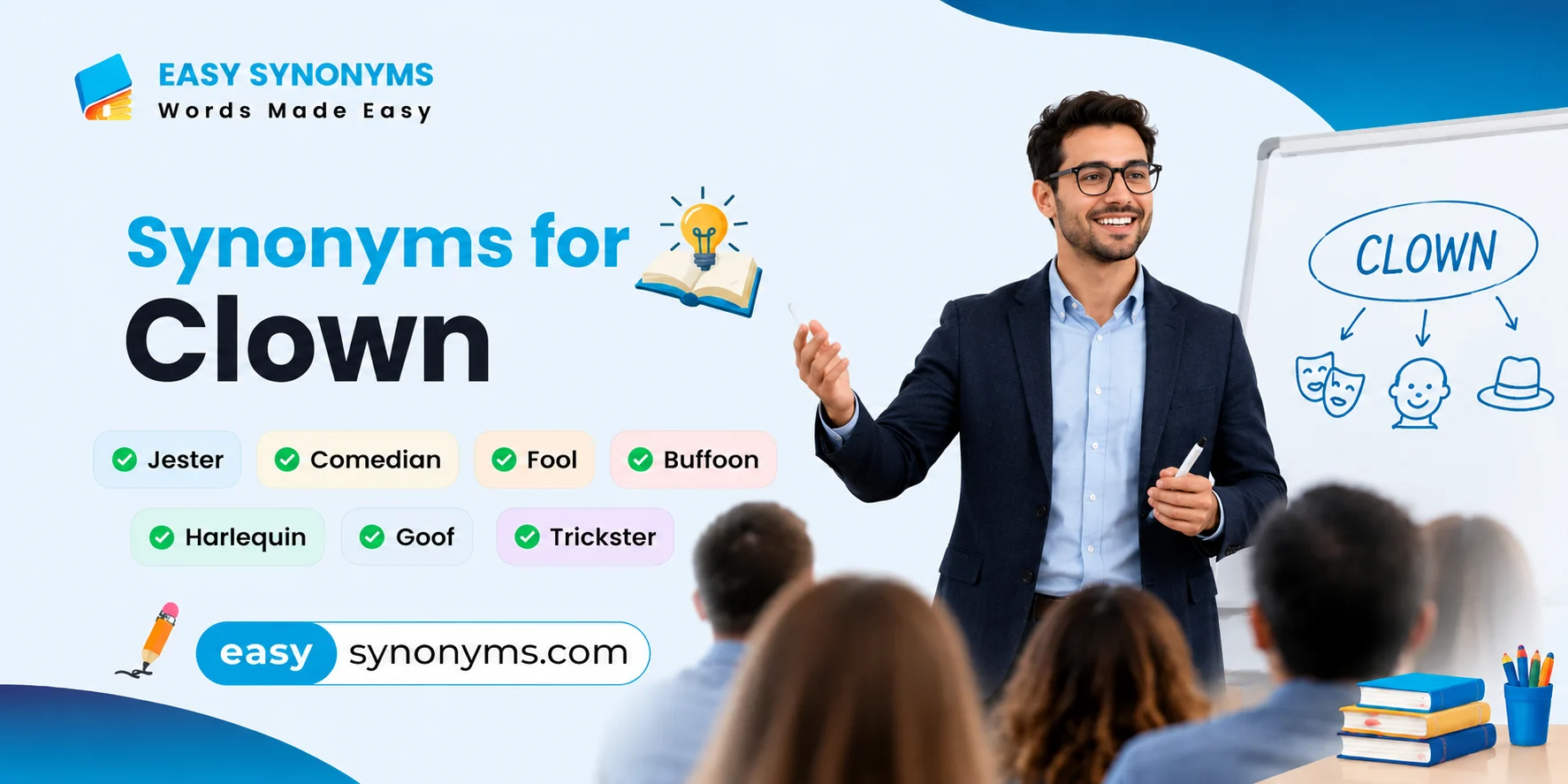
The closest synonyms for clown include buffoon, fool, jester, comedian, joker, comic, prankster, goofball, entertainer, and humorist. The best choice depends on what you mean: a professional entertainer, a foolish person, someone who plays jokes, or someone who behaves ridiculously.
Best Synonyms for Clown at a Glance
| Word | Relationship | Best context | Tone |
|---|---|---|---|
| Buffoon | Near-synonym | Ridiculous or undignified behavior | Negative |
| Fool | Near-synonym | Someone lacking good judgment | Negative |
| Jester | Contextual alternative | Historical or theatrical entertainer | Neutral/literary |
| Comedian | Contextual alternative | Professional humor | Neutral |
| Joker | Near-synonym | Someone who jokes frequently | Informal |
| Comic | Contextual alternative | Comedy performer | Neutral |
| Prankster | Contextual alternative | Someone who plays practical jokes | Informal |
| Goofball | Near-synonym | Silly, playful person | Informal |
| Entertainer | Contextual alternative | Someone performing for an audience | Neutral |
| Humorist | Contextual alternative | Person known for creating humor | Formal |
| Harlequin | Contextual alternative | Traditional theatrical character | Literary |
| Mime | Related/contextual | Silent performer using gestures | Neutral |
| Trickster | Near-synonym | Person who deceives or plays tricks | Neutral/negative |
| Cutup | Contextual alternative | Person who jokes around | Informal |
| Wisecracker | Contextual alternative | Person who makes clever remarks | Informal |
| Show-off | Related word | Person seeking attention | Negative |
| Comic actor | Contextual alternative | Actor specializing in comedy | Neutral |
| Jokester | Near-synonym | Person who constantly jokes | Informal |
| Silly person | Contextual alternative | Someone behaving foolishly | Neutral |
| Goof | Near-synonym | Foolish or inept person | Informal |
| Dunce | Related alternative | Someone considered unintelligent | Negative |
| Laughingstock | Related concept | Person made an object of ridicule | Negative |
| Clownish person | Related expression | Someone behaving ridiculously | Negative |
| Buffoonish person | Related expression | Someone acting absurdly | Negative |
| Amateur comedian | Contextual alternative | Someone attempting humor | Neutral/negative |
The most useful choices
If you need a quick replacement, these are usually the strongest options:
- Buffoon — someone who behaves ridiculously or undignifiedly.
- Fool — someone who acts unwisely or lacks good judgment.
- Jester — an entertainer, especially in a historical or theatrical setting.
- Comedian — someone whose profession is making people laugh.
- Joker — someone who frequently jokes.
- Goofball — a silly, playful person.
- Prankster — someone who plays practical jokes.
- Jokester — someone who enjoys making jokes.
What Does “Clown” Mean?
As a noun, clown has two major meanings.
The literal meaning is an entertainer who uses funny clothing, makeup, tricks, and silly behavior to entertain an audience. The figurative meaning describes someone who behaves foolishly or ridiculously.
For example:
The circus clown entertained the children.
Here, clown refers to a performer.
But:
Stop acting like a clown.
Here, it refers to someone behaving foolishly.
The word can also function as a verb. To clown around means to behave in a silly way, often to make people laugh.
Synonyms for Clown as a Foolish Person
When clown means someone who behaves foolishly or ridiculously, buffoon and fool are among the closest alternatives.
Buffoon
Buffoon is one of the strongest substitutes when you want to criticize someone for ridiculous or undignified behavior. Collins defines it in terms of someone who amuses others through ridiculous or odd behavior and also uses it for a foolish person.
Example:
The politician looked like a complete buffoon during the interview.
Best when: You want a stronger, more critical word than clown.
Fool
Fool emphasizes poor judgment or foolish behavior rather than humor itself.
Example:
Don’t be a fool and ignore the warning.
Unlike clown, fool does not necessarily suggest that the person is trying to make people laugh.
Goofball
Goofball is informal and often more playful than buffoon.
Example:
He’s a lovable goofball who keeps everyone laughing.
Use it when the criticism is lighthearted rather than harsh.
Goof
Goof can describe a foolish or awkward person in informal American English.
Example:
I felt like a complete goof after forgetting the meeting.
Synonyms for a Clown as an Entertainer
If you mean the performer rather than a foolish person, the alternatives change.
Comedian
Comedian is appropriate when the person professionally performs comedy.
Example:
The comedian had the audience laughing throughout the show.
However, comedian is not an exact synonym for clown. A comedian may perform stand-up comedy without wearing makeup or performing physical comedy.
Jester
A jester is especially appropriate for historical, literary, or theatrical contexts.
Example:
The king’s jester entertained the royal court.
It can evoke the traditional court entertainer rather than the modern circus clown.
Comic
Comic can describe a comedian or someone associated with comedy.
Example:
The comic delivered a sharp performance.
It is generally more appropriate for comedy performance than for describing a foolish person.
Entertainer
Entertainer is broader than clown. It can refer to anyone whose job is to entertain an audience.
Example:
The children’s entertainer performed songs, magic tricks, and comedy.
Because it is broader, it should be treated as a contextual alternative, not an exact synonym.
Words for Someone Who Jokes or Plays Tricks
Sometimes you call someone a clown because they are constantly joking or playing tricks.
Joker
Joker is a natural informal choice for someone who likes making jokes.
He’s always been the joker of the group.
Jokester
Jokester has a similar meaning and emphasizes a person’s habit of making jokes.
My brother is a real jokester.
Prankster
A prankster is someone who plays practical jokes.
The prankster hid everyone’s office supplies.
This is different from clown: a prankster specifically involves practical jokes or tricks.
Trickster
Trickster emphasizes deception, clever tricks, or schemes.
The trickster managed to fool everyone.
It can be more negative or strategic than clown.
Wisecracker
A wisecracker is someone who makes clever, sarcastic, or humorous remarks.
He’s a constant wisecracker during meetings.
This is useful when the person’s humor comes mainly through verbal comments.
Which Word Should I Use?
Choose buffoon when:
You want to criticize someone for ridiculous, undignified behavior.
The CEO looked like a buffoon during the presentation.
Choose fool when:
The main issue is poor judgment or foolishness.
Don’t be a fool.
Choose goofball when:
You want a playful, relatively lighthearted description.
Jake is a harmless goofball.
Choose comedian when:
The person professionally performs comedy.
The comedian performed for an hour.
Choose jester when:
The setting is historical, theatrical, or literary.
The jester entertained the king.
Choose prankster when:
The person is known for playing practical jokes.
The prankster covered his friend’s desk in sticky notes.
Choose joker when:
The person regularly jokes around.
He’s the joker in our office.
Clown vs. Buffoon
| Clown | Buffoon | |
|---|---|---|
| Main idea | Funny performer or foolish person | Ridiculous or undignified person |
| Can be literal? | Yes | Rarely |
| Humor involved? | Often | Often |
| Critical tone | Mild to strong | Usually stronger |
| Professional use | Sometimes | Usually inappropriate |
Clown is more versatile because it can describe an actual performer as well as a foolish person. Buffoon is more strongly associated with ridiculous behavior and usually carries a negative judgment. Collins specifically connects buffoon with ridiculous behavior and foolishness.
Clown vs. Jester
A jester is closer to the entertainer sense of clown, particularly in historical or theatrical contexts.
The jester entertained the king.
The clown entertained the children.
The words overlap in their entertainment function, but they evoke different settings. Jester sounds historical or literary, while clown is common in modern everyday English.
Clown vs. Comedian
A comedian is someone who performs comedy, often professionally.
A clown may also entertain people through comedy, but clowning often involves physical performance, visual humor, costumes, makeup, tricks, or exaggerated behavior.
Therefore:
comedian = comedy performer
clown = clown performer or foolish person
Calling every comedian a clown would be inaccurate.
Clown vs. Joker
These words overlap when describing someone who likes to joke.
He’s the joker of the family.
He’s always clowning around.
But joker generally emphasizes joking, while clown can suggest foolish or ridiculous behavior.
Common Mistakes With Clown Synonyms
1. Treating every funny person as a clown
A comedian is not necessarily a clown. The person may simply perform stand-up comedy.
2. Using “prankster” for every clown
A prankster specifically plays practical jokes. A clown does not have to play pranks.
3. Assuming “jester” is always interchangeable
Jester has historical and theatrical associations that clown does not necessarily have.
4. Using “fool” when you mean entertainer
A fool usually emphasizes foolishness rather than professional entertainment.
5. Confusing related words with synonyms
Words such as mime, entertainer, show-off, and laughingstock are related to some senses of clown, but they do not have the same meaning in every context.
Related Words That Are Not Exact Synonyms
Some words belong to the same semantic field but should not automatically replace clown.
- Mime — a performer who communicates through movement and gestures.
- Show-off — someone who tries to attract attention or admiration.
- Laughingstock — someone who becomes an object of ridicule.
- Entertainer — anyone who provides entertainment.
- Dunce — someone portrayed as slow or unintelligent.
- Harlequin — a traditional comic theatrical character.
- Comic actor — an actor specializing in comedy.
These can be useful alternatives in particular sentences, but calling them direct synonyms would be misleading.
FAQ
What is the best synonym for clown?
Buffoon is one of the closest choices when clown means a person behaving ridiculously. If you mean an entertainer, jester, comedian, or comic may be more appropriate depending on the setting.
What is a polite word for clown?
If you want to avoid an insulting tone, comedian, entertainer, or performer may be better choices when you are talking about an actual entertainer. For a foolish person, goofball can sound more playful than buffoon.
What is another word for someone who acts like a clown?
Depending on the intended tone, you could use buffoon, fool, goofball, joker, or jokester. Buffoon is more critical, while goofball is generally lighter and more informal.
Is “buffoon” a synonym for “clown”?
Yes, in the figurative sense. Both can describe someone who behaves in a ridiculous or foolish way. However, buffoon is more strongly negative and does not normally refer to a circus performer.
Is “jester” another word for clown?
Sometimes, but it is better considered a contextual alternative. A jester is traditionally an entertainer, especially one associated with a royal court or theatrical setting.
Is “comedian” the same as “clown”?
No. The words overlap in entertainment and humor, but comedian specifically refers to someone who performs comedy, while clown can also mean a foolish person or a particular type of performer.
What is the opposite of clown?
There is no single exact antonym because clown has multiple meanings. Depending on context, opposites might include serious person, professional, dignified person, or responsible person.
Conclusion
The best synonym for clown depends on what you are trying to communicate. Use buffoon for ridiculous or undignified behavior, fool for poor judgment, goofball for playful silliness, comedian for professional comedy, jester for historical or theatrical entertainment, and prankster for someone who plays practical jokes.
The key is not simply finding a word that looks similar in a thesaurus. The strongest replacement is the one that preserves the original meaning, tone, and context.