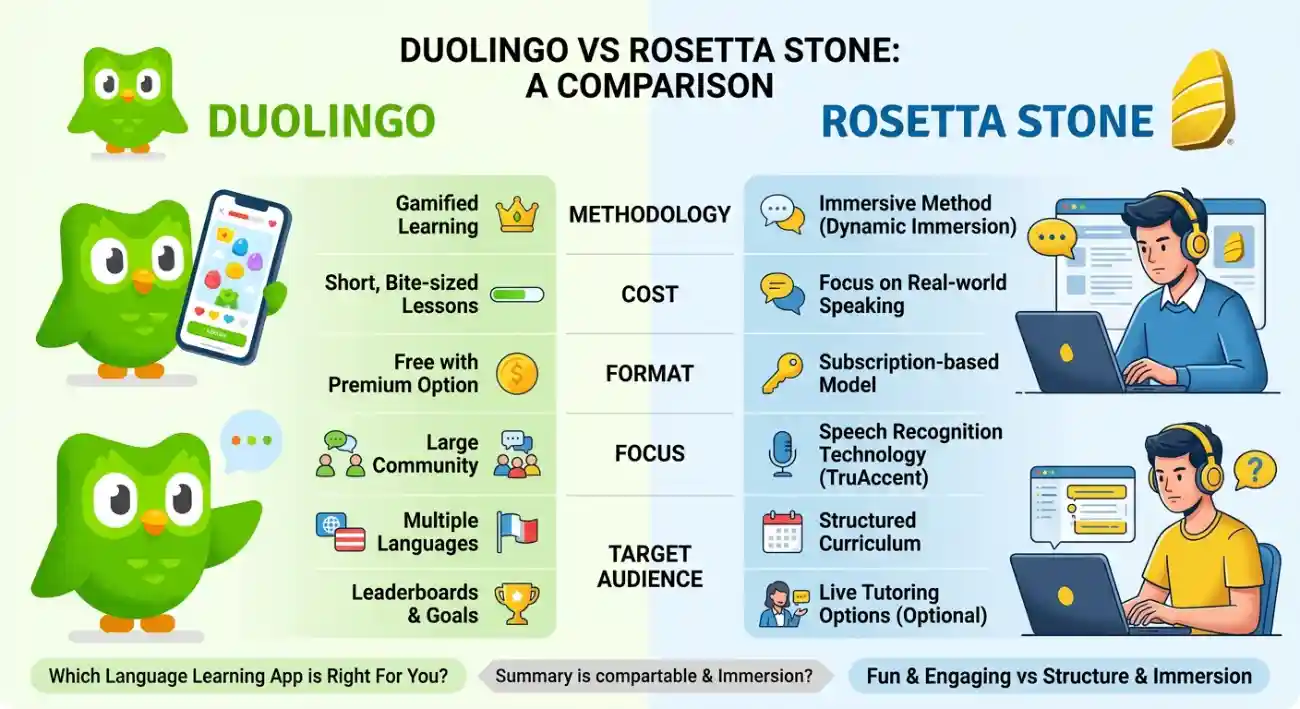

This Duolingo vs Rosetta Stone comparison shows that the two apps use very different teaching styles. Duolingo focuses on short, game-like practice, while Rosetta Stone uses immersive lessons built around images, audio, and the target language. Your choice depends on whether you prefer gamification, immersion, pronunciation practice, language variety, or a structured learning path.
Key Takeaways
- Duolingo offers free language courses with optional paid subscriptions and gamified practice.
- Rosetta Stone centers its lessons on Dynamic Immersion and target-language learning.
- Rosetta Stone includes TruAccent speech recognition for pronunciation practice.
- Duolingo offers a broader selection of languages, while Rosetta Stone currently provides access to 25 languages.
- Neither app replaces regular real-world conversation practice if your goal is confident speaking.
Duolingo vs Rosetta Stone: At a Glance
Duolingo and Rosetta Stone are both established language-learning platforms, but they are designed around different learning experiences.
Duolingo makes language practice feel more like a game. Short activities, streaks, XP, challenges, and other motivational features encourage users to return regularly.
Rosetta Stone takes a more immersive route. Its core Learning Path uses pictures, audio, written language, and contextual clues so learners can connect words with meaning without constantly relying on translation.
| Feature | Duolingo | Rosetta Stone |
| Main approach | Gamified language practice | Dynamic Immersion |
| Free access | Yes | No permanent free plan |
| Paid options | Super and Max | Monthly and yearly subscriptions |
| Language selection | 40+ languages | 25 languages |
| Pronunciation | Speaking exercises and speech features | TruAccent speech recognition |
| Grammar help | Explain My Answer | Grammar learned largely through context |
| Conversation | Speaking practice; AI features on eligible Max courses | Chat Missions and speaking activities |
| Lesson style | Short, game-like activities | Structured immersive lessons |
| Best fit | Habit-focused learners | Learners who prefer immersion |
Features and language availability can change, so users should check the companies’ current plans before subscribing.
How Duolingo and Rosetta Stone Teach Languages
The biggest difference in this Duolingo vs Rosetta Stone comparison is the teaching method.
Duolingo’s Gamified Approach
Duolingo uses short lessons covering skills such as reading, listening, writing, and speaking. Its game-like design uses progress systems and rewards to encourage frequent practice.
This approach can be useful if your biggest challenge is consistency. Instead of setting aside a long study session, you can complete shorter activities and build a daily routine.
Duolingo has also expanded its instructional features. Its Explain My Answer tool, which provides personalized explanations of mistakes, is available free to learners in supported courses. The Practice tab also provides additional ways to review skills.
For learners studying Spanish, French, German, Italian, Portuguese, Japanese, Korean, and Chinese, Duolingo has also expanded advanced course content toward B2 in its newer courses.
Rosetta Stone’s Dynamic Immersion
Rosetta Stone takes a different path with its Dynamic Immersion method.
Rather than repeatedly translating between English and the target language, the lessons use images, spoken language, written words, and context to help learners understand meaning.
For example, instead of immediately giving you the English translation of a foreign word, a lesson may show an image, play the target-language word, and ask you to connect the sound and written form with the image.
The current Rosetta Stone Learning Path is organized into units, lessons, and activities covering skills such as speaking, reading, writing, and listening.
This structure may appeal to learners who want a more traditional course progression while still using an immersive teaching method.
Duolingo vs Rosetta Stone: Features Compared
Speaking and Pronunciation
Speaking is an important difference between the two platforms.
Rosetta Stone includes TruAccent speech recognition throughout its learning experience. It listens to spoken responses and provides pronunciation feedback, making pronunciation practice a central part of the platform.
Duolingo also includes speaking exercises. Its higher-tier Max subscription adds AI-powered conversation features on supported courses, including Video Call and Roleplay.
That means the two platforms can both provide speaking practice, but they approach it differently. Rosetta Stone emphasizes pronunciation within its immersive course, while Duolingo combines speaking exercises with its broader gamified system and optional AI conversation tools.
Grammar and Vocabulary
Duolingo traditionally introduces grammar and vocabulary through exercises and repeated practice. Its newer Explain My Answer feature adds direct explanations for certain mistakes, giving learners more information about why an answer is correct or incorrect.
Rosetta Stone generally teaches grammar through examples and context rather than relying heavily on lengthy grammar explanations.
This difference matters if you like knowing the rule immediately. A learner who prefers explicit explanations may find Duolingo’s explanation features useful, while someone who enjoys discovering patterns through examples may prefer Rosetta Stone’s approach.
Lesson Structure and Practice
Duolingo is built around frequent, bite-sized practice. The app encourages users to maintain momentum through its progress and reward systems.
Rosetta Stone also uses bite-sized activities, but its Learning Path provides a more structured progression through units, lessons, and activities.
The practical difference is simple: Duolingo makes the learning journey feel more like a game, while Rosetta Stone makes it feel more like an immersive digital course.
Conversation Practice
Neither platform should be confused with practicing exclusively with a human conversation partner.
Rosetta Stone currently offers Chat Missions designed around realistic situations, while Duolingo Max provides AI-powered conversation features in supported languages and courses.
These tools can help you practice producing language, but real conversations with people can expose you to accents, interruptions, unexpected vocabulary, and natural responses that an app cannot fully reproduce.
Duolingo vs Rosetta Stone: Pricing
Price is another major difference.
Duolingo’s core language courses are available for free. The company supports the free experience through advertising and optional subscriptions. Super Duolingo adds benefits such as an ad-free experience and unlimited hearts, while Max adds additional AI-powered features.
Rosetta Stone is primarily a paid service. Its current U.S. pricing page lists a monthly plan at $19.99 and a yearly plan at $159, although promotional offers can change the price you actually see at checkout.
Rosetta Stone’s current subscription includes access to all 25 languages. Its platform also includes features such as immersive lessons, TruAccent, Chat Missions, 500+ flashcard sets, and Sapphire Studio.
Because subscription prices and promotions can change, checking the official pricing page before purchasing is important.
Which Languages Can You Learn?
Language availability is another area where the platforms differ.
Duolingo offers more than 40 languages across more than 100 courses, according to the company. Its catalog includes major languages such as Spanish, French, German, Italian, Japanese, Korean, and Portuguese, along with less commonly studied languages.
Rosetta Stone currently offers 25 languages through its Sapphire subscription. Its catalog includes Spanish, French, German, Italian, Arabic, Chinese, Japanese, Korean, Hindi, Portuguese, Vietnamese, and others.
If the exact language you want to study is unusual, check both catalogs before choosing. Language availability can change over time.
Which App Is Better for Different Learning Styles?
There is no single learning style that makes one platform universally suitable.
For Casual Daily Practice
Duolingo’s short lessons, streaks, rewards, and free access can make it convenient for people who want to practice regularly without committing to a paid course.
For Immersion
Rosetta Stone is specifically designed around immersion. Its lessons introduce vocabulary and language structures through target-language context, images, audio, and repetition.
For Pronunciation Practice
Rosetta Stone places strong emphasis on pronunciation through its TruAccent technology. Duolingo also provides speaking exercises and, for eligible Max users, additional AI conversation practice.
For Learners Who Want More Language Choices
Duolingo has a broader language catalog, with more than 40 languages compared with Rosetta Stone’s current 25-language subscription catalog.
Can Duolingo or Rosetta Stone Make You Fluent?
An app can be an important part of language learning, but completing app lessons is not automatically the same as becoming fluent.
Language ability develops through multiple skills: understanding speech, reading, writing, pronunciation, vocabulary, grammar, and spontaneous conversation.
Duolingo itself says its courses can help learners make progress, while its newer popular-language courses now include content reaching B2-level material. Rosetta Stone likewise provides structured learning beyond basic vocabulary and includes speaking and listening activities.
Still, if your goal is comfortable real-world conversation, it is useful to combine app-based study with activities such as listening to native speakers, reading authentic material, writing, and speaking with other people.
Pros and Cons of Duolingo and Rosetta Stone
Duolingo
Pros
- Free access to core courses
- Strong habit-building design
- Short and convenient lessons
- More than 40 languages
- Free grammar explanations in supported courses
- Optional AI conversation features with Max
Cons
- Free users encounter ads and usage limitations
- Some advanced features require a subscription
- Gamification may not appeal to learners who prefer a traditional course
- AI conversation is not the same as speaking with a person
Rosetta Stone
Pros
- Strong immersion-based approach
- Structured Learning Path
- TruAccent pronunciation feedback
- 25 languages included with the current subscription
- Conversation practice and flashcards
- Additional learning tools through Sapphire
Cons
- Primarily a paid platform
- Immersion can feel less intuitive if you prefer explicit explanations
- Its language catalog is smaller than Duolingo’s
- App practice should still be supplemented with real conversation
Duolingo vs Rosetta Stone: Which Fits Your Goals?
The choice becomes easier when you start with your own learning goal.
If you want free access, short practice sessions, gamification, and a large language selection, Duolingo’s design may fit those requirements.
If you want target-language immersion, a structured learning path, and dedicated pronunciation feedback, Rosetta Stone provides features built around those priorities.
For someone preparing for a trip, either platform can provide useful vocabulary and basic practice. For someone focused heavily on pronunciation, Rosetta Stone’s TruAccent may be particularly relevant. For someone who struggles to practice consistently, Duolingo’s game-style system may make daily study easier to maintain.
The important point is that the two services are not identical products. Comparing only their prices misses the larger difference in how they teach.
Frequently Asked Questions
Is Duolingo better than Rosetta Stone?
They are designed differently rather than offering exactly the same learning experience. Duolingo emphasizes gamified, frequent practice and offers free access to its core courses. Rosetta Stone emphasizes Dynamic Immersion, structured lessons, and pronunciation practice with TruAccent. The more suitable option depends on your budget, preferred teaching method, target language, and learning goals.
Is Rosetta Stone worth paying for?
Rosetta Stone can make sense for learners who specifically want an immersive, structured course and pronunciation feedback. Its current U.S. plans are paid, with access to 25 languages. Whether the subscription provides enough value for you depends on how often you use the course and whether its immersion-based method matches the way you prefer to study.
Which is better for pronunciation?
Rosetta Stone puts particular emphasis on pronunciation through its TruAccent speech-recognition technology. Duolingo also includes speaking exercises and offers AI conversation features on eligible Max courses. If pronunciation feedback is a central requirement, compare the specific speaking tools available for your target language before subscribing.
Is Duolingo really free?
Yes. Duolingo provides free access to its language courses. The free experience is supported by advertising, while Super Duolingo and Duolingo Max provide additional features. Some features and course tools can vary by language, platform, and subscription level.
Can you become fluent with Duolingo?
Duolingo can help develop language skills and provides increasingly advanced content in several major courses, but app study is only one part of becoming proficient. For strong real-world communication, combine structured app practice with listening, reading, writing, and regular conversations with other speakers.
Conclusion
This Duolingo vs Rosetta Stone comparison shows two different approaches to learning a language.
Duolingo focuses on accessibility, frequent practice, gamification, and a broad language catalog. Rosetta Stone focuses on immersive instruction, structured lessons, and pronunciation practice.
Before choosing, consider the language you want to learn, how much you want to spend, whether you prefer translations or immersion, and how much speaking practice you need.
The platform that matches those practical requirements is more important than choosing based on the brand name alone.