
Walk into almost any ten- to 3 hundred and sixty-five-one-year-old commercial enterprise building and ask the center’s manager what they had modified. Nine times out of ten, the solution includes power. A panel is, in reality, honest. A transformer that runs warm every July. A parking lot wherein no automobile can plug in an unbranded charger without a six-digit code.
None of this takes place because of the reality that a person made an inept preference. It happens because of the truth that the high-quality design spoke back the question “what do those properties need nowadays?” and stopped there.
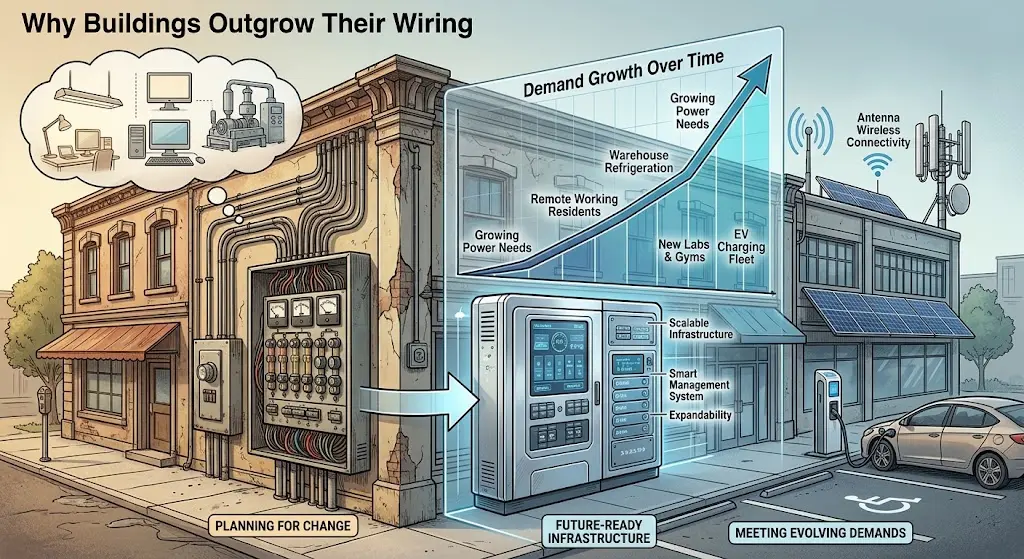
Properties do not stand now, but. A warehouse offers refrigeration. A condo block gets residents who all make money working from home. A college installs new labs, then a fitness center, then a bus fleet; this is going charging in an unmarried day. Demand no longer regularly drops. It climbs sideways and upward, Electrical Estimating normally faster than every person expected.
That’s why strong infrastructure deserves the same long-term, varied thinking as the reality of the construction’s shape or its format. For building owners, the electrical backbone is one of the few systems that quietly influences what the building is allowed to grow to be. Get it right and new tenants, new equipment, and new suggestions slide in without drama. Get it wrong, and every ambition runs proper proper right right into a wall of copper and conduit.
The cost of hysteria is straightforward to miss because it shows up later. A deal falls through. A retrofit takes eight months in an area of 8 weeks. A manufacturing loses rate because of the fact customers see a high-priced beautify looking in advance to them. Planning for change costs a touch greater at the start. Ignoring it makes charges some distance more, and often at the worst possible time.
The Traits of a System Built to Stretch
What separates a bendy setup from a brittle one? It’s not a unmarried product or brand. It’s a tough and speedy way of conduct baked into the format. Here are the inclinations really well, certainly, simply, and worth looking for.
- Spare capability for a cause. Not wasteful oversizing, but a deliberate margin in transformers, switchgear, and feeders. Fifteen to thirty percent headroom is a common place to begin.
- Physical room to boom. Empty conduit, extra wall area beside the primary panel, and a software application program room that is not packed to the ceiling.
- Clear separation of circuits. Loads grouped with the useful resource of reason so you can trade one area without shutting down a few first-rate.
- Open communication is vital. Meters, controllers, and batteries that communicate using non-proprietary protocols, so that you are not trapped with the useful resource of one enterprise employer.
- Accurate, exact documentation. Drawings that show what’s clearly within the partitions. You’d be surprised how uncommon that is.
- Metering at beneficial elements. If you cannot see where power goes, you can not plan where it ought to go in the long run.
Underneath all of this sits the concept of modular structures. Think of constructing blocks in place of an un-molded poured slab. A modular battery cabinet can double in duration through connecting with devices. A modular switchboard accepts new breakers without a rebuild. Each piece stands on its very own but connects cleanly to the rest.
A scalable format furthermore respects time. It now does not try to anticipate the following two to 3 years flawlessly, due to the reality that, in truth, no man or woman can. Instead, it continues options open and makes each preference lots a great deal much less costly. That’s an extremely goodthought-sett from “gather it huge and need,” and in reality, it’s far more humble.
Fixed Versus Flexible, Side by Side
Sometimes a desk says it quicker than paragraphs can. Here’s how the two strategies commonly test, as brief as a building is up and strolling.
| Factor | Fixed Design | Flexible Design |
| Upfront Cost | Lower | Moderately higher (typically 5–15%) |
| Adding a New Large Load | Major remodel, prolonged outage | Plug-in upgrade, quick outage |
| Panel and Conduit Space | Tight, no spare capacity | Reserved room for expansion |
| Equipment from Different Vendors | Often incompatible | Works through open standards |
| Visibility into Usage | Basic monthly bill | Circuit-level data |
| Response to New Regulations | Costly retrofit | Manageable adjustment |
| Effect on Resale or Lease Appeal | Neutral to negative | Positive, a selling point |
| Ten-Year Total Cost | Frequently higher | Frequently lower |
The untimely hole is real, and it is why many obligations select out the regular path. But take a look at the bottom rows. Flexibility now does not lose out over a whole decade, due to the fact the costly surprises are those it avoids. A production that could take shipping of a modern-day-day-day load in a weekend is in truth clearly nicely properly genuinely actually nicely worth multiple that goals 1 / four-prolonged production project to mention notable.
One caution: do not take a look at the possibilities as ensures. Costs range with the resource of region, Estimating Companies with the useful aid of constructing type, and with the useful beneficial useful useful resource of strategies messy the winning setup is. Treat them as a hard manual to your first conversation with an engineer.
What Growth Is Actually Worth
People talk about “scaling” as though it has been a vague, actual difficulty. Let’s get specific about where the fee lives.
It protects against the route of load increase. Most homes see regular load increases from small, stupid changes: more devices, greater cooling, more servers in a closet, not individual, deliberate changes. Add a few elements, like an enterprise corporation employer kitchen or a production line, and the curve jumps. A tool with room absorbs the jump. One without room forces a software program application, software utility, software program upgrade that would take twelve months in reality to time desk.
It makes new technology reasonably priced to adopt. Take EV charging. Five years into the future, some chargers may be a perk. Today, tenants, employees, and region net net page website website traffic anticipate them, and fleets are electrifying. A net-net page with spare conduit and panel functionality can add a dozen chargers in weeks. A net-net website online without it might face trenching, new troubles, and an extended wait. Same story with solar integration. Panels and batteries can be part of a construction that has been designed with a place for them, without trouble. Otherwise, you are squeezing inverters into corners and rerouting circuits.
It keeps tenants and customers involved. Businesses signal longer rentals in houses that might not maintain all of them over again. Buyers pay extra at the same time, as they may see an easy path to boom. Capacity is an element you could have problems with.
It lowers risk. Every unplanned outage is a threat of elimination, overspending, and downtime. Flexibility turns big, frightening alternatives into small, everyday ones.
It improves running prices. Better metering and controllable masses will allow you to shift usage a long way from high-priced peak hours. Some houses lessen call for costs pretty clearly through seeing their very personal patterns for the number one time.
Value compounds proper proper right right right proper right here. The first decade is easy, so the second one takes place quicker, and the development keeps pace with its private hobbies in location of lagging within the lower lower all over again of them.
A Mid-Size Office Block, Ten Years On
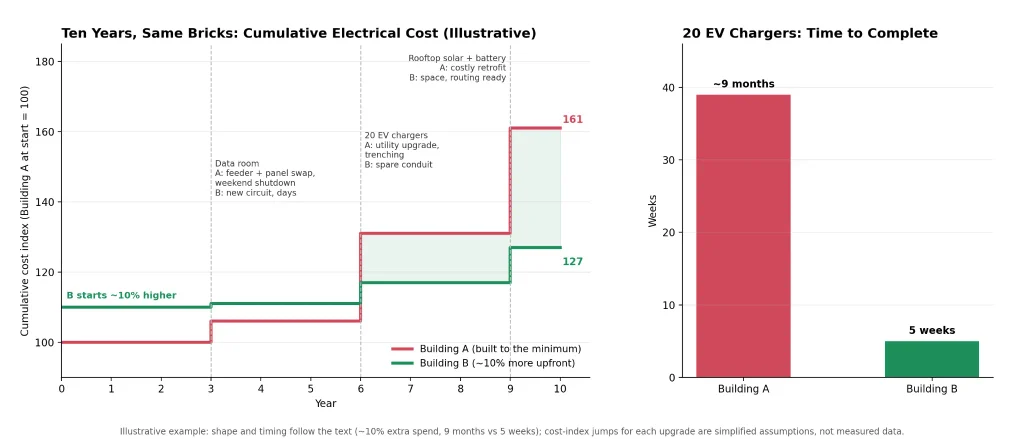
Let’s make this concrete with an illustrative example. The numbers are simplified, but the pattern is one engineers see all the time.
Picture the six equal six-storey office blocks, constructed identically over 3 hundred and sixty five days inside the same city. Each has a 1,000 kVA enterprise.
Building A was designed to the minimum. The electrical room is comfortable. Every breaker slot is used. Conduits run inside the path. Documentation exists, greater regularly than now, but the fact is that a few modifications have been in no way recorded.
Building B spent approximately 10% more on electric powered powered powered powered art work. It has a transformer sized with 25% headroom, a switchboard with empty bays, spare conduits to the auto park, a roof vicinity marked for Destiny Sun, and a critical monitoring tool on each floor.
In 3 hundred and sixty 5 days three, a tenant wants to open a small facts room. Building A has a cutting-edge feeder and a panel alternative with a weekend shutdown and an invoice that surprises anybody. Building B drops a modern circuit right, right proper into a reserved slot.
In 365 days, the owners want twenty EV chargers. Building A’s company is, in a form of, maxed out, so it desires a software program enhancement, trenching, and approximately nine months. Building B uses its spare conduit and headroom, allows load control so the chargers use energy intelligently, VDC Services and finishes in 5 weeks.
In 365 days 9, the owners need rooftop sun and a battery. Building B already has vicinity, routing, and a meter that tells them where the exquisite healthful is. Building A starts offevolved offevolved offevolved off advanced; but, each precise costly have a take a look at.
By three hundred and sixty-five days ten, Building B has spent more at the start, and in the long run a lot less every day. It’s also a first-rate deal, much less complex to rent. Same bricks, very specific future.
Practical Tips Before You Pour Concrete
You do not want a massive fee range to reap flexibility. You need some clever options early, at the same time as adjustments are priced. Here are some tips that keep up in actual responsibilities.
- Run empty conduit at the same time because the partitions are open. It costs nearly nothing now and a fortune later. Pull strings through it so data cables are clean to feed.
- Size the primary room generously. Leave at least one more panel nicely, well in reality, nicely nicely worth of wall space, plus clean walking get right of access to.
- Ask for an increase in the situation; no longer a superb load calculation. Have your engineer check what takes location if name for rises with the beneficial beneficial resource of way of 30% or 50%. Seeing the solution shapes better options.
- Reserve space for batteries and inverters. Even if you do not install them, the choice has real expenses.
- Choose a machine with open protocols. Before you purchase, ask how it talks to 1-of-a-kind devices and who can carry it.
- Install sub-metering early. Floor-metering, usage of ground or tenant-usage data, can pay for itself quickly.
- Plan charging in degrees. Install the infrastructure for masses of chargers, then add the devices as names for scenes.
- Keep drawings sincere. Update them after every exchange. An accurate drawing saves days of guesswork.
- Talk to the software program utility early. Learn their lead times and functionality limits earlier than you want them.
- Review every few years. Set a calendar reminder. Needs go along with the glide, and a short test-up catches issues in the same time as they may be reasonably-priced.
None of these is glamorous. That’s the factor. Flexibility comes from loads of small, practical alternatives stacking up, no longer from one dramatic gesture.
Final Thoughts
An asset is an extended-term wager on the future. Its strength infrastructure wants to be treated identically, as something that grows with the improvement in a place of a few problems the construction has to tiptoe around; you cannot recognize precisely what’s coming. Nobody can count on how quickly charging, warm-temperature pumps, and the internet era may reshape the call. What you may do is leave doors open. Spare functionality, physical location, easy records, and bendy device flip unknowns into functionality options.
For property owners, the message is simple. A bit more concept and a modest rate range nowadays can save you from a painful, costly scramble later. Build together with you count on change, due to the fact you need to. The homes that maintain prevailing tenants and keep prices aren’t frequently people with the flashiest device. They’re the ones that could say “immoderately outstanding” at the same time as a few new records come along.
FAQs
How much do I want to pay for a flexible electric layout?
Most duties land someplace between five% and 15% above a bare-minimum layout, even though it is primarily based absolutely upon the construction type and network charges. The spend typically is going toward spare functionality, more conduit, and better metering. Ask your engineer to charge each version through Facet so you can see the distinction in reality.
Can present-day manufacturing be advanced, or is that the simplest for contemporary-day manufacturing?
Older homes can in fact be improved. Start with an audit to find out what capability is virtually available and where the bottlenecks are. Often, which includes sub-metering, tidying documentation, and putting in load control, gives you an opportunity an extended way earlier than any critical work is wanted.
Is it better to oversize everything to be consistent?
Not in truth. Oversizing too much wastes cash and can lessen usual performance, due to the fact that the tool frequently runs extremely close to its intended load. A moderate margin blended with physical vicinity for future additions is typically smarter than absolutely trying to find a huge device.
How often do you want the tool to be reviewed?
Every 3 to 5 years is a practical rhythm, or quicker at the same time as a super tenant change, protection, or new device is deliberate. A quick assessment keeps your plans sensible and stops small gaps from becoming great priced surprises.
Also read