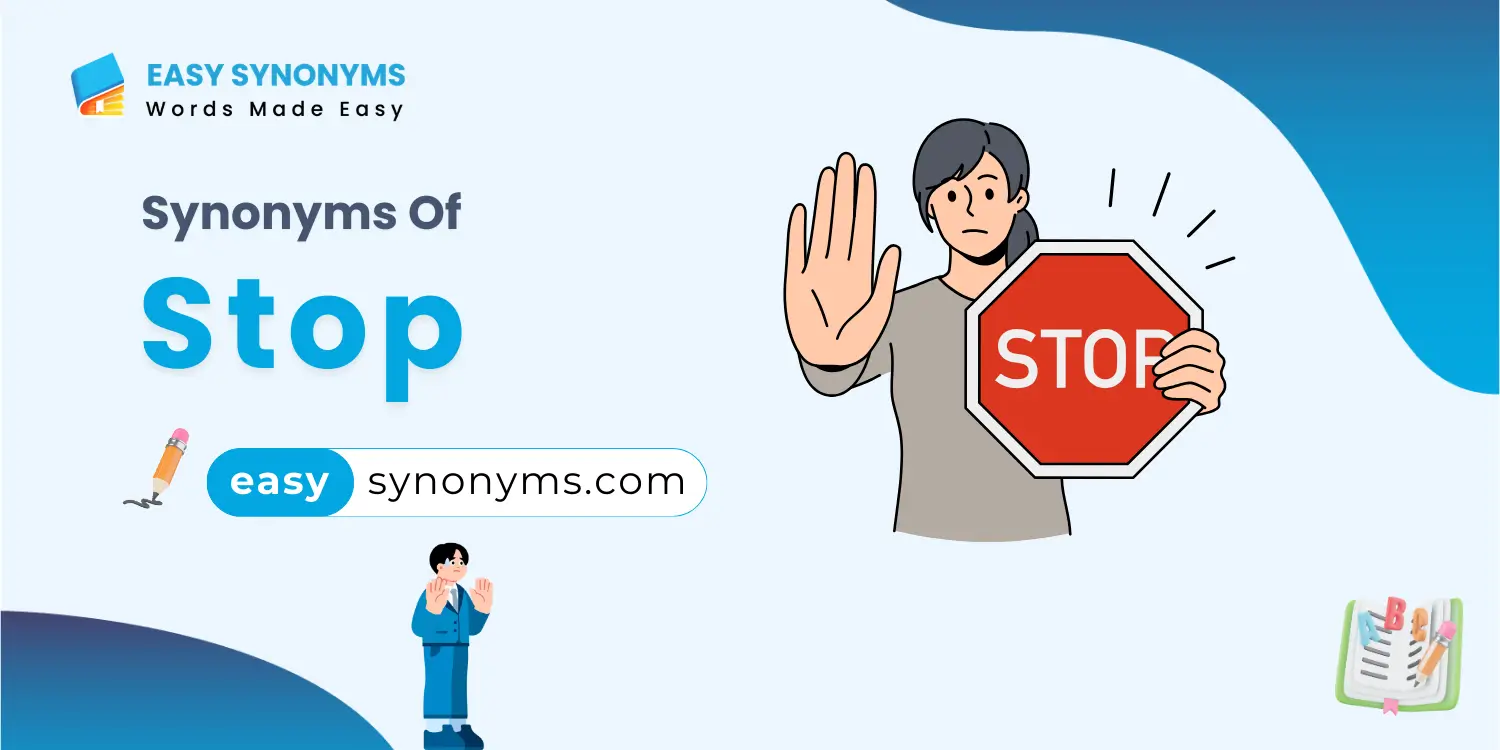

Synonyms of stop appear everywhere in English. Imagine a teacher saying “stop talking,” or a driver seeing a red light. The word is simple, but English offers many ways to express the same idea.
In real life, people rarely repeat the same word again and again. Instead, they use different expressions. Learning synonyms of stop helps conversations sound natural and clear.
Students, bloggers, and English learners often search for synonyms of stop because the word appears in daily speech, essays, and storytelling.
Understanding synonyms of stop expands vocabulary. It helps writers avoid repetition and helps speakers express actions like ending, pausing, or preventing something.
What Does “Synonyms of Stop” Really Mean?
The phrase synonyms of stop refers to words that have a similar meaning to the verb stop.
The word stop usually means to end an action, pause movement, or prevent something from continuing.
Native speakers use this word in everyday situations such as giving instructions, describing actions, or setting limits.
Common contexts include:
- daily conversation
- instructions and warnings
- writing and storytelling
- professional communication
Part of Speech
The word stop functions as both a verb and a noun.
Simple Definition
Stop means to end an action, pause movement, or prevent something from continuing.
Example:
“Please stop the music.”
Connotative Meaning
(Connotation = the emotional meaning associated with a word.)
Positive Tone
Sometimes stopping something prevents harm.
Example:
“The guard stopped the fight.”
Negative Tone
Stopping may interrupt progress or activity.
Example:
“The rain stopped the event.”
Neutral Tone
Often the word simply describes a pause or ending.
Example:
“The bus made a stop.”
Etymology
The word stop comes from Old English.
Old English: stoppian
Meaning: “to block or close.”
Historical Development
Old English (450–1100)
The word described blocking an opening or closing something.
Middle English (1100–1500)
The meaning expanded to include halting movement.
Modern English (1500–Present)
The word developed many meanings related to ending actions.
Pronunciation
US: /stɑp/
UK: /stɒp/
Syllables
stop
Affixation Pattern
Root: stop
Prefix: none
Suffix: none
Synonyms List
Below are commonly used synonyms of stop with meanings and examples.
Halt (verb) — /hɔlt/ | /hɔːlt/
Meaning:
To bring something to an immediate stop.
Examples
- The officer halted the car.
- Construction halted due to heavy rain.
Cease (verb) — /sis/ | /siːs/
Meaning:
To stop doing something permanently or completely.
Examples
- The company ceased operations last year.
- The noise finally ceased.
End (verb) — /ɛnd/ | /ɛnd/
Meaning:
To bring something to its conclusion.
Examples
- The meeting ended early.
- She ended the conversation politely.
Quit (verb) — /kwɪt/ | /kwɪt/
Meaning:
To stop doing an activity or job.
Examples
- He quit smoking.
- She decided to quit the project.
Terminate (verb) — /ˈtɜrməˌneɪt/ | /ˈtɜːmɪneɪt/
Meaning:
To officially end something.
Examples
- The company terminated the contract.
- They terminated the service.
Discontinue (verb) — /ˌdɪskənˈtɪnju/ | /ˌdɪskənˈtɪnjuː/
Meaning:
To stop producing or providing something.
Examples
- The brand discontinued the product.
- The company discontinued the service.
Pause (verb) — /pɔz/ | /pɔːz/
Meaning:
To temporarily stop an activity.
Examples
- She paused the video.
- The speaker paused for a moment.
Suspend (verb) — /səˈspɛnd/ | /səˈspend/
Meaning:
To temporarily stop something officially.
Examples
- The school suspended classes.
- The club suspended membership.
Interrupt (verb) — /ˌɪntəˈrʌpt/ | /ˌɪntəˈrʌpt/
Meaning:
To stop an activity briefly.
Examples
- The phone call interrupted the meeting.
- Rain interrupted the game.
Break Off (verb) — /breɪk ɔf/ | /breɪk ɒf/
Meaning:
To suddenly stop something.
Examples
- They broke off negotiations.
- She broke off the conversation.
Block (verb) — /blɑk/ | /blɒk/
Meaning:
To prevent movement or progress.
Examples
- A fallen tree blocked the road.
- Fear blocked his decision.
Prevent (verb) — /prɪˈvɛnt/ | /prɪˈvent/
Meaning:
To stop something before it happens.
Examples
- Vaccines prevent disease.
- The guard prevented entry.
Freeze (verb) — /friz/ | /friːz/
Meaning:
To stop movement suddenly.
Examples
- The players froze when the whistle blew.
- He froze during the speech.
Shut Down (verb) — /ʃʌt daʊn/ | /ʃʌt daʊn/
Meaning:
To stop operations or activity.
Examples
- The factory shut down.
- The system shut down unexpectedly.
Cut Off (verb) — /kʌt ɔf/ | /kʌt ɒf/
Meaning:
To stop supply or communication.
Examples
- The storm cut off electricity.
- The call cut off suddenly.
Arrest (verb) — /əˈrɛst/ | /əˈrest/
Meaning:
To stop movement or progress.
Examples
- The treatment arrested the disease.
- Police arrested the suspect.
Cancel (verb) — /ˈkænsəl/ | /ˈkænsəl/
Meaning:
To stop something planned.
Examples
- They canceled the event.
- She canceled the meeting.
Finish (verb) — /ˈfɪnɪʃ/ | /ˈfɪnɪʃ/
Meaning:
To bring something to completion.
Examples
- He finished the work early.
- The movie finished at midnight.
Close (verb) — /kloʊz/ | /kləʊz/
Meaning:
To stop business or activity.
Examples
- The shop closed at 8 PM.
- The company closed the branch.
Abandon (verb) — /əˈbændən/ | /əˈbændən/
Meaning:
To stop doing something completely.
Examples
- They abandoned the plan.
- She abandoned the project.
Suspend (verb) — /səˈspɛnd/ | /səˈspend/
Meaning:
To temporarily stop an activity, rule, or process for a period of time.
Examples
- The school suspended classes due to heavy snow.
- The company suspended the project until funding improved.
Shut (verb) — /ʃʌt/ | /ʃʌt/
Meaning:
To close something so that it stops operating or functioning.
Examples
- She shut the laptop after finishing her work.
- The manager shut the store early today.
Desist (verb) — /dɪˈzɪst/ | /dɪˈzɪst/
Meaning:
To stop doing something, often after being warned or advised.
Examples
- The lawyer asked the company to desist from using the logo.
- The teacher told the students to desist from making noise.
Discontinue (verb) — /ˌdɪskənˈtɪnjuː/ | /ˌdɪskənˈtɪnjuː/
Meaning:
To stop producing, offering, or doing something permanently.
Examples
- The company discontinued the old smartphone model.
- The service was discontinued last year.
Discontinue Activity (verb phrase) — /ˌdɪskənˈtɪnjuː ækˈtɪvəti/ | /ˌdɪskənˈtɪnjuː ækˈtɪvɪti/
Meaning:
To officially stop a particular action or operation.
Examples
- The organization discontinued activity in the region.
- The factory discontinued activity during repairs.
Hold (verb) — /hoʊld/ | /həʊld/
Meaning:
To pause or delay something temporarily.
Examples
- The manager held the meeting until everyone arrived.
- The project was held due to missing documents.
Stand Down (verb phrase) — /stænd daʊn/ | /stænd daʊn/
Meaning:
To stop performing duties or withdraw from an active role.
Examples
- The soldiers were ordered to stand down.
- The officer decided to stand down after the incident.
Withdraw (verb) — /wɪðˈdrɔ/ | /wɪðˈdrɔː/
Meaning:
To stop participating in something by pulling back or leaving.
Examples
- The country withdrew its troops from the conflict.
- She withdrew from the competition.
Discontinue Use (verb phrase) — /ˌdɪskənˈtɪnjuː juːs/ | /ˌdɪskənˈtɪnjuː juːs/
Meaning:
To stop using something completely.
Examples
- The hospital discontinued use of the outdated equipment.
- The company discontinued use of plastic bags.
Hold Back (verb phrase) — /hoʊld bæk/ | /həʊld bæk/
Meaning:
To prevent something from moving forward or continuing.
Examples
- Fear held him back from speaking.
- The heavy rain held back the construction work.
Restrain (verb) — /rɪˈstreɪn/ | /rɪˈstreɪn/
Meaning:
To stop someone or something by controlling or limiting movement.
Examples
- The guard restrained the aggressive customer.
- She restrained herself from laughing.
Check (verb) — /tʃɛk/ | /tʃek/
Meaning:
To slow down, control, or stop progress.
Examples
- The new policy checked rising expenses.
- The goalkeeper checked the ball before it crossed the line.
Synonyms of Stop by Tone
Positive
prevent
halt
restrain
These words suggest protection or safety.
Neutral
pause
end
cease
These simply describe stopping an action.
Negative
cancel
terminate
cut off
These may imply problems or interruptions.
Informal
quit
hold on
Tone matters because different situations require different vocabulary.
“Stop” vs Close Alternatives
| Word | Meaning | Usage |
|---|---|---|
| Stop | general ending | everyday speech |
| Cease | formal ending | legal or formal writing |
| Pause | temporary stop | conversations |
Example:
Stop → “Stop the car.”
Pause → “Pause the video.”
Cease → “The activity ceased.”
How “Stop” Changes by Context
Daily Conversation
People use simple forms like stop, pause, or quit.
Example:
“Stop talking.”
Writing or Blogging
Writers use more descriptive synonyms.
Example:
“The noise ceased suddenly.”
Professional or Academic Tone
Formal words appear more often.
Example:
“The company terminated the agreement.”
Creative or Informal Use
Stories often use expressive verbs.
Example:
“The hero halted the attack.”
Common Mistakes Learners Make
Using Formal Words in Casual Speech
“Terminate talking” sounds unnatural.
Use “stop talking” instead.
Using the Wrong Context
Pause means temporary stop, not permanent.
Overusing One Word
Repeating “stop” weakens writing.
Use synonyms like cease, halt, or pause.
Register Notes
Formal writing → cease, terminate
Casual speech → stop, quit
Real‑Life Examples Using “Stop”
Workplace
A manager stops a project that is losing money.
Social Situations
Friends stop arguing after calming down.
Media / Pop Culture
Movies often show heroes stopping villains.
Writing or Storytelling
Authors describe characters halting danger.
Conclusion
Learning synonyms of stop helps English learners communicate more clearly and effectively. Instead of repeating the same word, writers can use more precise alternatives.
Strong vocabulary improves writing, speaking, and storytelling. Synonyms also help readers understand subtle differences in meaning.
Students, bloggers, and professionals benefit from using varied language. Even simple verbs like stop can become powerful tools in communication.
Practice these synonyms in conversations, essays, and emails. The more you use them, the more natural your English will sound.
Exercises
Choose the best synonym.
- The officer told the driver to ___ the car.
A) halt
B) paint
C) jump - The rain forced organizers to ___ the event.
A) cancel
B) climb
C) throw - She ___ the video for a moment.
A) paused
B) built
C) drove - The company ___ production last year.
A) ceased
B) opened
C) bought - The teacher asked students to ___ talking.
A) stop
B) run
C) write - The storm ___ electricity supply.
A) cut off
B) planted
C) cleaned - The phone call ___ the meeting.
A) interrupted
B) repaired
C) washed - The shop ___ at night.
A) closed
B) jumped
C) swam - He decided to ___ smoking.
A) quit
B) bake
C) draw - Police ___ the suspect.
A) arrested
B) painted
C) fixed - The company ___ the contract.
A) terminated
B) polished
C) counted - The teacher asked students to ___ for a moment.
A) pause
B) fly
C) dance
Reflection Task
Write three sentences using three different synonyms of stop to describe a situation in school or work.
Answer Key:
A A A A A A A A A A A A