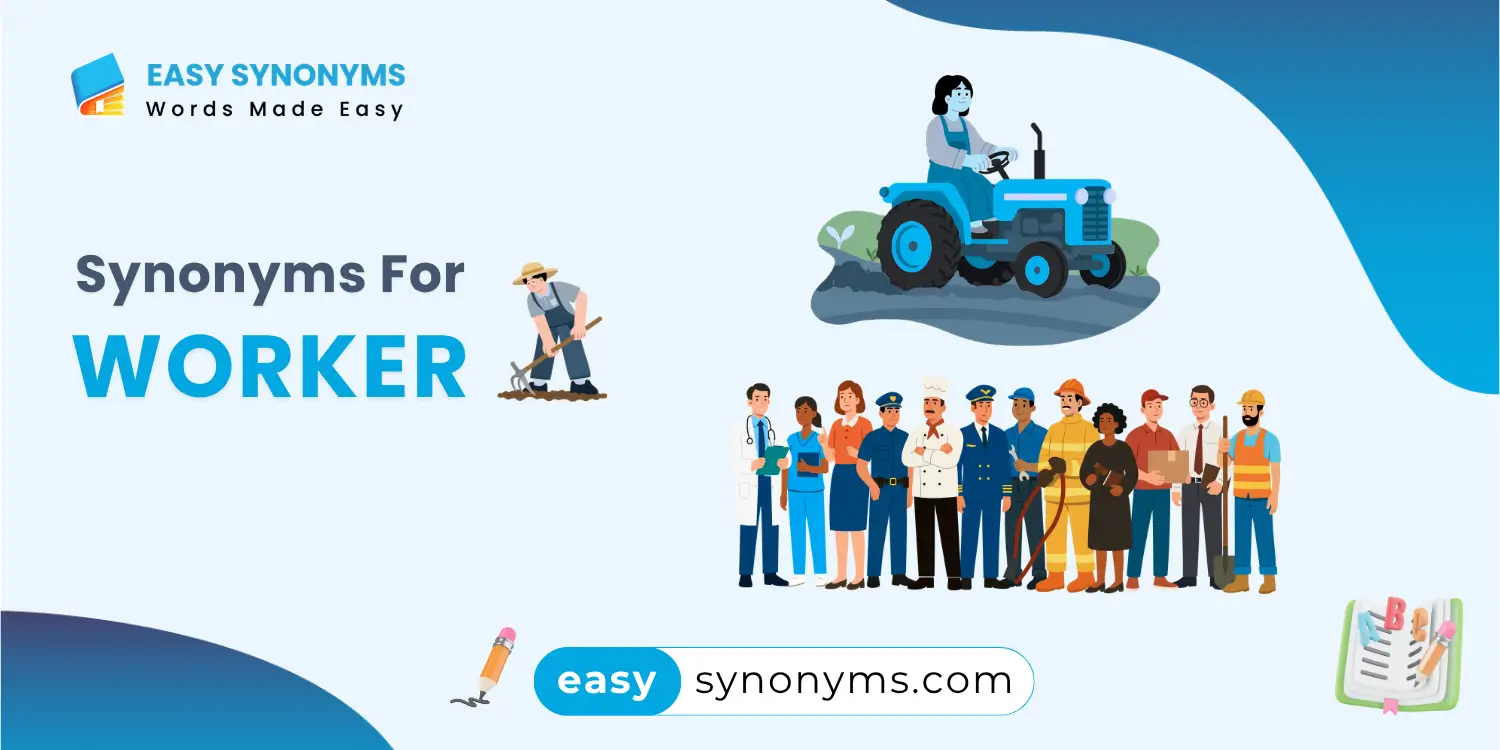

Synonyms for worker appear in daily conversations, workplaces, and writing when we describe people who do jobs, earn income, or contribute to society through effort and skills.
Imagine a factory employee finishing his shift after a long day. Someone calls him a hardworking employee instead of just a worker. This small change makes language richer and clearer.
Learning synonyms for worker helps students, bloggers, and content writers avoid repetition and improve vocabulary in essays, articles, and professional communication.
Understanding synonyms for worker also helps daily English users speak more naturally and confidently in workplaces, interviews, and conversations with others.
📚 What Does “Synonyms for Worker” Really Mean?
The word worker is a common noun in English.
It refers to a person who does a job, performs tasks, or earns money through work or labor.
In simple English, a worker is someone who works in any field such as office, factory, business, or service industry.
Native speakers use this word in many everyday contexts.
Common contexts
- factory worker
- office worker
- construction worker
- healthcare worker
- social worker
- government worker
Simple definition
Worker (noun): a person who performs a job or labor to earn income or complete tasks.
Examples:
- The worker repaired the machine.
- Office workers attend meetings daily.
The tone of this word is usually neutral and practical.
🧠 Connotative Meaning
Connotation (the emotional or cultural feeling connected to a word beyond its basic meaning).
Positive tone
Sometimes worker suggests dedication and effort.
Example:
- She is a hardworking worker.
This shows responsibility and commitment.
Negative tone
In some contexts, worker may sound basic or low-level.
Example:
- He is just a worker.
Here, it may suggest limited status.
Neutral tone
Most of the time, the word is neutral.
Example:
- The worker completed the task.
It simply describes a person doing a job.
📖 Etymology
The word worker comes from Old English.
Origin
- Old English: weorc (work)
- Proto-Germanic: werkan (to do or perform)
- Modern English: worker
The original meaning was a person who performs tasks or labor.
Old English Period (450–1100)
The word weorc referred to labor, effort, and action.
People who performed tasks were described using related forms.
Middle English Period (1100–1500)
The word evolved into workere.
It referred to laborers and craftsmen.
Usage expanded in trade and industry.
Modern English Period (1500–Present)
The word worker became widely used in industry, business, and society.
Today, it applies to all types of jobs and professions.
🔊 Pronunciation (US & UK – IPA)
US: /ˈwɜːrkər/
UK: /ˈwɜːkə/
🔡 Syllables
work-er
2 syllables
🧩 Affixation Pattern of Worker
Root:
work (labor or task)
Prefix:
none
Suffix:
-er (person who performs an action)
work + er = worker (person who works)
📖 Synonyms for Worker (Part 1)
Below are commonly used and accurate synonyms related to worker.
Each synonym reflects profession, labor, or employment.
Employee (Noun) — US /ɪmˈplɔɪiː/ | UK /ɪmˈplɔɪiː/
Meaning: a person who works for a company or organization.
Examples:
- The employee arrives on time every day.
- Employees attend weekly meetings.
Laborer (Noun) — US /ˈleɪbərər/ | UK /ˈleɪbərə/
Meaning: a person who performs physical work.
Examples:
- The laborer carries heavy materials.
- Laborers build roads and bridges.
Staff Member (Noun) — US /stæf ˈmembər/ | UK /stɑːf ˈmembə/
Meaning: a person who works in an organization or office.
Examples:
- Staff members help customers daily.
- The staff member answered my question.
Personnel (Noun) — US /ˌpɜːrsəˈnel/ | UK /ˌpɜːsəˈnel/
Meaning: people working in an organization.
Examples:
- Military personnel work hard.
- Company personnel attend training.
Hand (Noun) — US /hænd/ | UK /hænd/
Meaning: a worker who performs manual tasks.
Examples:
- Farmhands work in fields.
- Factory hands operate machines.
Operator (Noun) — US /ˈɑːpəreɪtər/ | UK /ˈɒpəreɪtə/
Meaning: a person who controls machines or equipment.
Examples:
- The operator runs the machine.
- Crane operators work on construction sites.
Technician (Noun) — US /tekˈnɪʃən/ | UK /tekˈnɪʃən/
Meaning: a skilled worker in technical fields.
Examples:
- The technician repaired the computer.
- Lab technicians conduct tests.
Craftsman (Noun) — US /ˈkræftsmən/ | UK /ˈkrɑːftsmən/
Meaning: a skilled worker who makes things by hand.
Examples:
- The craftsman builds furniture.
- Skilled craftsmen create art pieces.
Builder (Noun) — US /ˈbɪldər/ | UK /ˈbɪldə/
Meaning: a person who constructs buildings.
Examples:
- Builders construct houses.
- The builder repaired the wall.
Workman (Noun) — US /ˈwɜːrkmən/ | UK /ˈwɜːkmən/
Meaning: a man who performs manual work.
Examples:
- The workman fixed the roof.
- Workmen repaired the road.
Helper (Noun) — US /ˈhelpər/ | UK /ˈhelpə/
Meaning: a person who assists in work.
Examples:
- The helper carried tools.
- Kitchen helpers prepare food.
Assistant (Noun) — US /əˈsɪstənt/ | UK /əˈsɪstənt/
Meaning: a person who supports another worker.
Examples:
- The assistant organizes files.
- Office assistants handle documents.
Clerk (Noun) — US /klɜːrk/ | UK /klɑːk/
Meaning: a worker who handles records or office tasks.
Examples:
- The clerk manages files.
- Store clerks help customers.
Agent (Noun) — US /ˈeɪdʒənt/ | UK /ˈeɪdʒənt/
Meaning: a person who works on behalf of others.
Examples:
- The agent sells property.
- Insurance agents meet clients.
Crew Member (Noun) — US /kruː ˈmembər/ | UK /kruː ˈmembə/
Meaning: a person who works in a team.
Examples:
- Crew members clean the plane.
- Ship crew members follow orders.
Employee (Noun) — US /ɪmˈplɔɪiː/ | UK /ɪmˈplɔɪiː/
Meaning: a person hired by a company to perform a job.
Examples:
- The employee completed the report on time.
- Employees attend training every month.
Laborer (Noun) — US /ˈleɪbərər/ | UK /ˈleɪbərə/
Meaning: a person who performs physical or manual work.
Examples:
- The laborer lifted heavy bricks.
- Laborers work on construction sites.
Staff (Noun) — US /stæf/ | UK /stɑːf/
Meaning: people working together in an organization.
Examples:
- The hospital staff works day and night.
- Staff members help visitors.
Personnel (Noun) — US /ˌpɜːrsəˈnel/ | UK /ˌpɜːsəˈnel/
Meaning: workers employed in an organization or institution.
Examples:
- Military personnel protect the country.
- Company personnel follow safety rules.
Labor Force (Noun) — US /ˈleɪbər fɔːrs/ | UK /ˈleɪbə fɔːs/
Meaning: all workers available for work in a country or organization.
Examples:
- The labor force supports the economy.
- Skilled labor force improves industry.
Professional (Noun) — US /prəˈfeʃənl/ | UK /prəˈfeʃənl/
Meaning: a skilled and trained worker in a specific field.
Examples:
- Professionals work in offices and hospitals.
- The company hires skilled professionals.
Specialist (Noun) — US /ˈspeʃəlɪst/ | UK /ˈspeʃəlɪst/
Meaning: a worker with expert knowledge in one area.
Examples:
- The specialist repaired the engine.
- Doctors are medical specialists.
Practitioner (Noun) — US /prækˈtɪʃənər/ | UK /prækˈtɪʃənə/
Meaning: a person actively working in a profession.
Examples:
- The practitioner treats patients.
- Legal practitioners handle cases.
Contractor (Noun) — US /ˈkɑːntræktər/ | UK /ˈkɒntræktə/
Meaning: a worker hired for a specific project.
Examples:
- The contractor built the house.
- Contractors work on short-term projects.
Freelancer (Noun) — US /ˈfriːlænsər/ | UK /ˈfriːlɑːnsə/
Meaning: a worker who works independently.
Examples:
- The freelancer designs websites.
- Freelancers work from home.
Wage Earner (Noun) — US /weɪdʒ ˈɜːrnər/ | UK /weɪdʒ ˈɜːnə/
Meaning: a person who earns money through work.
Examples:
- Wage earners support families.
- The wage earner works daily.
Breadwinner (Noun) — US /ˈbredwɪnər/ | UK /ˈbredwɪnə/
Meaning: a person who earns money for a family.
Examples:
- He is the breadwinner of the house.
- Breadwinners work hard.
Operator (Noun) — US /ˈɑːpəreɪtər/ | UK /ˈɒpəreɪtə/
Meaning: a person who controls equipment or machines.
Examples:
- The operator runs the crane.
- Machine operators work in factories.
Technician (Noun) — US /tekˈnɪʃən/ | UK /tekˈnɪʃən/
Meaning: a trained technical worker.
Examples:
- The technician fixed the laptop.
- Technicians maintain systems.
Tradesman (Noun) — US /ˈtreɪdzmən/ | UK /ˈtreɪdzmən/
Meaning: a skilled manual worker.
Examples:
- Tradesmen repair houses.
- Skilled tradesmen build furniture.
Artisan (Noun) — US /ˈɑːrtɪzən/ | UK /ˈɑːtɪzæn/
Meaning: a worker who creates handmade products.
Examples:
- The artisan makes pottery.
- Artisans create beautiful crafts.
Mechanic (Noun) — US /məˈkænɪk/ | UK /məˈkænɪk/
Meaning: a worker who repairs machines.
Examples:
- The mechanic fixed the car.
- Mechanics work in garages.
Engineer (Noun) — US /ˌendʒɪˈnɪr/ | UK /ˌendʒɪˈnɪə/
Meaning: a technical worker who designs or builds systems.
Examples:
- Engineers build bridges.
- The engineer designed the machine.
Operator Staff (Noun Phrase) — US /ˈɑːpəreɪtər stæf/ | UK /ˈɒpəreɪtə stɑːf/
Meaning: workers who operate equipment or systems.
Examples:
- Operator staff manage machines.
- The operator staff ensures safety.
Field Worker (Noun) — US /fiːld ˈwɜːrkər/ | UK /fiːld ˈwɜːkə/
Meaning: a worker who performs duties outside the office.
Examples:
- Field workers collect data.
- Health field workers visit villages.
Industrial Worker (Noun) — US /ɪnˈdʌstriəl ˈwɜːrkər/ | UK /ɪnˈdʌstriəl ˈwɜːkə/
Meaning: a worker in factories or industry.
Examples:
- Industrial workers operate machines.
- Industrial workers produce goods.
Service Worker (Noun) — US /ˈsɜːrvɪs ˈwɜːrkər/ | UK /ˈsɜːvɪs ˈwɜːkə/
Meaning: a person working in the service sector.
Examples:
- Service workers help customers.
- Many service workers work in restaurants.
Office Worker (Noun) — US /ˈɔːfɪs ˈwɜːrkər/ | UK /ˈɒfɪs ˈwɜːkə/
Meaning: a person working in an office.
Examples:
- Office workers attend meetings.
- Office workers handle documents.
Skilled Worker (Noun) — US /skɪld ˈwɜːrkər/ | UK /skɪld ˈwɜːkə/
Meaning: a trained and experienced worker.
Examples:
- Skilled workers improve productivity.
- Skilled workers earn higher wages.
Unskilled Worker (Noun) — US /ʌnˈskɪld ˈwɜːrkər/ | UK /ʌnˈskɪld ˈwɜːkə/
Meaning: a worker with little training.
Examples:
- Unskilled workers do simple tasks.
- Many unskilled workers work in factories.
🧠 Synonyms for “Worker” by Tone
Positive Tone
- professional
- specialist
- artisan
- craftsman
- technician
- engineer
- skilled worker
These suggest expertise and respect 👷
Neutral Tone
- employee
- staff
- personnel
- operator
- assistant
- clerk
- field worker
These are commonly used in daily and professional English.
Negative Tone
- laborer
- unskilled worker
- hand
Sometimes these suggest lower status or manual work.
Informal Tone
- helper
- crew member
- hand
These sound casual in conversation.
Why Tone Matters
Tone affects how people perceive workers.
Example:
- worker → neutral
- professional → respectful
- laborer → physical work focus
Choosing the right synonym improves communication clarity.
⚖️ Mini Comparison
Worker vs Employee vs Laborer
| Word | Meaning | Tone | Usage |
|---|---|---|---|
| Worker | general person doing work | neutral | all contexts |
| Employee | person hired by company | professional | business |
| Laborer | physical worker | specific | construction |
Key Difference
Worker is general.
Employee is professional.
Laborer focuses on manual work.
Native Usage Tip
Native speakers usually say:
- office worker (neutral)
- employee (professional)
- laborer (manual work)
Choosing the right word depends on context and tone.
🧠 How “Synonyms for Worker” Changes by Context
Understanding context helps you choose the right synonym for worker in real situations. Different environments require different vocabulary.
Daily Conversation
In everyday speech, people use simple and friendly words.
Common choices include employee, helper, staff member, or assistant.
These words sound natural and easy to understand.
Example:
- The office staff finished the work early.
- The helper cleaned the room.
Simple synonyms make communication clear and smooth.
Writing or Blogging
In blogs and articles, writers avoid repeating the word worker.
They often use professional, specialist, crew member, technician, or personnel.
This improves readability and SEO.
Example:
- Skilled professionals manage the project.
- Technical specialists maintain the system.
Using varied synonyms makes writing more engaging and professional.
Professional or Academic Tone
In business and academic writing, formal words are preferred.
Common synonyms include:
- employee
- personnel
- professional
- practitioner
- contractor
Example:
- Company personnel must follow safety rules.
- The contractor completed the project on time.
Formal synonyms create authority and credibility.
Creative or Informal Use
In storytelling or casual writing, flexible synonyms work best.
Examples include:
- breadwinner
- crew member
- artisan
- craftsman
Example:
- The village artisan created beautiful pottery.
- The breadwinner worked day and night.
Creative usage adds emotional depth and realism.
⚠️ Common Mistakes Learners Make
Many English learners misuse synonyms for worker.
Here are common problems.
Using All Synonyms as Equal
Not every synonym fits every context.
Incorrect:
- The engineer is a laborer in the company.
Correct:
- The engineer is a professional in the company.
Some words show skill level, while others show manual work.
Confusing Formal and Informal Words
Learners sometimes use casual words in professional writing.
Incorrect:
- Our helpers manage company operations.
Correct:
- Our employees manage company operations.
Formal writing needs professional vocabulary.
Overusing the Word Worker
Repeating worker makes writing dull.
Incorrect:
- The worker completed work with other workers.
Correct:
- The employee completed the task with staff members.
Using synonyms improves clarity and readability.
🧾 Register Notes
Formal English
- employee
- personnel
- professional
- contractor
Used in business, academic writing, and reports.
Informal English
- helper
- hand
- crew member
Used in conversation and storytelling.
Spoken English
Simple words are common.
Example:
- staff
- employee
- helper
Written English
More precise words are preferred.
Example:
- professional
- practitioner
- technician
Choosing the right register makes communication effective.
🧩 Real-Life Mini Scenarios
Workplace Scenario
A company hires new staff.
Manager says:
- We need skilled employees for this project.
This sounds professional and clear.
Social Situation
A person talks about family.
He says:
- I am the breadwinner of my family.
This shows responsibility and emotion.
Media or News
News report says:
- Industrial workers protested for better wages.
This sounds formal and factual.
Writing or Storytelling
A writer describes a character.
- The old craftsman worked quietly in his shop.
This creates a vivid image.
✅ Conclusion
Learning synonyms for worker helps you speak and write with confidence in daily life, workplaces, and academic environments. It improves vocabulary and communication clarity.
Using different synonyms for worker makes writing more engaging and professional. It also helps avoid repetition and makes your language sound natural and fluent.
Students, bloggers, and content writers benefit greatly from learning synonyms for worker because it strengthens expression and improves SEO-friendly writing.
Start practicing these synonyms for worker in emails, essays, and daily conversations to build strong vocabulary and communicate more effectively every day ✍️
📝 Practice Exercise
Choose the Best Synonym
- A person hired by a company is called ______
- A person who repairs machines is a ______
- A skilled technical worker is a ______
- A person working independently is a ______
- A person earning money for family is a ______
- A person doing manual construction work is a ______
- A person working in office is an ______
- A handmade product creator is an ______
- A person working in a team on a ship is a ______
- A trained expert in a field is a ______
- A person working on short-term projects is a ______
- A person who assists another worker is an ______
Fill in the Sentence
- The ______ repaired my car yesterday.
- The company hired skilled ______ for the project.
- The village ______ makes beautiful pottery.
🧠 Reflection Task
Write 5 sentences using different synonyms for worker in real-life situations such as school, office, or business communication.
✅ Answer Key
employee — mechanic — technician — freelancer — breadwinner — laborer — office worker — artisan — crew member — specialist — contractor — assistant — mechanic — employees — artisan