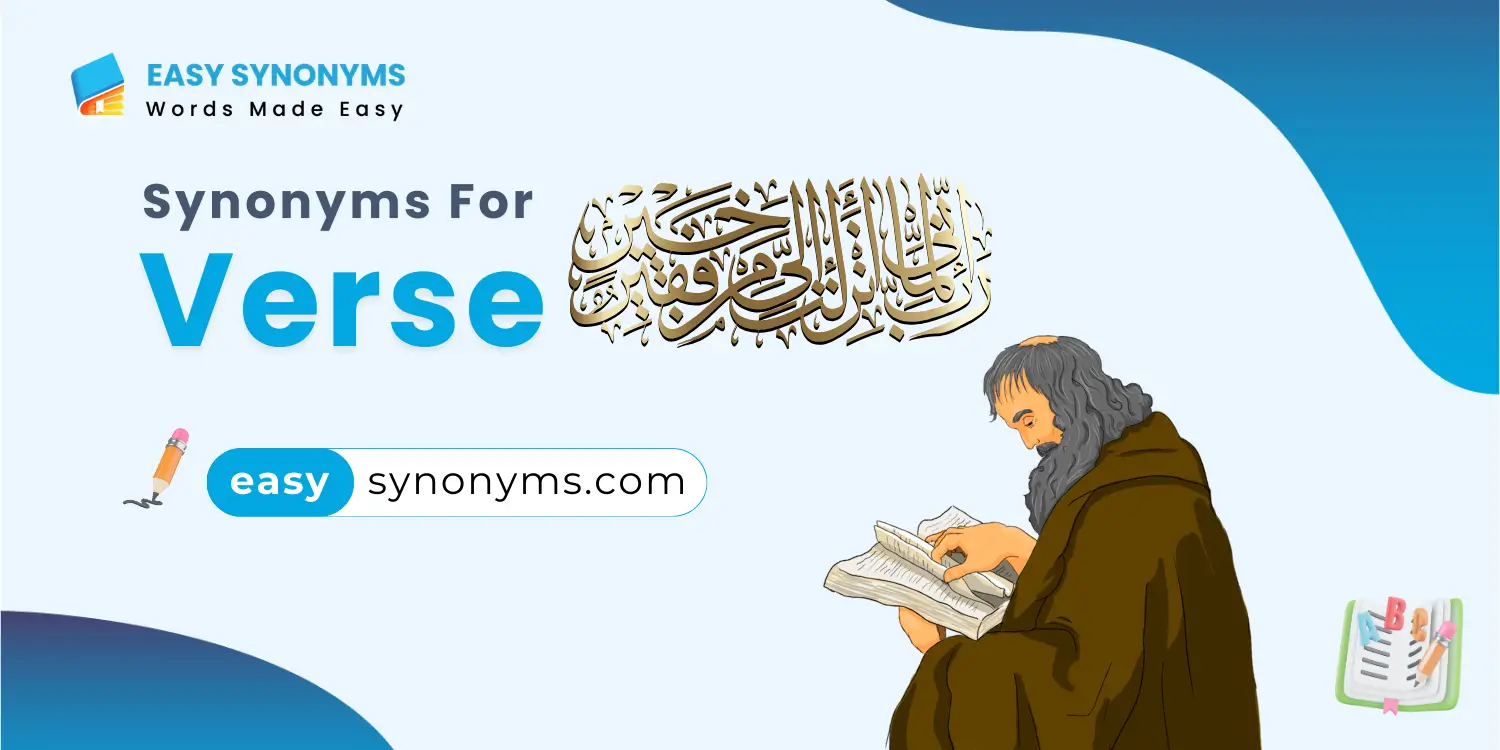

Synonyms for verse often appear when people read poetry, lyrics, or religious texts. Imagine reading a poem and noticing that each short section tells part of the story. That section is called a verse.
Many English learners search for synonyms for verse because the word appears in poetry, songs, and literature. Writers also use it when describing creative writing structures.
Learning synonyms for verse helps students and bloggers avoid repeating the same word. It also makes essays and creative writing richer and more expressive.
For students, content creators, and daily English users, understanding synonyms for verse strengthens vocabulary. It helps describe poetry, storytelling, and lyrical writing more clearly.
What Does “Synonyms for Verse” Really Mean?
The word verse usually refers to a short section of a poem, song, or religious text.
Native speakers often use the word when discussing poetry or lyrics. It carries a creative tone and often appears in literature or music.
In simple English, verse describes a group of lines in poetry that form a unit.
Part of Speech:
Noun
Simple Definition:
A short group of lines in a poem, song, or sacred text.
Example:
The singer wrote a beautiful verse for the new song.
Connotative Meaning
(Connotation = the emotional meaning associated with a word.)
Positive tone
Verse often suggests creativity, artistry, and emotional expression.
Negative tone
Rarely negative, but sometimes used to describe overly dramatic writing.
Neutral tone
In academic writing, verse simply describes a poetic structure.
Etymology
The word verse comes from the Latin word versus, meaning “a line or turning.”
Historical Development
Old English (450–1100)
Poetry existed, but the term “verse” entered later through Latin influence.
Middle English (1100–1500)
The word began appearing in literary translations and religious texts.
Modern English (1500–Present)
Verse became a common term in poetry, songwriting, and literature.
Pronunciation
US: /vɝːs/
UK: /vɜːs/
Syllables
verse
Affixation Pattern
Root: verse
Prefix: none
Suffix: none
SYNONYMS LIST
Below are common synonyms for verse used in literature, poetry, and writing.
Stanza (noun) — /ˈstænzə/ | /ˈstænzə/
Meaning:
A group of lines forming a section in a poem.
Examples
- The poem contains four stanzas.
- She wrote a stanza about nature.
Line (noun) — /laɪn/ | /laɪn/
Meaning:
A single row of words in poetry.
Examples
- The poet repeated the line for emphasis.
- That line expresses deep emotion.
Poetic line (noun phrase) — /poʊˈɛtɪk laɪn/ | /pəʊˈɛtɪk laɪn/
Meaning:
A line written in poetic style.
Examples
- The poetic line sounds very musical.
- Each poetic line carries meaning.
Passage (noun) — /ˈpæsɪdʒ/ | /ˈpæsɪdʒ/
Meaning:
A short section of text.
Examples
- The passage describes love.
- Students analyzed the passage carefully.
Segment (noun) — /ˈsɛɡmənt/ | /ˈsɛɡmənt/
Meaning:
A small part of a larger work.
Examples
- The poem has several segments.
- Each segment tells part of the story.
Lyric (noun) — /ˈlɪrɪk/ | /ˈlɪrɪk/
Meaning:
Words of a song or poetic expression.
Examples
- The lyric sounds poetic.
- That lyric feels emotional.
Couplet (noun) — /ˈkʌplət/ | /ˈkʌplət/
Meaning:
Two rhyming lines in poetry.
Examples
- The poet ended with a couplet.
- Shakespeare often used couplets.
Quatrain (noun) — /ˈkwɑːtreɪn/ | /ˈkwɒtreɪn/
Meaning:
A stanza of four lines.
Examples
- The poem begins with a quatrain.
- Each quatrain carries a theme.
Prose line (noun phrase) — /proʊz laɪn/ | /prəʊz laɪn/
Meaning:
A written line resembling poetic style.
Examples
- The prose line reads like poetry.
- Writers often use poetic prose lines.
Chant (noun) — /tʃænt/ | /tʃɑːnt/
Meaning:
A repeated rhythmic line used in songs or prayers.
Examples
- The monks recited a chant.
- The crowd repeated the chant.
Psalm line (noun phrase)
Meaning:
A verse from religious poetry.
Examples
- The psalm line inspired hope.
- He memorized the psalm line.
Ballad line (noun phrase)
Meaning:
A poetic line in storytelling songs.
Examples
- The ballad line tells a legend.
- The singer repeated the ballad line.
Rhyming line (noun phrase)
Meaning:
A poetic line that rhymes with another.
Examples
- The rhyming line sounds musical.
- Kids enjoy rhyming lines.
Poetic phrase (noun phrase)
Meaning:
A short expressive part of poetry.
Examples
- The poetic phrase feels vivid.
- Writers use poetic phrases often.
Hymn line (noun phrase)
Meaning:
A line from a religious song.
Examples
- The hymn line moved the audience.
- Choir members sang the hymn line.
(Additional related synonyms: poetic segment, poetic unit, lyric segment, poetic section, poetic extract, verse line, poetic stanza, lyrical passage, song line, poetic fragment, poetic excerpt, poetic unit line, chant line, lyrical phrase, poetic text line, poetic clause, lyric passage, metrical line, poetic meter line.)
Synonyms for “Verse” by Tone
Positive
- Lyric
- Stanza
- Quatrain
- Couplet
These emphasize poetic beauty.
Neutral
- Line
- Passage
- Segment
These are neutral literary descriptions.
Informal
- Song line
- Lyric line
These appear in casual speech.
Tone matters because poetry discussions may require precise vocabulary.
“Verse” vs Close Alternatives
Verse vs Stanza
It can refer to one poetic unit or song section.
Stanza specifically means a grouped set of poetic lines.
Verse vs Line
Line refers to a single row of text.
Verse may contain multiple lines.
Verse vs Lyric
Lyric usually refers to song words.
Verse is broader and includes poetry.
Context‑Based Usage
Daily conversation
People often use “verse” when talking about songs.
Writing or blogging
Bloggers use it when discussing poetry or literature.
Academic tone
Teachers use it when analyzing poems.
Creative writing
Poets organize their poems into verses.
Common Mistakes Learners Make
Misuse scenarios
Some learners confuse verse with prose.
Confusing tone
“Verse” sounds literary, while “line” is more general.
Overuse warnings
Repeating “verse” in poetry analysis may sound repetitive.
Real‑Life Examples Using “Verse”
Workplace
A songwriter may write a new verse for a music project.
Social situations
Friends might discuss their favorite song verse.
Media
Many films include songs with memorable verses.
Writing
Authors sometimes include poetic verses in novels.
Conclusion
Learning synonyms for verse strengthens vocabulary and improves writing clarity. It allows writers and students to describe poetry structures more precisely.
Understanding different poetic terms also helps readers analyze poems more deeply. Each synonym highlights a unique part of poetic form.
Writers who expand vocabulary often create richer and more expressive texts. Synonyms allow ideas to flow without repetition.
Start practicing these synonyms in essays, poems, and daily writing. The more you use them, the more confident your English communication becomes ✨
Practice Exercises
Multiple Choice Questions
- Which word best replaces “verse” in poetry discussion?
A. Stanza
B. Table
C. Brick - Which synonym relates to song writing?
A. Lyric
B. Engine
C. Cable - Which word refers to two rhyming lines?
A. Couplet
B. Essay
C. Speech - Which term describes four lines of poetry?
A. Quatrain
B. Chapter
C. Column - Which synonym is the smallest unit?
A. Line
B. Book
C. Page - Which word appears in religious songs?
A. Hymn line
B. Stone
C. Tool - Which term fits storytelling songs?
A. Ballad line
B. Chart
C. Screen - Which synonym means poetic section?
A. Stanza
B. Brick
C. Cable - Which word fits musical writing?
A. Lyric
B. Screw
C. Wheel - Which synonym describes a short text section?
A. Passage
B. Wall
C. Stone
Reflection Task
Write four sentences using different synonyms for verse while describing a poem or song.
Answer Key:
A, A, A, A, A, A, A, A, A, A