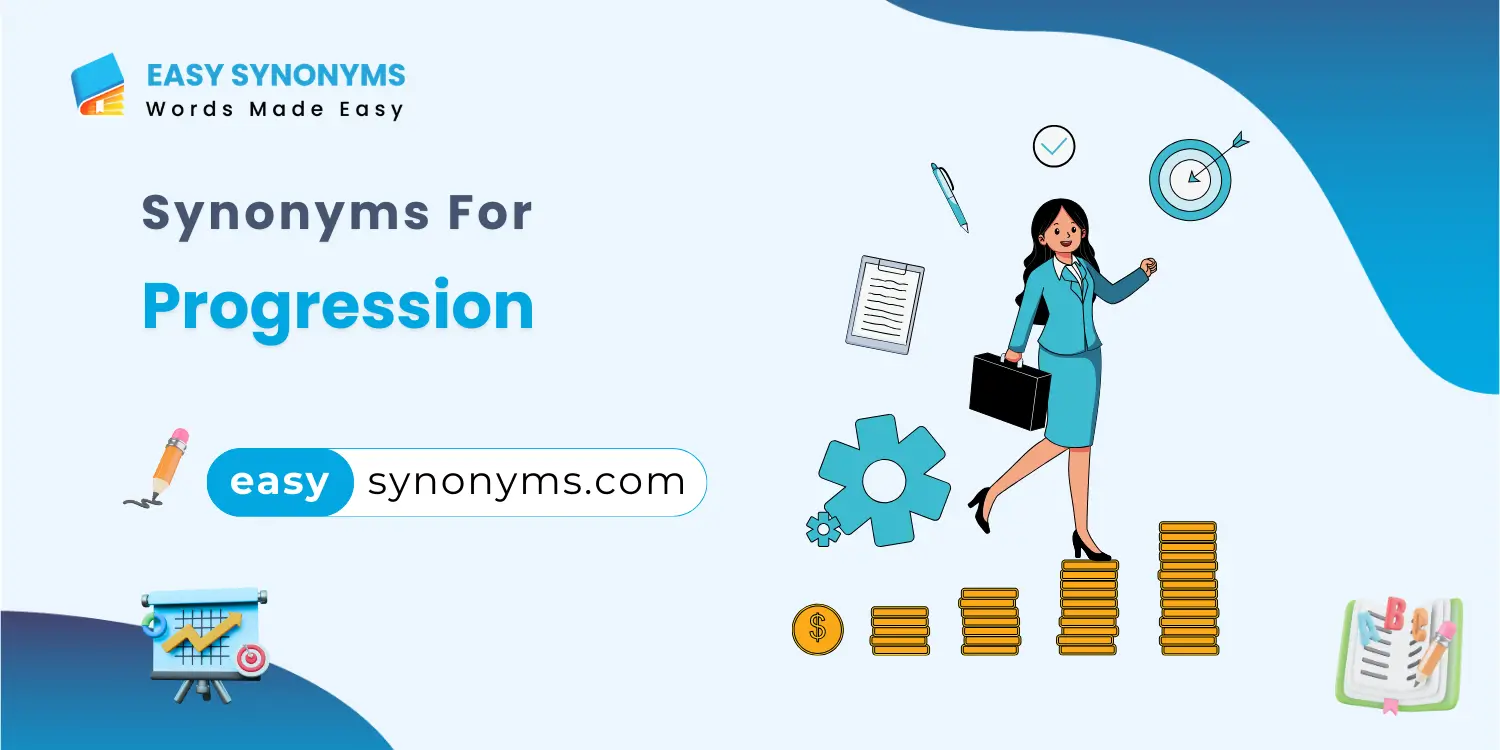

Synonyms for progression appear everywhere in English. Imagine a student describing how their skills improve over time. Instead of repeating one word, they can use several alternatives.
Many writers and speakers rely on the word progression to describe growth, improvement, or development. However, using the same word repeatedly can make writing sound dull.
Learning synonyms for progression helps students, bloggers, and content creators sound more natural. It also improves clarity and variety in essays, articles, and everyday communication.
In simple terms, synonyms for progression allow English users to express change, advancement, or development in different ways. Understanding these words strengthens vocabulary and writing style.
What Does “Synonyms for Progression” Really Mean?
The phrase synonyms for progression refers to words that carry a similar meaning to the noun progression.
The word progression describes movement forward, growth, or gradual improvement over time.
Native speakers often use it when discussing learning, career growth, or development.
Common contexts include:
- Education
- Career growth
- Personal development
- Science and technology
- Storytelling
Part of Speech:
Progression is a noun.
Simple Definition:
A gradual movement forward or development over time.
Example:
“Her career progression happened quickly after graduation.”
Connotative Meaning
(Connotation = the emotional meaning associated with a word.)
Positive Tone
Progression often suggests improvement, success, and growth.
Example:
“The athlete showed clear progression during training.”
Negative Tone
Sometimes progression describes worsening conditions.
Example:
“The disease showed rapid progression.”
Neutral Tone
In many contexts, it simply means a sequence of change.
Example:
“The film shows the progression of events.”
Etymology
The word progression comes from Latin.
Latin root: progressio
Meaning: “a moving forward”
Historical Development
Old English (450–1100)
The exact word did not exist yet, but ideas of movement forward appeared in related verbs.
Middle English (1100–1500)
The term entered English through Old French progression.
Modern English (1500–Present)
The word became common in education, science, and storytelling.
Pronunciation
US: /prəˈɡreʃən/
UK: /prəˈɡreʃən/
Syllables
pro-gres-sion
Affixation Pattern
Root: gress (step or move)
Prefix: pro‑ (forward)
Suffix: ‑ion (noun form)
Synonyms List
Below are commonly used synonyms for progression with meanings and examples.
Advancement (noun) — /ədˈvænsmənt/ | /ədˈvɑːnsmənt/
Meaning:
Movement forward or improvement in position.
Examples
- Her career advancement impressed everyone.
- The company rewarded employees for advancement.
Development (noun) — /dɪˈvɛləpmənt/ | /dɪˈvɛləpmənt/
Meaning:
Gradual growth or improvement.
Examples
- Child development requires patience.
- The project showed strong development.
Growth (noun) — /ɡroʊθ/ | /ɡrəʊθ/
Meaning:
Increase in size, ability, or importance.
Examples
- Personal growth takes time.
- The company experienced rapid growth.
Evolution (noun) — /ˌɛvəˈluːʃən/ | /ˌiːvəˈluːʃən/
Meaning:
Gradual transformation over time.
Examples
- Language evolution fascinates linguists.
- Technology shows constant evolution.
Improvement (noun) — /ɪmˈpruːvmənt/ | /ɪmˈpruːvmənt/
Meaning:
A positive change or better result.
Examples
- Her writing showed improvement.
- Daily practice brings improvement.
Advancement (noun) — /ədˈvænsmənt/ | /ədˈvɑːnsmənt/
Meaning:
Progress toward a higher level.
Examples
- Education supports career advancement.
- The promotion marked his advancement.
Progress (noun) — /ˈprɑːɡrɛs/ | /ˈprəʊɡrɛs/
Meaning:
Forward movement or improvement.
Examples
- Students made steady progress.
- Progress requires effort.
Expansion (noun) — /ɪkˈspænʃən/ | /ɪkˈspænʃən/
Meaning:
Growth in size or scope.
Examples
- The business planned global expansion.
- Urban expansion changed the city.
Rise (noun) — /raɪz/ | /raɪz/
Meaning:
Movement upward or increase.
Examples
- The rise of digital media changed journalism.
- Her rise in the company was impressive.
Advancement (noun) — /ədˈvænsmənt/ | /ədˈvɑːnsmənt/
Meaning:
Movement forward to a better stage.
Examples
- His advancement came after years of work.
- Skill advancement takes dedication.
Breakthrough (noun) — /ˈbreɪkθruː/ | /ˈbreɪkθruː/
Meaning:
A sudden major improvement.
Examples
- Scientists announced a medical breakthrough.
- The discovery marked a breakthrough.
Progression (noun) — /prəˈɡreʃən/ | /prəˈɡreʃən/
Meaning:
A sequence of gradual development.
Examples
- The story follows a natural progression.
- The disease showed progression.
Momentum (noun) — /moʊˈmɛntəm/ | /məˈmɛntəm/
Meaning:
Steady forward movement or growing strength in development.
Examples
- The team gained momentum after winning two matches.
- Her learning momentum increased with daily practice.
Trajectory (noun) — /trəˈdʒɛktəri/ | /trəˈdʒɛktri/
Meaning:
The path of development or direction something follows over time.
Examples
- His career trajectory surprised many experts.
- The company changed its growth trajectory.
Transformation (noun) — /ˌtrænsfərˈmeɪʃən/ | /ˌtrænsfəˈmeɪʃən/
Meaning:
A major change that gradually leads to a new stage or form.
Examples
- The town experienced economic transformation.
- Her fitness transformation inspired friends.
Maturation (noun) — /ˌmætʃəˈreɪʃən/ | /ˌmætʃʊəˈreɪʃən/
Meaning:
The process of becoming mature or fully developed.
Examples
- Emotional maturation takes time.
- The wine reached maturation after years.
Enhancement (noun) — /ɪnˈhæns.mənt/ | /ɪnˈhɑːns.mənt/
Meaning:
Improvement that increases quality or value.
Examples
- Software enhancement improved performance.
- The update brought visual enhancement.
Refinement (noun) — /rɪˈfaɪnmənt/ | /rɪˈfaɪnmənt/
Meaning:
Gradual improvement through careful changes.
Examples
- Writing refinement takes practice.
- The design went through several refinements.
Betterment (noun) — /ˈbɛtərmənt/ | /ˈbɛtəmənt/
Meaning:
A change that improves a situation.
Examples
- Education leads to social betterment.
- She worked hard for self‑betterment.
Elevation (noun) — /ˌɛləˈveɪʃən/ | /ˌɛlɪˈveɪʃən/
Meaning:
Movement to a higher level or status.
Examples
- The promotion marked his elevation.
- Her leadership brought team elevation.
Ascent (noun) — /əˈsɛnt/ | /əˈsɛnt/
Meaning:
A steady climb upward in position or success.
Examples
- His ascent in politics was rapid.
- The athlete’s ascent inspired many.
Upswing (noun) — /ˈʌpswɪŋ/ | /ˈʌpswɪŋ/
Meaning:
A noticeable improvement or positive change.
Examples
- The economy showed an upswing.
- Her grades saw a sudden upswing.
Forward March (noun) — /ˈfɔrwərd mɑrtʃ/ | /ˈfɔːwəd mɑːtʃ/
Meaning:
Continuous movement ahead toward improvement.
Examples
- Technology continues its forward march.
- Education supports society’s forward march.
Step Forward (noun) — /stɛp ˈfɔrwərd/ | /stɛp ˈfɔːwəd/
Meaning:
A small but important improvement or advancement.
Examples
- The new rule was a step forward.
- Daily practice is a step forward.
Learning Curve (noun) — /ˈlɜrnɪŋ kɜrv/ | /ˈlɜːnɪŋ kɜːv/
Meaning:
The rate at which someone gains skill or knowledge.
Examples
- Programming has a steep learning curve.
- The job had a fast learning curve.
Upward Movement (noun) — /ˈʌpwərd ˈmuvmənt/ | /ˈʌpwəd ˈmuːvmənt/
Meaning:
Gradual improvement toward a higher level.
Examples
- The stock showed upward movement.
- His career saw upward movement.
Increment (noun) — /ˈɪŋkrəmənt/ | /ˈɪŋkrəmənt/
Meaning:
A small step in growth or increase.
Examples
- Small increments improve learning.
- The salary increased in increments.
Escalation (noun) — /ˌɛskəˈleɪʃən/ | /ˌɛskəˈleɪʃən/
Meaning:
A gradual rise in intensity or level.
Examples
- The conflict showed escalation.
- Costs rose due to escalation.
Surge (noun) — /sɜrdʒ/ | /sɜːdʒ/
Meaning:
A sudden strong increase or movement forward.
Examples
- The market saw a surge in demand.
- The athlete experienced a surge in performance.
Breakthrough Phase (noun) — /ˈbreɪkθru feɪz/ | /ˈbreɪkθruː feɪz/
Meaning:
A stage where major progress suddenly happens.
Examples
- The project entered a breakthrough phase.
- The research reached a breakthrough phase.
Ascendancy (noun) — /əˈsɛndənsi/ | /əˈsɛndənsi/
Meaning:
Rising power, influence, or success.
Examples
- The company gained market ascendancy.
- Her ascendancy in leadership grew quickly.
Transition (noun) — /trænˈzɪʃən/ | /trænˈzɪʃən/
Meaning:
Movement from one stage to another.
Examples
- The transition to digital learning happened quickly.
- Career transition can feel challenging.
Developmental Path (noun) — /dɪˌvɛləpˈmɛntl pæθ/ | /dɪˌvɛləpˈmentl pɑːθ/
Meaning:
The route of gradual growth or improvement.
Examples
- Each student has a unique developmental path.
- The company followed a clear developmental path.
Gradation (noun) — /ɡrəˈdeɪʃən/ | /ɡrəˈdeɪʃən/
Meaning:
A series of small stages of change.
Examples
- The color showed smooth gradation.
- Skill improves through gradation.
Sequential Growth (noun) — /sɪˈkwɛnʃəl ɡroʊθ/ | /sɪˈkwenʃəl ɡrəʊθ/
Meaning:
Growth that happens step by step.
Examples
- Learning follows sequential growth.
- The system improved through sequential growth.
Career Ladder (noun) — /kəˈrɪr ˈlædər/ | /kəˈrɪə ˈlædə/
Meaning:
A sequence of positions showing advancement in work.
Examples
- She climbed the career ladder quickly.
- Hard work helps people move up the career ladder.
Expansionary Trend (noun) — /ɪkˈspænʃəˌnɛri trɛnd/ | /ɪkˈspænʃənəri trɛnd/
Meaning:
A pattern of gradual growth or increase.
Examples
- The market showed an expansionary trend.
- Technology followed an expansionary trend.
Skill Building (noun) — /skɪl ˈbɪldɪŋ/ | /skɪl ˈbɪldɪŋ/
Meaning:
The process of gradually improving abilities.
Examples
- Training focuses on skill building.
- Daily practice supports skill building.
Uptrend (noun) — /ˈʌptrɛnd/ | /ˈʌptrɛnd/
Meaning:
A steady increase or positive direction.
Examples
- The graph shows an uptrend.
- Sales followed a strong uptrend.
Personal Evolution (noun) — /ˈpɜrsənəl ˌɛvəˈluʃən/ | /ˈpɜːsənəl ˌiːvəˈluːʃən/
Meaning:
Gradual improvement in personality or character.
Examples
- The novel shows his personal evolution.
- Travel encouraged her personal evolution.
Capability Expansion (noun) — /ˌkeɪpəˈbɪləti ɪkˈspænʃən/ | /ˌkeɪpəˈbɪləti ɪkˈspænʃən/
Meaning:
Growth in skills, knowledge, or abilities.
Examples
- Training supports capability expansion.
- Technology allows capability expansion.
Continuous Improvement (noun) — /kənˈtɪnjuəs ɪmˈpruvmənt/ | /kənˈtɪnjʊəs ɪmˈpruːvmənt/
Meaning:
Ongoing progress through small changes.
Examples
- The company focuses on continuous improvement.
- Learning requires continuous improvement.
Synonyms for “Progression” by Tone
Positive
Growth
Advancement
Improvement
Evolution
Breakthrough
Rise
Expansion
These words emphasize success and development.
Neutral
Development
Increase
Change
Sequence
Movement
These describe change without emotional judgment.
Negative
Deterioration
Decline
Regression
Downturn
These suggest negative progression.
Playful / Informal
Glow‑up
Level‑up
Step‑up
These appear in casual speech or social media.
Tone matters because word choice changes how readers interpret growth or change.
“Progression” vs Close Alternatives
—- vs Progress
Progression focuses on a sequence of steps.
Progress focuses on improvement itself.
Example:
Progression → “The story shows character progression.”
Progress → “The student made progress.”
Progression vs Development
Development emphasizes growth and building.
Progression emphasizes movement from stage to stage.
Progression vs Evolution
Evolution suggests long-term transformation.
Progression suggests step-by-step movement.
How “Synonyms for Progression” Change by Context
Daily Conversation
People often say progress, growth, or improvement.
Example:
“I see real growth in your skills.”
Writing or Blogging
Writers prefer development, evolution, or advancement.
Example:
“The article shows the progression of ideas.”
Professional or Academic Tone
Experts use development, progression, and advancement.
Example:
“Career progression depends on experience.”
Creative or Informal Use
Storytelling often uses rise or journey.
Example:
“The hero’s journey shows personal progression.”
Common Mistakes Learners Make
Misuse of Tone
Using rise when discussing negative situations may sound confusing.
Correct:
“The disease progression worsened.”
Overusing One Word
Repeating progression too often weakens writing.
Better approach:
Use development, growth, and advancement.
Confusing Meaning
Some learners think progression always means improvement.
However, it may also describe negative change.
Register Notes
Formal writing: progression, development
Informal speech: growth, progress
Written English often prefers precise synonyms.
Real-Life Examples Using “Progression”
Workplace
A manager tracks employee progression through promotions.
Social Situations
Friends discuss fitness progression during training.
Media and Pop Culture
Movies often show character progression from beginner to hero.
Writing or Storytelling
Authors build emotional progression in novels.
Conclusion
Learning synonyms for progression helps you communicate ideas about growth and change more clearly. These words add depth and variety to writing.
Students and writers benefit greatly from using different expressions. Vocabulary variety improves essays, articles, and conversations.
Understanding synonyms also helps you recognize tone and context. Some words sound formal, while others feel casual or creative.
Practice using these synonyms in emails, essays, and conversations. Over time, your vocabulary progression will become natural and confident.
Exercises
Choose the best synonym.
- The athlete showed clear ___ during training.
A) decline
B) growth
C) regression - The company experienced rapid ___ last year.
A) expansion
B) reduction
C) pause - The scientist announced a major ___.
A) decline
B) breakthrough
C) delay - The novel shows the ___ of the hero’s journey.
A) progression
B) collapse
C) loss - Her career ___ impressed everyone.
A) advancement
B) decline
C) failure - The city’s population saw steady ___.
A) decrease
B) increase
C) stop - The startup entered a rapid ___.
A) growth phase
B) stagnation
C) ending - Students showed academic ___.
A) regression
B) improvement
C) loss - Technology continues its ___.
A) evolution
B) stop
C) reversal - His skills showed steady ___.
A) development
B) failure
C) drop - The hero’s ___ impressed readers.
A) rise
B) fall
C) decline - The team showed strong ___.
A) progress
B) loss
C) delay
Reflection Task
Write three sentences about your personal learning progression using at least two different synonyms from this list.
Answer Key:
B, A, B, A, A, B, A, B, A, A, A, A